XRISM Mission Captures High-Res Analysis of Pulsar Feeding Habits
NASA and JAXA’s XRISM mission has achieved a significant breakthrough by capturing high-resolution X-ray spectra of the binary system Vela X-1, revealing how the pulsar captures stellar wind from its companion.
DATA LOG: VELA X-1 OBSERVATION
According to NASA Breaking News, the X-ray Imaging and Spectroscopy Mission (XRISM), a collaborative effort between JAXA and NASA, has successfully mapped the complex interactions within Vela X-1. This high-mass X-ray binary system, located approximately 7,000 light-years away, consists of a dense neutron star (pulsar) and a massive blue supergiant companion.
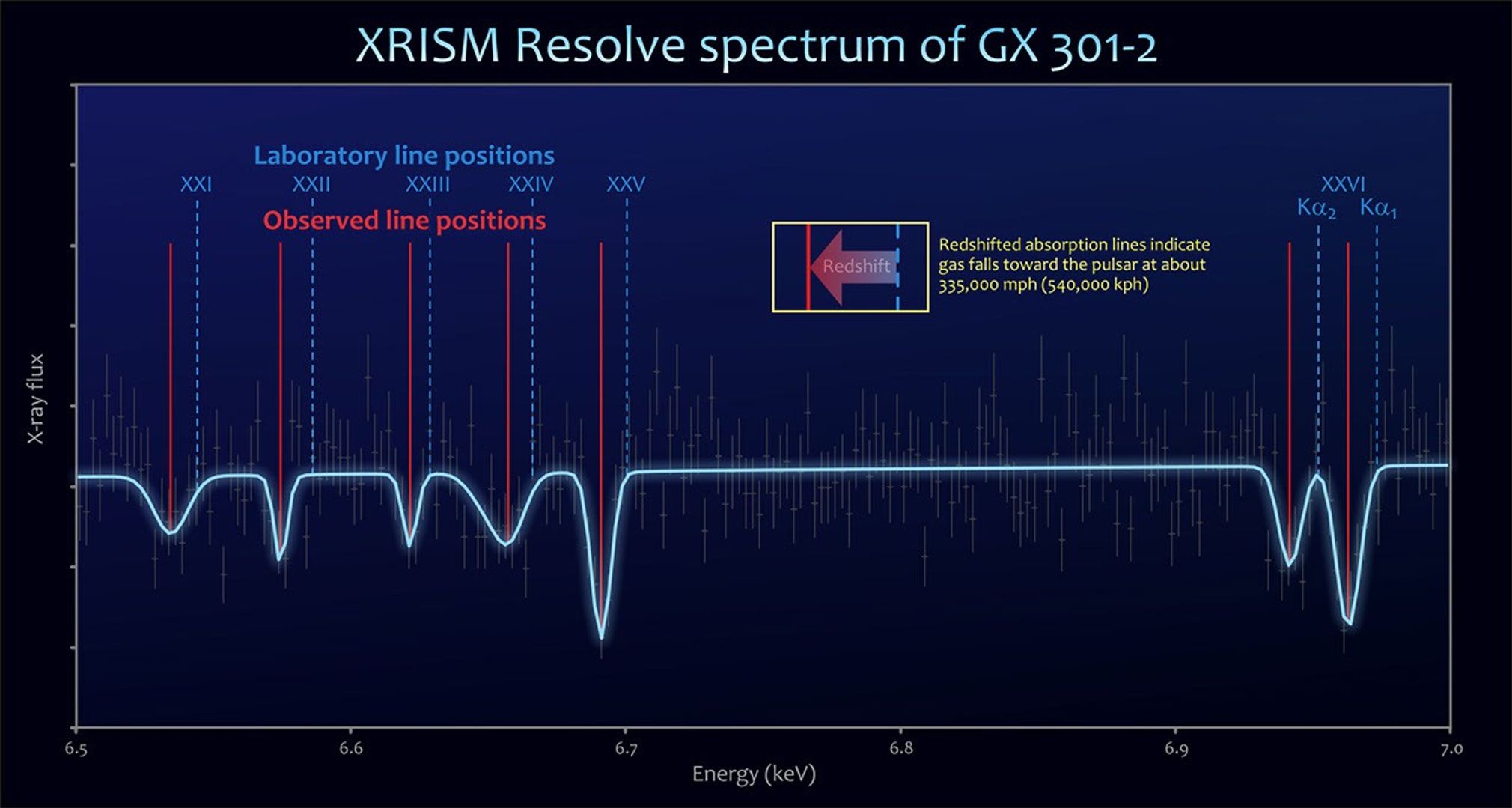
Using its Resolve instrument—a microcalorimeter spectrometer—XRISM captured unprecedented spectral data. The pulsar is currently embedded in the intense stellar wind emitted by the supergiant. As the pulsar rotates, it effectively "gathers" this material, which is then heated to extreme temperatures, emitting the X-rays detected by the mission’s sensors.
TECHNICAL ANALYSIS
The Resolve instrument functions by measuring minute temperature changes when X-rays strike its 6-by-6 pixel detector. By cooling the instrument to a fraction of a degree above absolute zero, researchers obtained a resolution 30 times greater than previous CCD detectors. This precision allowed the team to distinguish between different chemical elements—including iron, silicon, and sulfur—within the surrounding nebula.
COLLISION DYNAMICS
The data reveals a "bow shock" where the pulsar’s movement through the stellar wind creates a compressed region of gas. The resulting X-ray signatures provide a forensic look at the wind's composition and the pulsar's gravitational influence. These findings help astrophysicists understand how matter behaves under extreme gravity and how massive stars lose mass over their lifecycles.