WEBB CAPTURES COSMIC VOLATILITY IN COLLIDING GALAXIES
New observations from the James Webb Space Telescope reveal the aftermath of a massive galactic collision, providing fresh data on star formation and structural deformation in deep space.
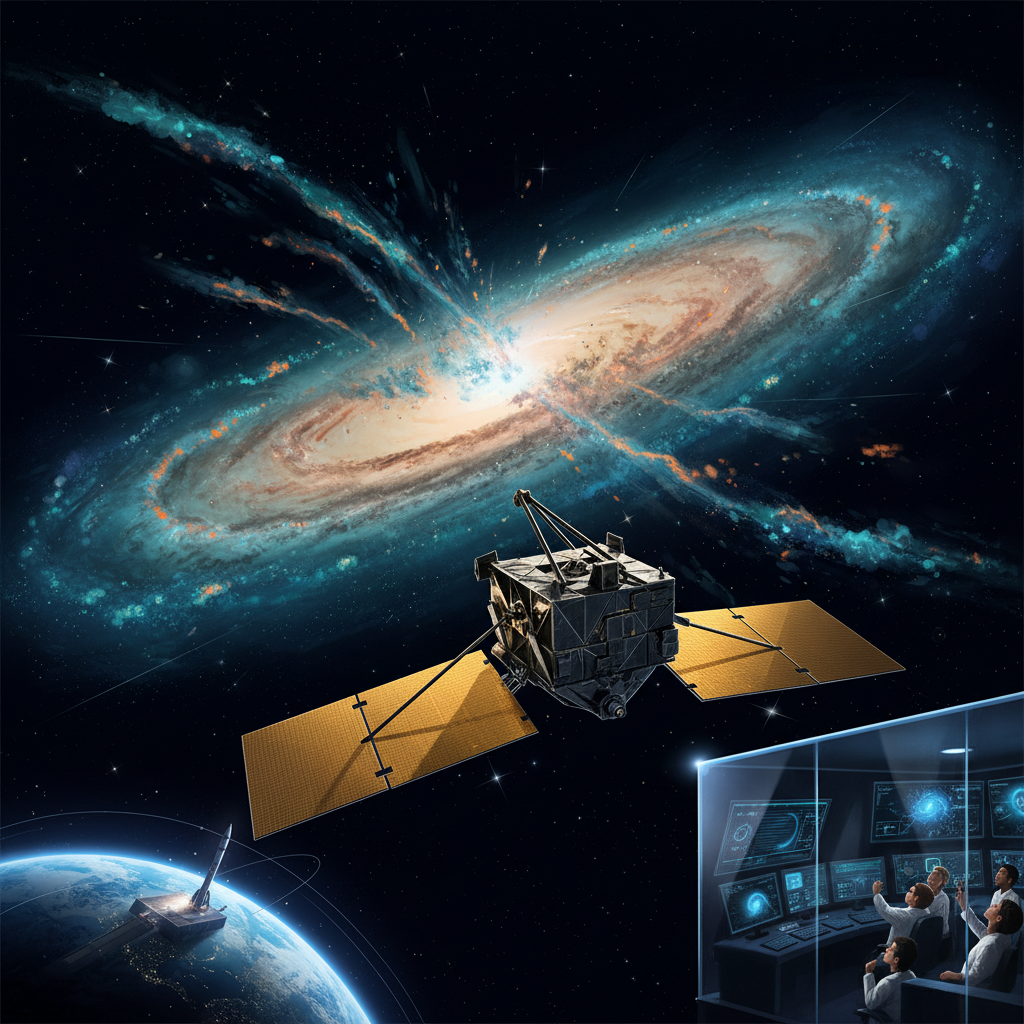
DATA OVERVIEW
Latest telemetry from the James Webb Space Telescope (JWST) has identified a unique galactic structure forged by a high-velocity cosmic collision. According to NASA Breaking News, the observatory’s infrared sensors have pierced through interstellar dust to reveal stars sparking to life in a rare, celebration-like display of stellar birth.
KINETIC EVOLUTION
The impact has radically altered the galaxy’s original morphology, transforming a standard celestial body into an unusual, distorted form. Observations indicate that the gravitational forces involved in the merger have triggered a massive surge in star formation. While traditional optical telescopes often struggle with the thick veils of gas surrounding such events, Webb’s Mid-Infrared Instrument (MIRI) and Near-Infrared Camera (NIRCam) have successfully mapped the heat signatures of these fledgling stars.
ANALYTICAL SIGNIFICANCE
This discovery provides a high-resolution look at the chaotic life cycle of galaxies. By tracking the distribution of gas and the specific regions where stars are Igniting, researchers can better predict how our own local group might evolve in similar future encounters. This data serves as a critical benchmark for extragalactic physics, demonstrating the persistent utility of the Webb platform in deciphering complex gravitational interactions across the deep-field environment.