US Army Establishes a Space Operations Branch
Modern warfare relies heavily on space-based technologies, and the US Army is making moves to tightly integrate those capabilities with the rest of its military might. The post US Army Establishes a Space Operations Branch appeared first on Payload.
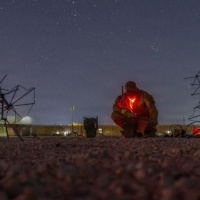
Modern warfare relies heavily on space-based technologies, and the US Army is making moves to tightly integrate those capabilities with the rest of its military might.
The Army established the Space Operations Branch last week to consolidate its broad space capabilities into the hands of a smaller force of specifically trained soldiers.
“Space integration is absolutely critical,” Lt. Gen. John Rafferty, commanding general of the Army’s Space and Missile Defense Command, said in a statement.
The new branch, he added, “provides the Army with the professional structure to deliver space-based effects directly to our soldiers and units at the tactical edge, enabling commanders to fight and win in a contested, multidomain environment.”
Why now: The announcement comes after the Army spent years leveling-up its space-capabilities, but those decisions have landed the Army in a disjointed setup.
The Army says it relies on “hundreds of thousands of space-enabled systems,” that are currently spread broadly, even though it is the “largest user of space capabilities” in the joint force.
The establishment of a Space Operations Branch is intended to relieve this “operational pressure,” on the Air Defense Artillery, Signal Corps, and Military Intelligence Corps, which had previously supplied soldiers on temporary missions requiring use of space assets.
In January, the Army put out the call for Army soldiers to be trained as Tactical Space Operations Specialists (Army acronym: 40D MOS), and last week’s announcement places those new soldiers in a branch all of their own.
The things they carry: The new Space Operations branch will be capable of staffing and deploying satcom and missile-warning systems to help soldiers use space assets for terrestrial missions.
Critically, these soldiers should expect to be embedded in tactical forces near the front lines. In January, Sgt. Maj. John Foley (Ret.), who was then leading US Army Space and Missile Defense Command, said these new soldiers should expect to “operate in deep-enemy and extended-deep areas,” to provide space-based capabilities within teams fighting overseas.
The Space Operations Branch will consist of Army Space Operations Officers and an initial force of 1,000 enlisted 40D MOS soldiers. The Army expects the group could grow to 1,500 by 2032.
Related Stories

Military • Startups • Technology
True Anomaly Declares Mission X-3 Success
True Anomaly announced today that its autonomous orbital vehicle, Jackal, has completed all of its Mission X-3 test objectives, clearing the final hurdles to being fully commissioned.

PiLogic Partners with AFRL on AI Anomaly Detection Tech
PiLogic is already testing its AI on two terrestrial based flat sats with AFRL, with hopes of expanding the military partnership into orbit.

Northrop Grumman Taps Apex for Golden Dome SBI Collab
Northrop Grumman is on track to deliver on-orbit missile defense capabilities with Apex in 2027.

Satellogic Lands $18M+ Defense-Monitoring Contract
The contract marks the company’s first large agreement since it made that strategic shift to persistent-monitoring capabilities.
More Stories
Time is running out to keep the ISS in orbit, as the chair of a NASA advisory committee warned last week that risk margin for regular operations “is now reduced to an alarming level.”
And the worry extends to parts, too: the supply chain for the decades-old spacesuits is wearing thin, according to Susan Helms, a former astronaut who chairs the Aerospace Safety Advisory Panel.
“It is increasingly difficult for NASA to ensure the ISS risks remain manageable for day-to-day operations, with enough contingency margins,” Helms said during a June 22 meeting of the panel.
Load More
Payload in your inbox
Payload _Our daily flagship newsletter_
Payload Pro _Weekly, curated insights, analysis, and data_
Payload Europe _Our weekly deep dive into EU space news_
Polaris _Our weekly look at policy news_
Marketing & Events _Periodic emails about company news and events_
Sign Up
You are now subscribed to our list.
Be sure to add us to your contacts, so we don’t end up in your spam folder!
!Payload Pro
In-depth research, exclusive data, and expert analysis on the business and policy of space. Get ahead of the competition.
Popular Stories
Aetherflux Rebrands, Pivots Business—and Raises $275M
May 11, 2026May 11, 2026
Exclusive: LEAP Launches its First Rocket
May 13, 2026May 13, 2026
Lt. Gen. Schiess Nominated to Lead Space Force
May 4, 2026May 4, 2026
Anduril Names Its SBI Team For Golden Dome
May 5, 2026May 5, 2026
Business • Equities • Technology
York Space Systems to Acquire Solestial
May 19, 2026May 19, 2026
Upcoming Events
live event
Salt Lake City Happy Hour
Poplar Street Pub, Salt Lake City, UT
25Aug
Thanks for signing up
Check your inbox for an email from general@payloadspace.com. Make sure to check your spam folder and add us to your Safe Senders list. Please allow up to 48 hours for the messages to
come through. Still don't see it? Send us a note
×