Unlocking the Secrets of the Arsia Mons Elongated Cloud
New data from the Mars Express Visual Monitoring Camera reveals the complex dynamics of the Arsia Mons Elongated Cloud, a massive water-ice feature stretching 1,800 kilometers across the Martian surface.
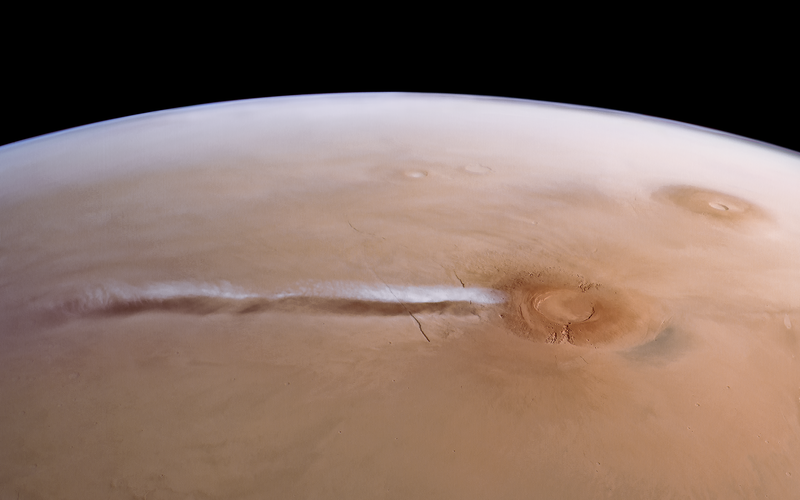
Atmospheric Anomaly Detected
For years, a massive, recurring streak of white has been observed trailing from the Arsia Mons volcano on Mars. Known as the Arsia Mons Elongated Cloud (AMEC), this feature is not the result of volcanic activity, but a complex meteorological phenomenon. According to the European Space Agency (ESA), recent findings using the Visual Monitoring Camera (VMC) on the Mars Express orbiter have provided the most detailed look yet at this elusive structure.
Lifecycle of a Martian Giant
The AMEC is composed of water ice and can reach lengths of up to 1,800 kilometers. Despite its scale, the cloud is highly transient. Observations indicate it follows a strict diurnal cycle during the Martian southern summer solstice. It begins forming before sunrise on the western slope of the volcano, expanding rapidly at speeds exceeding 600 km/h. By the time the sun reaches its zenith, the cloud evaporates as atmospheric temperatures rise, making it invisible to many high-resolution orbiters that traditionally observe in the afternoon.
Orographics in Action
ESA researchers have classified this as an orographic cloud. It forms when moist air is forced upward by the 20-kilometer-high volcanic terrain, cooling sufficiently to condense into ice crystals. According to ESA, the VMC—originally a low-resolution webcam intended for deployment confirmation—has proven invaluable due to its wide field of view and ability to capture long sequences of images throughout the Martian morning.
This data reveals that the AMEC is the largest orographic cloud ever recorded on the Red Planet. Understanding its behavior is critical for modeling the Martian water cycle and atmospheric dust transport, providing essential data for future landing missions.