U.S. defense agencies tap three companies for satellite disposal study
Firefly, D-Orbit and Katalyst will compete to show how commercial operators could capture and remove aging spacecraft The post U.S. defense agencies tap three companies for satellite disposal study appeared first on SpaceNews.

Home / U.S. defense agencies tap three companies for satellite disposal study

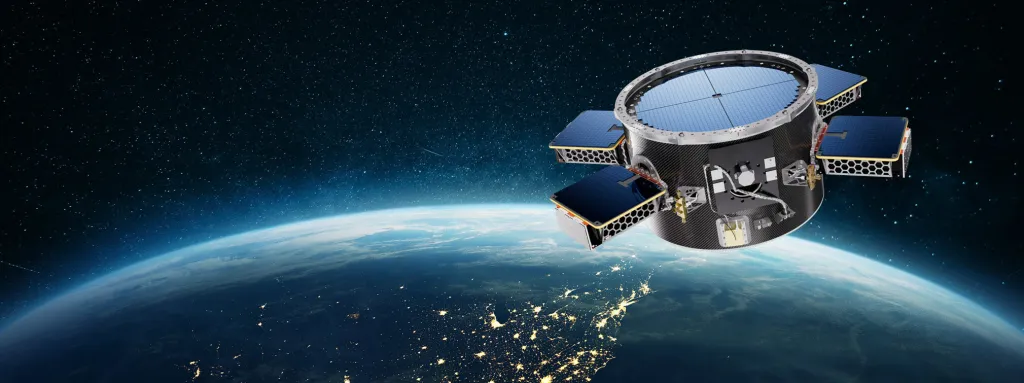
Rendering of Firefly's Elytra orbital vehicle Credit: Firefly Aerospace, Inc.
WASHINGTON — Three companies have been selected to study options for providing satellite deorbiting services to the U.S. government as the Pentagon explores whether disposal of aging spacecraft can be purchased from commercial operators rather than handled through a dedicated government capability.
D-Orbit, Firefly Aerospace and Katalyst Space received contracts of undisclosed value from the Defense Innovation Unit and the Space Development Agency for a “deorbit-as-a-service” project, the agencies announced. The work is focused on relocating spacecraft that were not designed to be serviced and may be unable to cooperate with an approaching vehicle.
“Through this effort, SDA and DIU are developing a scalable commercial capability to safely rendezvous with, capture and de-orbit unprepared or non-cooperative satellites,” the agencies said. “The selected companies will begin with preliminary design and risk-reduction activities, after which SDA and DIU will together evaluate their technical maturity, mission approach, schedule and affordability before deciding which solution proceeds to a full on-orbit demonstration.”
The awards broaden an SDA effort to develop commercial options for disposing of satellites in its low-Earth-orbit architecture. In 2024, the agency awarded feasibility studies to six companies, including Starfish Space, to examine on-demand deorbit services.
Starfish subsequently received a contract worth $52.5 million to deorbit up to seven spacecraft.
The three new participants enter the competition with different levels of flight experience and different approaches to the central problem of reaching and moving a spacecraft that may not have been built for docking or servicing.
Firefly said Aug. 13 that it proposed using its Elytra maneuvering spacecraft to rendezvous with a client satellite nearing the end of its life, conduct proximity operations and inspection, and carry out the maneuver needed to dispose of it.
Elytra has yet to fly its first mission, although the spacecraft incorporates hardware and software derived from Firefly’s Blue Ghost lunar program.
Katalyst is pursuing perhaps the most directly relevant test of capturing an unprepared spacecraft. Its Link robotic servicing vehicle launched July 3 on NASA’s Swift Boost mission and is intended to rendezvous with the Neil Gehrels Swift Observatory, secure the satellite with robotic arms and raise it to a higher orbit. Link encountered attitude-control problems during commissioning in late July. The company said it uploaded new flight software that restored attitude control using the spacecraft’s remaining actuators, allowing preparations for the mission to continue.
D-Orbit enters the competition with a substantial commercial record in orbital transportation. The Italian company launched its 23rd commercial ION Satellite Carrier mission in July. Its robotic servicing technology is less mature. D-Orbit is developing GEA, a spacecraft designed for autonomous rendezvous, docking, inspection and repositioning of satellites. The company says those capabilities are due to be demonstrated through the European Space Agency-backed RISE mission, scheduled for 2029.
DIU and SDA have said a viable deorbit service would have to combine several activities into a repeatable operation: getting a servicer into the correct orbit, locating and approaching a target autonomously, determining its attitude and motion, capturing it without generating debris, and supplying enough propulsion to dispose of the combined mass. It would also have to do so at a price that makes commercial procurement attractive.
_Related_

Sandra Erwin
Sandra Erwin writes about military space programs, policy, technology and the industry that supports this sector. She has covered the military, the Pentagon, Congress and the defense industry for nearly two decades as editor of NDIA’s National Defense... More by Sandra Erwin
Sign in or register
Close
Continue with Google
Or
Enter the code sent to your email
Email address
Enter your password
Sign in by entering the code we sent to , or clicking the magic link in the email.
ContinueResend codeEmail me a one-time code instead Forgot password Go back
Continue Set a password (optional)
We'll send a verification code to %EMAIL%.
Send code
Skip for now
To continue reading this article:
Register now to get
2 more free articles this month.
You’ll also receive our weekly Editor’s Choice, SpaceNews This Week and Opinions newsletters. Opt-out at any time.
Sign up
Sign in to an existing account
Get unlimited access to SpaceNews.com, the SpaceNews app and our digital monthly magazine for less than $5 per week.
$250/year
Subscribe now
_Cancel anytime. Sales tax may apply. No refunds._ _Terms and conditions apply._
Link
Copy link
Digital All-Access Subscription (Monthly) $25.00 / monthDigital All-Access Subscription (Quarterly) $70.00 every 3 monthsDigital All-Access Subscription (Yearly) $250 / yearDigital All-Access Subscription (2 Years) $450 every 2 yearsPurchase
Sign in to an existing account Cancel