Thermal Anomalies Detected at Mount Michael Crater
New satellite analysis confirms persistent thermal activity at Mount Michael in the South Sandwich Islands, revealing a rare, active lava lake in one of Earth's most remote volcanic sites.
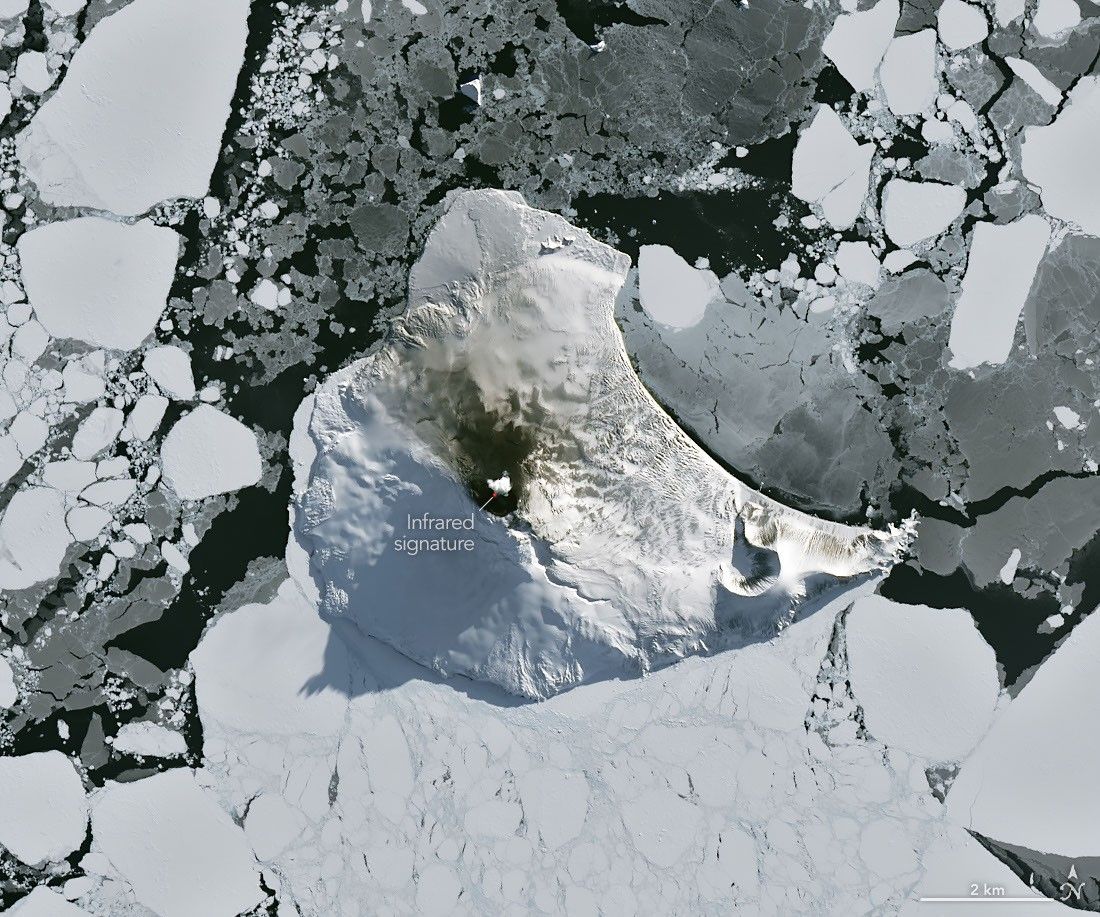
DATA ANALYSIS: MOUNT MICHAEL THERMAL SIGNATURES
Orbital reconnaissance has identified a significant infrared anomaly at the summit of Mount Michael, a remote stratovolcano situated on Saunders Island in the South Sandwich archipelago. According to NASA Breaking News, recent high-resolution imaging from Earth-observing platforms confirms the presence of a persistent, active lava lake within the volcano's crater.
GEOLOGICAL CONTEXT
Mount Michael remains one of the most challenging geological sites to monitor due to its extreme sub-Antarctic location and near-constant cloud cover. The volcano, standing at 843 meters, frequently emits steam and sulfurous plumes, masking the activity below. However, advanced short-wave infrared (SWIR) sensors have penetrated the atmospheric interference to reveal the "bright spot"—a concentrated heat signature indicative of molten rock at the surface.
RARE VOLCANIC PHENOMENA
While Earth hosts over 1,500 active volcanoes, lava lakes are exceptionally rare, requiring a precise balance between magma supply and cooling rates. The confirmation at Mount Michael places it among a select group of globally recognized active lava lakes, including those at Erebus in Antarctica and Erta Ale in Ethiopia. Data indicates the lake is between 90 and 215 meters in diameter, with temperatures estimated to reach up to 1,279 degrees Celsius.
ORBITAL SURVEILLANCE NECESSITY
Given the hazardous terrain and logistical impossibility of frequent ground expeditions, satellite telemetry remains the primary method for tracking this activity. The continued monitoring of these thermal signatures provides critical data on the tectonic shifts occurring within the Scotia Arc, a region of high seismic interest.