Swift Array Detects Rogue SMBH Consuming Stellar Mass
NASA’s Neil Gehrels Swift Observatory identifies a supermassive black hole outside its galactic core engaged in a violent tidal disruption event.
DATA LOG: EVENT J2115
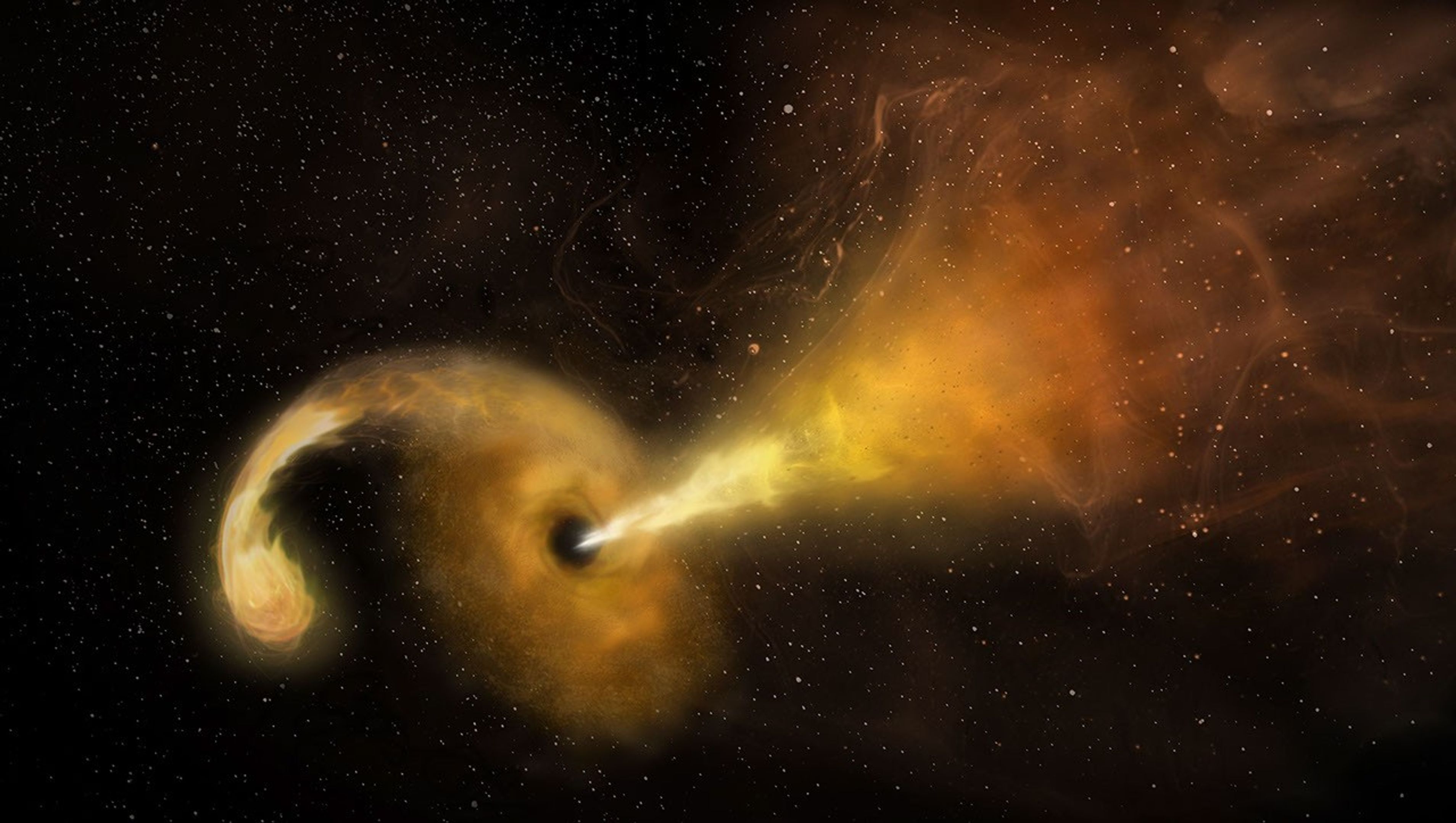
According to NASA Breaking News, the Neil Gehrels Swift Observatory has identified a rare astronomical phenomenon: a wandering supermassive black hole (SMBH) actively shredding a star in a distant galaxy. This process, known as a Tidal Disruption Event (TDE), typically occurs within the gravitational centers of galaxies. However, the event designated 2MASX J21153904−4718327 is occurring offset from its galaxy’s nucleus.
TECHNICAL ANALYSIS
While most SMBHs remain anchored at the center of their host galaxies, researchers believe this particular entity was displaced—likely following a galactic merger. When two galaxies collide, their respective black holes can undergo a gravitational interaction that 'kicks' the resulting merged hole into a wandering orbit.
Swift’s X-ray and ultraviolet sensors detected the high-energy flare produced as the star was pulled apart. The gravitational forces were so intense that the star was stretched into a stream of superheated debris. As the black hole consumed this matter, it emitted a luminous signal visible across millions of light-years.
MISSION SIGNIFICANCE
This discovery validates the theory that 'rogue' supermassive black holes exist in the voids of galactic outskirts. The ability of the Swift mission to pivot and capture these transient events remains critical for mapping the unseen population of black holes that do not inhabit traditional galactic hubs. This data provides a thermal blueprint for how matter behaves under extreme gravitational stress outside of stable environments.