Starship V3: Tactical Overhaul Debuts in Texas
SpaceX has conducted the inaugural flight of its Starship V3 architecture, deploying new Starlink simulators despite engine anomalies during the booster recovery phase.
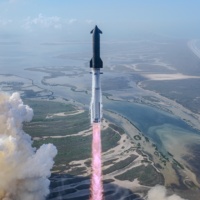
Operational Report
SpaceX has officially transitioned to the Starship V3 architecture. According to Payload, the inaugural flight of the upgraded vehicle took place Friday at 18:30 local time from the newly commissioned pad at Starbase, Texas. While the mission achieved the majority of its technical objectives, hardware reliability remains in flux: one Raptor 3 engine failed during ascent, and the Super Heavy booster suffered a premature engine shutdown during its boost-back burn, resulting in a loss of the vehicle in the Gulf.
Hardware Specifications
The V3 iteration represents a comprehensive system overhaul. The Super Heavy booster now features a three-grid-fin configuration—down from four—with a 50% increase in surface area and integrated catch-points for recovery. Internal plumbing was modified via a redesigned fuel-transfer tube to support the simultaneous ignition of all 33 Raptor engines. Additionally, the hot-stage separation ring has been hardened for reusability.
The upper stage has been structurally expanded with increased propellant capacity and a revamped reaction-control system for precision maneuvering. It also debuted an optimized PEZ dispenser designed for rapid satellite deployment and integrated docking ports for future orbital refueling operations.
Mission Trajectory
During the flight, the upgraded dispenser successfully deployed 20 Starlink simulators and two specialized units that captured imagery of the ship in vacuum. While long-term objectives involve lunar and Martian logistics—slated for 2028—SpaceX remains focused on internal constellation maintenance. High-cadence Starlink deployment missions using Starship V3 are expected to commence by mid-2027, eventually scaling to 50+ Mobile V2 satellites per launch.