Starship Sticks the Water Landing on Flight 13
SpaceX flew the 13th test flight of its Starship rocket Friday evening, ending with the first intact Starship put in the water. The post Starship Sticks the Water Landing on Flight 13 appeared first on Payload.
Listen to this article
3 min
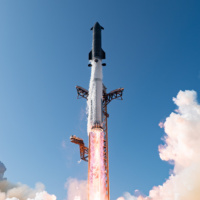
SpaceX flew the 13th test flight of its Starship rocket Friday evening, lifting off from Starbase at 6:51 pm EDT and ending with the first intact Starship put in the water.
It was the first Starship flight since the company’s record-breaking IPO in June. A Thursday attempt was scrubbed for cloud cover that would have blocked heat-shield imaging.
Hot to go: The ship splashed down in the Indian Ocean ~65 minutes after liftoff, flipped upright, then tipped over and floated (versus exploding). It continued transmitting over Starlink while SpaceX drones inspected it.
During the flight, SpaceX pushed Starship harder than ever:
- The vehicle withstood a higher dynamic pressure ascent than any prior flight, trading tile stress for payload capacity;
- It featured 18,000+ ceramic tiles that came through reentry temps of more than 1,400 degrees Celsius;
- The vehicle remained intact during a descent from over Mach 20 to subsonic.
CEO Elon Musk said on X that SpaceX will attempt a tower catch on the next flight, absent problems in data review.
Bolder than ever: SpaceX debuted Starship V3 in May, when booster engines failed to relight, the ship shut down an engine early, and SpaceX scrapped the in-space relight demo.
Flight 13 fixed the relight issue, with a Raptor firing ~14 seconds in space. The booster fared worse. All 33 engines lit at liftoff, then fired again for the high-thrust portion of the boostback burn, a first for a V3 booster. The second burn ended early. Only 5 of 13 engines fired during the landing burn, which SpaceX called a “hard splashdown.”
Bird watching: On Friday’s flight, Starship deployed 20 Starlink V3 sats, which were the first working birds after six flights of dummy payloads. SpaceX contacted all 20 over RF and laser links during ~20 minutes of tests, including solar array and antenna deployment. Six carried cameras trained on the heat shield to study return readiness. All demised on reentry, as expected on a suborbital trajectory.
What’s next: SpaceX President and COO Gwynne Shotwell told CNBC in June that a clean Flight 13 could make Flight 14 the first orbital attempt. No Starship has completed an orbit in 13 flights. SpaceX is building two Starship pads in Florida.
Starship is central to SpaceX’s long-term plans:
- It will increase the deployment cadence of SpaceX’s V3 Starlink constellation;
- It’s planned to dock with Orion on Artemis III, and land astronauts on the Moon on Artemis IV;
- It will also open the door for SpaceX to debut Starmind, its orbital data center constellation.
Related Stories

International • Launch • Startups
Skyroot Aerospace Reaches Orbit with Vikram-1 Rocket
Skyroot Aerospace became the first private Indian company to reach orbit on Saturday, when its Vikram-1 rocket lifted off from India’s primary spaceport—the Satish Dhawan Space Centre.

DoD Adds $11.4B to NatSec Launch Contracts
The DoD upped its ceiling for national security space launches on Friday, more than tripling the pool of NSSL launch contracts from $5.6B to $17B.

Spinifex Space Launches With Australian Test Ranges
Spinifex Space will provide end-to-end suborbital launch campaigns, private range access, and test and evaluation (T&E) infrastructure.

US Government Studying Offshore Launch Opportunities
The Bureau of Ocean Energy Management (BOEM) published an RFI on Wednesday seeking information, to consider building or repurposing infrastructure on the Outer Continental Shelf, for space launch and reentry.
More Stories
ispace-Europe is heading to the Moon following a €65M (~$74M) commitment from ESA for Europe’s first lunar polar ice exploration rover mission.
The award is a Phase 2 contract for MAGPIE—the Mission for Advanced Geophysics and Polar Ice Exploration—which will fully fund the remaining development of the rover and payload as well as manufacturing, testing, transportation, lunar surface operations, and delivery of scientific data.
“ispace-Europe is the industrial prime for ESA’s first lunar surface exploration mission—a role that would have been traditionally assigned to a large system integrator,” ispace-Europe CEO Julien-Alexandre Lamamy told Payload over email. “MAGPIE is the first mission under ESA’s Small Exploration Missions (SMEX) program, whose purpose is to perform high-impact exploration missions with a higher risk tolerance for smaller budgets and faster implementation, led by small space companies.”
Load More
Payload in your inbox
Payload _Our daily flagship newsletter_
Payload Pro _Weekly, curated insights, analysis, and data_
Payload Europe _Our weekly deep dive into EU space news_
Polaris _Our weekly look at policy news_
Marketing & Events _Periodic emails about company news and events_
Sign Up
You are now subscribed to our list.
Be sure to add us to your contacts, so we don’t end up in your spam folder!
!Payload Pro
In-depth research, exclusive data, and expert analysis on the business and policy of space. Get ahead of the competition.
Popular Stories
Aetherflux Rebrands, Pivots Business—and Raises $275M
May 11, 2026May 11, 2026
Exclusive: LEAP Launches its First Rocket
May 13, 2026May 13, 2026
Lt. Gen. Schiess Nominated to Lead Space Force
May 4, 2026May 4, 2026
Anduril Names Its SBI Team For Golden Dome
May 5, 2026May 5, 2026
Business • Equities • Technology
York Space Systems to Acquire Solestial
May 19, 2026May 19, 2026
Upcoming Events
live event
Salt Lake City Happy Hour
Poplar Street Pub, Salt Lake City, UT
25Aug
live event
Payload Space Happy Hour
El Segundo, CA
3Sep
live event
Off World
Houston, TX
23Sep
Thanks for signing up
Check your inbox for an email from general@payloadspace.com. Make sure to check your spam folder and add us to your Safe Senders list. Please allow up to 48 hours for the messages to
come through. Still don't see it? Send us a note
×