Spider Crater: Mapping the High-Impact Geometry of Gow Lake
New orbital imaging of Saskatchewan's Gow Lake confirms its status as a complex impact structure, revealing a unique central uplift and 'spider-leg' channels formed 200 million years ago.
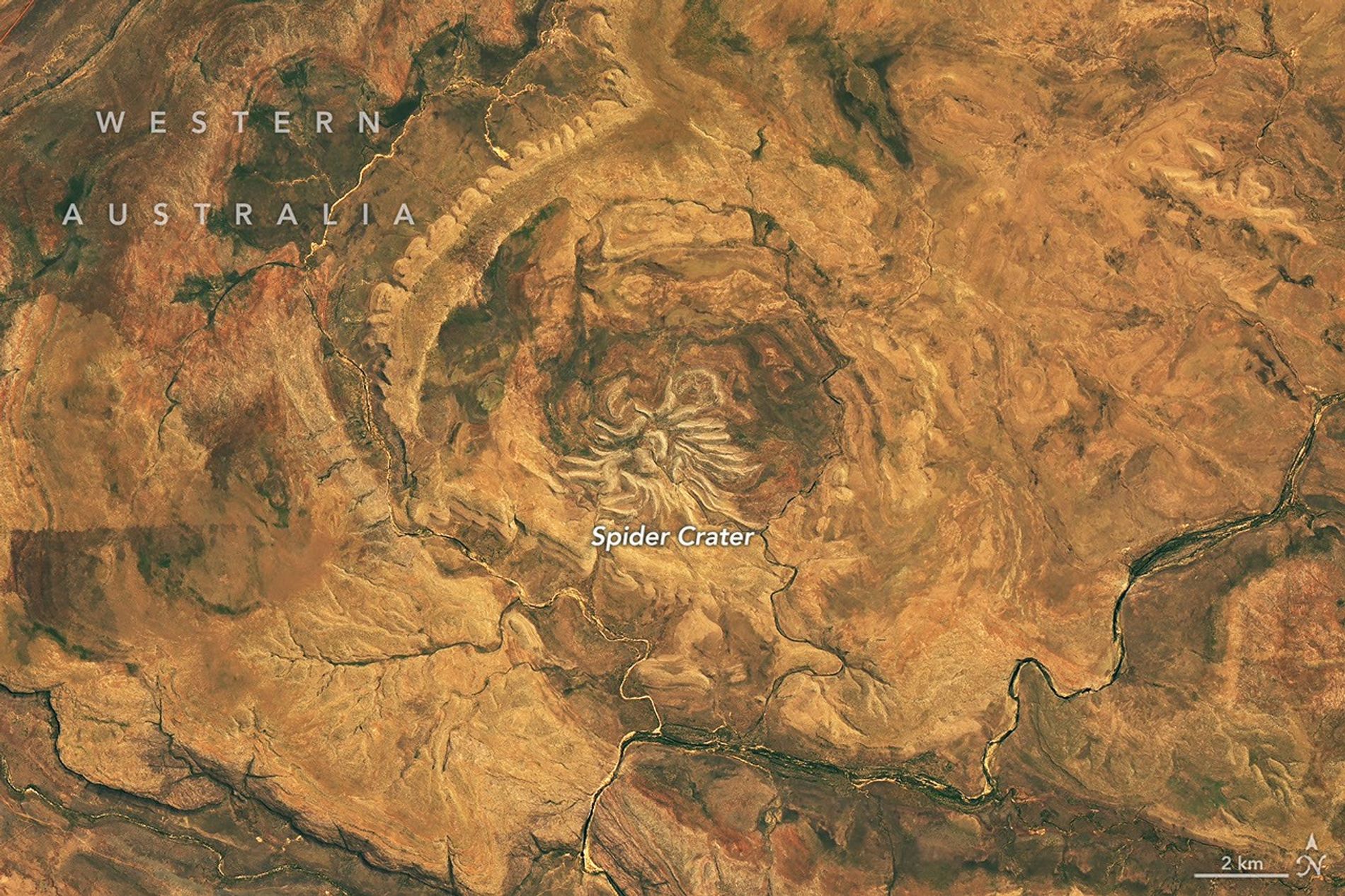
Data Analysis: Impact Site Gow-L
Surface reconnaissance confirms the distinct morphology of the Gow Lake impact structure in Saskatchewan, Canada. According to NASA Breaking News, this 200-million-year-old scar serves as a primary example of a "complex crater," characterized by a central uplift rather than a simple bowl-shaped depression.
Structural Geometry
The most striking feature of Gow Lake is its "legs"—eight radial channels extending from the central 5-kilometer diameter crater. These channels, carved by ancient drainage and erosion, give the structure a spider-like appearance from low Earth orbit. The central feature, Calder Island, represents the peak of the impact’s rebound, where compressed rock snapped back toward the sky seconds after the kinetic event.
Geologic Context
Unlike simple craters like Arizona's Barringer, Gow Lake entered a state of gravitational collapse immediately following the impact. The resulting structure measures roughly 4 kilometers in diameter across the primary water-filled ring. Recent imaging by the OLI-2 (Operational Land Imager-2) on Landsat 9 provides high-fidelity multispectral data, allowing researchers to differentiate between the impact melt rocks and the surrounding Precambrian crystalline basement.
For orbital observers, the site is located at approximately 56.45°N, 104.5°W. It remains a critical terrestrial analogue for studying similar complex impact sites on Mars and the Moon, where thermal signatures and erosion patterns often mirror those found in the Canadian Shield.