Space Force awards K2 Space $22.9 million for laser communications demonstration
Two K2 satellites will host optical terminals intended to connect military systems in orbit The post Space Force awards K2 Space $22.9 million for laser communications demonstration appeared first on SpaceNews.

Home / Space Force awards K2 Space $22.9 million for orbital laser communications demonstration

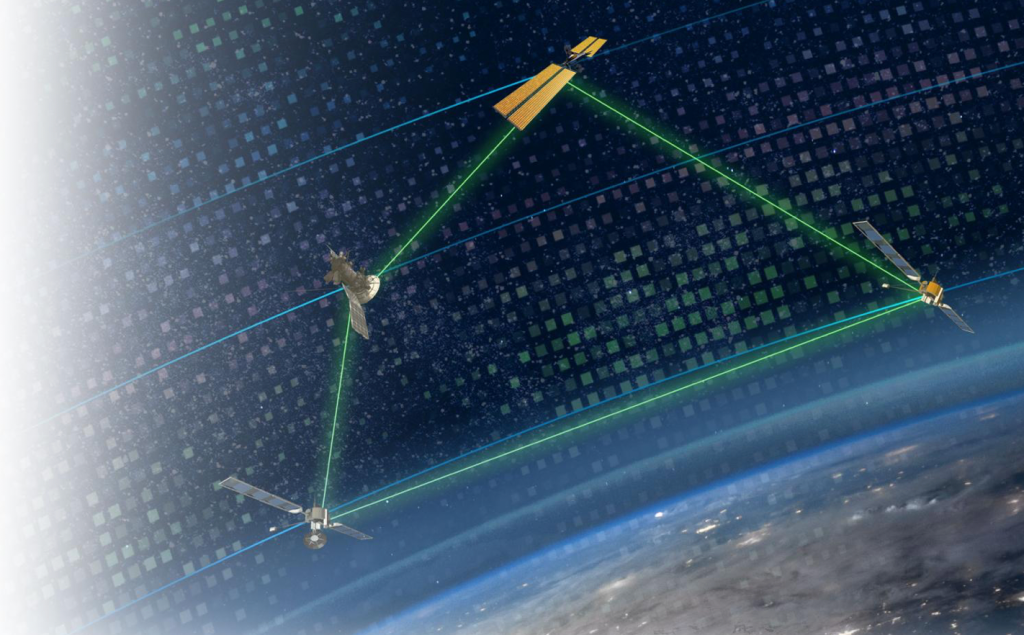
Illustration of optically linked satellites. Credit: CACI
WASHINGTON — The U.S. Space Force awarded K2 Space a $22.9 million contract to test laser terminals designed to transmit data directly between satellites in orbit.
Under the contract announced July 31, K2 Space will procure, integrate, launch and operate two Enterprise Space Terminals, with each terminal carried as a hosted payload on a separate K2 satellite. The demonstration is scheduled to be completed by 2028.
A hosted payload is equipment carried aboard a satellite that relies on the host spacecraft for power, thermal control, pointing, communications and other support. K2, based in Torrance, California, will be responsible for integrating the terminals with its satellite buses and operating the spacecraft during the test.
The award does not identify which companies will supply the two terminals.
Space Systems Command has selected CACI International, General Atomics and Viasat as Phase 3 suppliers under the Enterprise Space Terminal program, a roughly $100 million effort launched in 2024 to develop and evaluate optical communications hardware from multiple vendors.
The three companies are developing terminals designed to use common technical standards. The Space Force has not disclosed whether K2 will purchase both flight units from one company or select terminals from two different suppliers.
Optical communications use tightly focused laser beams to transmit data between satellites. They require precise pointing and tracking, particularly when spacecraft are separated by thousands of miles and moving relative to one another.
That capability is becoming more important as the Pentagon develops networks of sensors distributed across low, medium and higher Earth orbits. Those satellites must be able to pass missile-warning, tracking and targeting data quickly among spacecraft, ground systems and military users.
The flight experiment is being funded by the Space-Based Sensing and Targeting portfolio, the Space Force acquisition organization responsible for programs like the Space-Based Airborne Moving Target Indicator, an initiative intended to provide persistent tracking of aircraft and other aerial targets from orbit. The portfolio also oversees key elements of the Space Data Network, a planned optically connected communications architecture for transporting military information through space.
K2 was selected through the FreeSol Broad Agency Announcement, a Space Force contracting vehicle used to solicit commercial technologies and research-and-development proposals outside traditional acquisition programs.
The new award follows K2’s selection as a vendor under the Pentagon’s Overhead Persistent Infrared Space Modernization Initiative, or OPIR SMI, a research-and-development program supporting technologies for space-based missile warning and defense.
_Related_

Sandra Erwin
Sandra Erwin writes about military space programs, policy, technology and the industry that supports this sector. She has covered the military, the Pentagon, Congress and the defense industry for nearly two decades as editor of NDIA’s National Defense... More by Sandra Erwin
Sign in or register
Close
Continue with Google
Or
Enter the code sent to your email
Email address
Enter your password
Sign in by entering the code we sent to , or clicking the magic link in the email.
ContinueResend codeEmail me a one-time code instead Forgot password Go back
Continue Set a password (optional)
We'll send a verification code to %EMAIL%.
Send code
Skip for now
Link
Copy link