Solar Geometry: Analemma Alignment Captured Over Callanish Stones
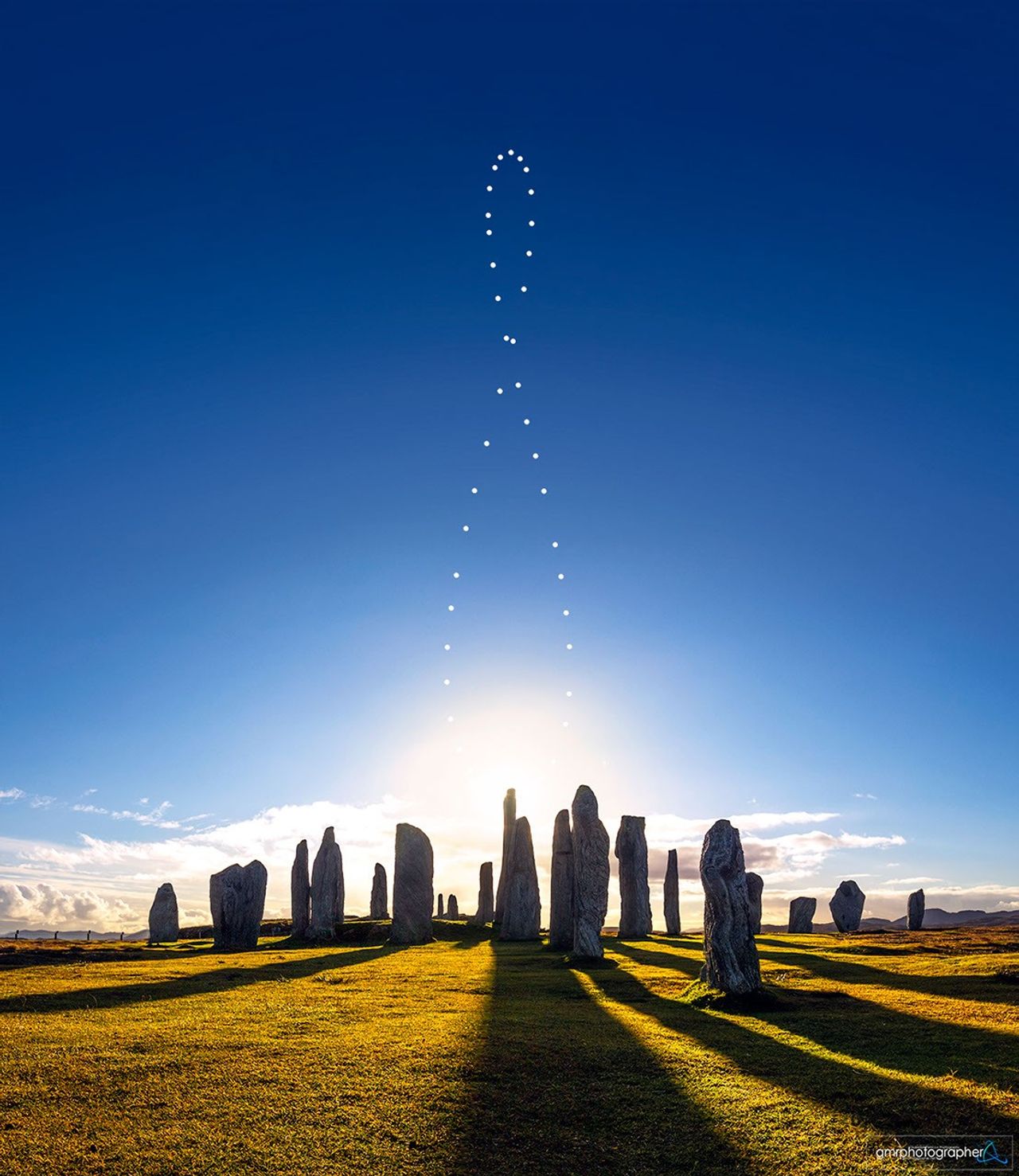
A new composite sequence reveals the Sun’s figure-eight analemma over the Neolithic Callanish Stones, mapping Earth's axial tilt and orbital eccentricity through a year of solar tracking.
Orbital Mechanics Visualized
Recent imaging data published by NASA Breaking News documents a precise celestial alignment over the Callanish Stones in Scotland. The sequence captures a solar analemma—the figure-eight path the Sun appears to follow in the sky when recorded at the same time every day for one Earth year.
According to NASA Breaking News, this geometric curve is a direct byproduct of two primary orbital variables: the Earth's 23.5-degree axial tilt and its elliptical orbit around the Sun. The northern and southern extremes of the figure-eight represent the summer and winter solstices, while the crossover point occurs near the equinoxes. This specific capture over the Neolithic standing stones provides a stark bridge between ancient observational astronomy and modern astrophysical verification.
Solar Variability and Orbital Tilt
Because Earth does not orbit in a perfect circle, its speed varies depending on its proximity to the Sun. This causes the Sun to be slightly ahead of or behind its mean position throughout the year, dictating the width of the analemma’s loops. The vertical displacement is dictated by the planet’s tilt as it moves from perihelion to aphelion.
The Callanish site, often referred to as a prehistoric lunar and solar observatory, serves as an ideal terrestrial reference frame for these dynamics. The resulting composite is more than an aesthetic capture; it is a data-driven map of the Earth’s oscillation within the solar system, reinforcing the consistency of planetary motion over millennia. As NASA continues to monitor Earth-Sun interactions via the Heliophysics division, these terrestrial perspectives remain vital for public comprehension of orbital mechanics.