SMOS salinity could offer early indicator of El Niño
As the Pacific Ocean moves into an El Niño phase, scientists are monitoring changes in sea-surface temperature, but also sea-surface salinity – which is another key indicator of this phenomenon.Measurements from satellites such as the European Space Agency's SMOS mission are reve
We use cookies which are essential for you to access our website and/or to provide you with our services, enable you to share our website content via your social media accounts and allow us to measure and improve the performance of our website.
Accept all cookies Accept only essential cookies See our Cookie Notice
!ESA menu toggle!ESA search toggle!ESA title

About ESA
The European Space Agency (ESA) is Europe’s gateway to space. Its mission is to shape the development of Europe’s space capability and ensure that investment in space continues to deliver benefits to the citizens of Europe and the world.
Highlights
Careers \\
\\
 Business with ESA\\
\\
 Newsroom\\
\\
 Education\\
\\
 Kids\\
\\
 ESA Space Shop\\
\\

ESA - United space in Europe
This is ESA ESA facts Member States & Cooperating States Funding Director General Top management For Member State Delegations European vision European Space Policy ESA & EU Space Councils Responsibility & Sustainability Annual Report Calendar of meetings Corporate news
Establishments & sites
ESA Headquarters ESA ESTEC ESA ESOC ESA ESRIN ESA EAC ESA ESAC Europe's Spaceport ESA ESEC ESA ECSAT Brussels Office Washington Office
Working with ESA
Business with ESA ESA Commercialisation Gateway Law at ESA Careers Cyber resilience at ESA IT at ESA Newsroom Partnerships Merchandising Licence Education Open Space Innovation Platform Integrity and Reporting Administrative Tribunal Health and Safety
More about ESA
History ESA Historical Archives Exhibitions Publications Art & Culture ESA Merchandise Kids Diversity ESA Brand Centre
Latest
Story\\
\\

Focus on\\
\\

Press ReleaseN° 5–2026\\
\\
Open
Space in Member States
Find out more about space activities in our 23 Member States, and understand how ESA works together with their national agencies, institutions and organisations.
                      
Science & Exploration
Exploring our Solar System and unlocking the secrets of the Universe
Programmes
Space Science Human and Robotic Exploration
Astronauts
Sophie Adenot\\
\\
 Pablo Álvarez Fernández\\
\\
 Rosemary Coogan\\
\\
 Samantha Cristoforetti\\
\\
 Alexander Gerst\\
\\
 Raphaël Liégeois\\
\\
 Matthias Maurer\\
\\
 Andreas Mogensen\\
\\
 Luca Parmitano\\
\\
 Thomas Pesquet\\
\\
 Marco Sieber\\
\\

Missions
Juice Euclid Webb Solar Orbiter BepiColombo Gaia ExoMars Cheops Exoplanet missions More missions
Activities
International Space Station Orion service module Gateway Concordia Caves & Pangaea Benefits/videos)
Latest
Story\\
\\

Press ReleaseN° 49–2024\\
\\
Open
Focus on\\
\\

Space Safety
Protecting life and infrastructure on Earth and in orbit
About space safety
Protecting our Pale Blue Dot Space Safety at ESA
Asteroids
Asteroids and Planetary Defence Asteroid danger explained Flyeye telescope: asteroid detection Hera mission: asteroid deflection Near-Earth Object Coordination Centre
Space junk
About space debris Space debris by the numbers Space Environment Report In space refuelling, refurbishing and removing
Safety from space
Clean Space Ecodesign Zero Debris Technologies Space for Earth Supporting Sustainable Development
Space weather
Space weather and its hazards ESA Vigil: providing solar warning ESA Space Weather Service Network
Latest
Story\\
\\

Focus on\\
\\

Applications
Using space to benefit citizens and meet future challenges on Earth
Observing the Earth
Observing the Earth Future EO Copernicus Meteorology Space for our climate Satellite missions
Connectivity
Connectivity and Secure Communications ARTES Moonlight Civil security from space
Satellite navigation
Satellite navigation Galileo EGNOS NAVISP Genesis Celeste
Commercialisation
ESA Commercialisation Gateway Open Space Innovation Platform Business Incubation ESA Space Solutions
Latest
Story\\
\\

Press ReleaseN° 1–2024\\
\\
Open
Focus on\\
\\

Enabling & Support
Making space accessible and developing the technologies for the future
Building missions
Space Engineering and Technology Test centre Laboratories Concurrent Design Facility Shaping the Future Discovery and Preparation Advanced Concepts Team ESA Young Professionals Satellites
Space transportation
Space Transportation Ariane Vega Space Rider Future space transportation Boost! Europe's Spaceport Launches from Europe's Spaceport from 2012
Flying missions
Operations ESA ground stations Ground Systems Engineering
Latest
Story\\
\\

Focus on\\
\\

Press ReleaseN° 8–2024\\
\\
Open
As the Pacific Ocean moves into an El Niño phase, scientists are monitoring changes in sea-surface temperature, but also sea-surface salinity – which is another key indicator of this phenomenon.
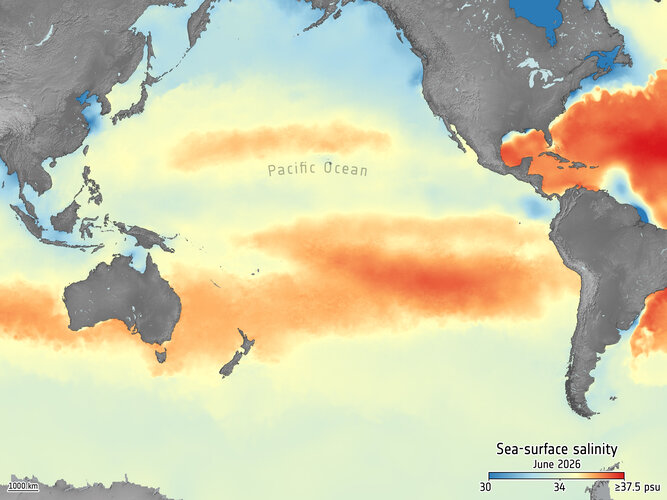
Measurements from satellites such as the European Space Agency's SMOS mission are revealing how freshwater and salt patterns shift across the Pacific as this year’s El Niño develops – offering a potential new pathway for early detection.
Sea-surface salinity, the concentration of dissolved salts in the upper layer of the ocean, is much more than a measure of how salty the sea is. It responds rapidly to changes in rainfall, evaporation, river discharge and, specifically in polar regions, the melting and formation of sea ice. Salinity is both an important driver of ocean circulation and a tracer of the movement of water masses and surface currents.
Together with temperature, salinity controls the density of seawater, triggering ocean currents that redistribute heat around the planet. Observing both variables gives scientists a much more complete picture of how the coupled ocean–atmosphere system behaves during El Niño – the warm phase of the El Niño–Southern Oscillation (ENSO).
ENSO is a single climate phenomenon, but it has three phases; the two opposite phases, El Niño and La Niña, and a neutral phase in the middle of the continuum.
During the current emerging El Niño, satellites have detected notable changes in the tropical Pacific.
Shifting freshwater pool of the El Niño–Southern Oscillation
During normal, or neutral, conditions, strong trade winds trap a large layer of low-salinity surface water, known as the freshwater pool, in the far western Pacific. However, during El Niño, the easterly trade winds weaken or even reverse, removing the force that normally confines this warm western Pacific freshwater pool.
Drawing on data from ESA’s SMOS and NASA’s SMAP missions and other data sources, the animation above illustrates the movement of the freshwater pool during the 2023 El Niño and La Niña events, and the current emerging El Niño.
Here, the eastern edge of the western Pacific freshwater pool shifts eastwards, together with the associated belt of deep atmospheric convection and heavy rainfall.
One of the most striking features is the eastward displacement of the saltier waters immediately to the east of the freshwater pool, while salinity within much of the pool itself remains relatively low. This evolution reflects the combined influence of changing rainfall patterns and ocean surface currents as the trade winds weaken during El Niño.
Freshwater pool of the 2026 El Niño
This redistribution of warm surface waters and rainfall creates distinct regional salinity anomalies. Areas experiencing more rainfall become fresher than normal, while regions with less precipitation and greater evaporation become more saline. Together, these contrasting patterns trace the redistribution of atmospheric moisture and highlight the close coupling between the ocean and the global hydrological cycle.
Measurements of changing sea-surface temperature and salinity are helping researchers better understand the processes driving the El Niño and improve predictions of the phenomenon’s far-reaching impacts on weather, climate and marine ecosystems around the world.
Pacific Ocean salinity June 2026
ESA’s SMOS Mission Manager, Klaus Scipal, said, “Salinity acts as a fingerprint of the water cycle.
“Where temperatures tell us how much heat the ocean contains, salinity gives us a first approximation where freshwater is entering or leaving the ocean.
“Together, these measurements allow us to better understand the exchange of heat and water between the ocean and atmosphere, improving our ability to monitor and predict climate variability.”
Although sea-surface temperature remains the defining characteristic of El Niño, scientists say salinity has become an indispensable companion variable – offering a clearer picture of how heat and freshwater move through the coupled ocean-atmosphere system.
Researchers are developing an ENSO-specific sea-surface salinity index to complement traditional sea-surface temperature indices. The aim is to determine whether spatial patterns of sea-surface salinity can improve forecasts of the timing and intensity of ENSO events by providing an earlier signal than sea-surface temperature alone.
As the current El Niño unfolds, satellites are providing a unique, global perspective on one of Earth's most influential climate phenomena.
Launched in 2009, ESA's SMOS, which stands for Soil Moisture and Ocean Salinity, mission is specifically designed to map sea-surface salinity from space while also measuring soil moisture over land.
Using an imaging microwave radiometer, SMOS can detect tiny variations in the natural microwave emissions from Earth's surface, allowing scientists to monitor subtle changes in ocean salinity.
More than 15 years after launch, the mission continues to add to the long-term record that is advancing our understanding of the global water cycle, ocean circulation and climate variability.
Related Articles
Story\\
\\

Story\\
\\

Story\\
\\

Related Links
Focus on\\
\\

Focus on\\
\\

Mission\\
\\
