SKYROOT TARGETS JULY FOR VIKRAM-1 ORBITAL DEBUT
India’s Skyroot Aerospace has moved its Vikram-1 rocket to the pad for a mid-July launch, marking a critical step toward private high-cadence orbital operations.
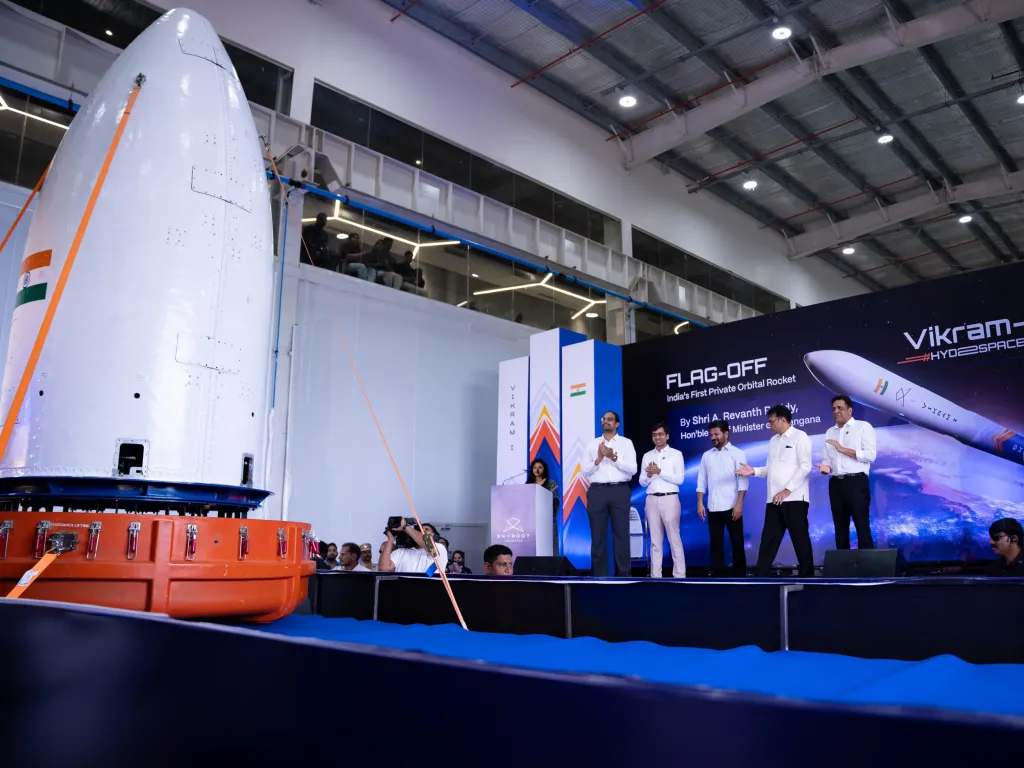
Mission Aagaman: Terminal Countdown
India’s commercial space sector reaches a critical milestone as Skyroot Aerospace readies the Vikram-1 rocket for its inaugural orbital attempt. According to SpaceNews, the vehicle was transported to the Satish Dhawan Space Centre in April, with a launch window now confirmed to open on July 12 and extending through August 4.
Vehicle Specifications
The mission, designated Aagaman, serves as a primary test flight to validate internal engineering and telemetry. Vikram-1 is a four-stage architecture: three solid-fuel lower stages topped by a liquid-propellant kick stage. Designed to deliver up to 350 kg to low Earth orbit (LEO), the vehicle is currently targeting a 450-kilometer orbit at a 60-degree inclination. The payload includes a mix of domestic and international cubesats.
Scaling Production
Following a successful suborbital test of the Vikram-S in 2022, Skyroot is pivoting toward mass production. Supported by a recent $60 million funding round—valuing the firm at $1.1 billion—the company aims to reach a monthly launch cadence. Strategy lead Ashwin Mahavadi indicated that two additional Vikram-1 launches are planned for this year. By 2027, the firm intends to introduce the Vikram-1U, featuring strap-on boosters to increase LEO capacity to 550 kg.
Domestic Support
Skyroot’s rapid development is buoyed by ISRO infrastructure access and new Indian government subsidies, which offset launch costs by 30% (up to $3,000 per kg). While the immediate focus remains on reliability, the company is already exploring expansion into international markets, including potential operations in Japan. As CEO Pawan Kumar Chandana stated, the outcome of Aagaman will dictate the trajectory of India’s private high-cadence launch capability.