SATURNIAN SILHOUETTE: ENCELADUS ECLIPSES THE LIGHT
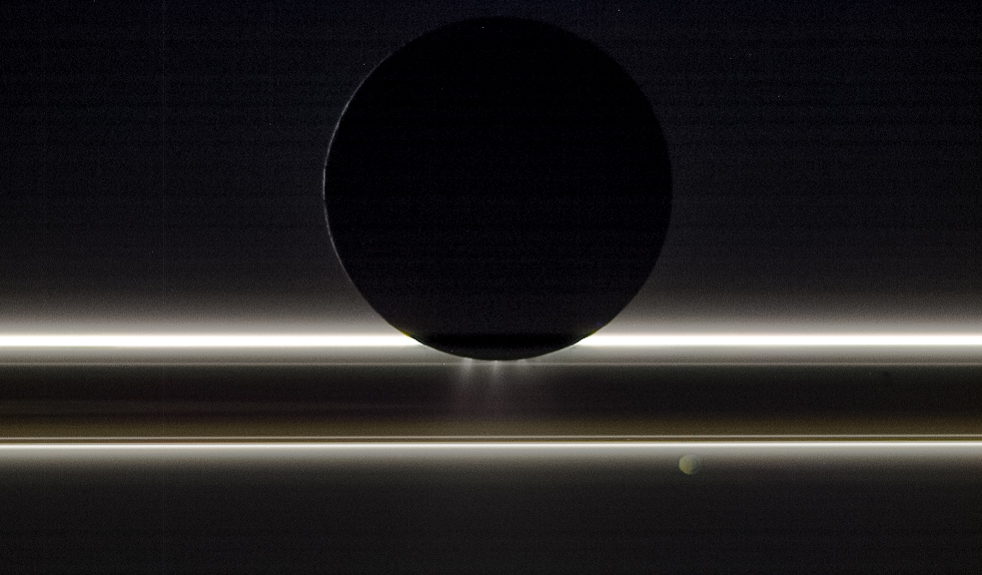
NASA images captured on November 5, 2026, reveal Enceladus in stark silhouette, highlighting the icy moon's unique topography against Saturn's glow.
DATA FEED: ENCELADUS MONITORING
Recent telemetry from the outer solar system has provided a high-contrast perspective of Enceladus. According to NASA Breaking News, the November 5, 2026, Astronomy Picture of the Day (APOD) features the Saturnian moon suspended in a deep silhouette. The imagery captures the moon as a dark disk, framed against the diffused, ambient illumination of Saturn’s atmosphere and ring system.
ANALYSIS OF ICE AND SHADOW
This specific alignment offers more than a visual spectacle; it provides critical structural data. While Enceladus is primarily known for its cryovolcanic activity and subsurface saltwater ocean, silhouette captures allow researchers to map the precise limb of the moon and identify irregularities in the surface ice. The contrast highlights the geologically active southern polar region, where plumes of water vapor and ice grains are regularly ejected into space.
CONTEXTUAL SCIENCE
This release coincides with several other milestones in planetary science. Recent NASA reports indicate that the Hubble Space Telescope has identified a significant oxygen deficit in nearby dwarf galaxies, while laboratory analysis of the Teghaza 001 Martian meteorite has identified it as one of the oldest geological samples ever recovered from the Red Planet. Furthermore, the November skywatching schedule notes that Enceladus remains a focal point for orbital observers as mission planners refine future trajectories for icy moon exploration.
By observing Enceladus in silhouette, scientists can better isolate the faint haze of its plumes from the overwhelming glare of Saturn. These observations are vital for the continued study of the moon’s potential habitability and the chemical composition of the E-ring, which is continually replenished by Enceladus's discharges.