SATURN SYSTEMS UPDATE: HUBBLE DETECTS SOUTHERN POLAR DECAGON
New imaging from the Hubble Space Telescope has identified a stable decagonal atmospheric formation at Saturn’s south pole, presenting a complex geometric evolution from previously observed structures.
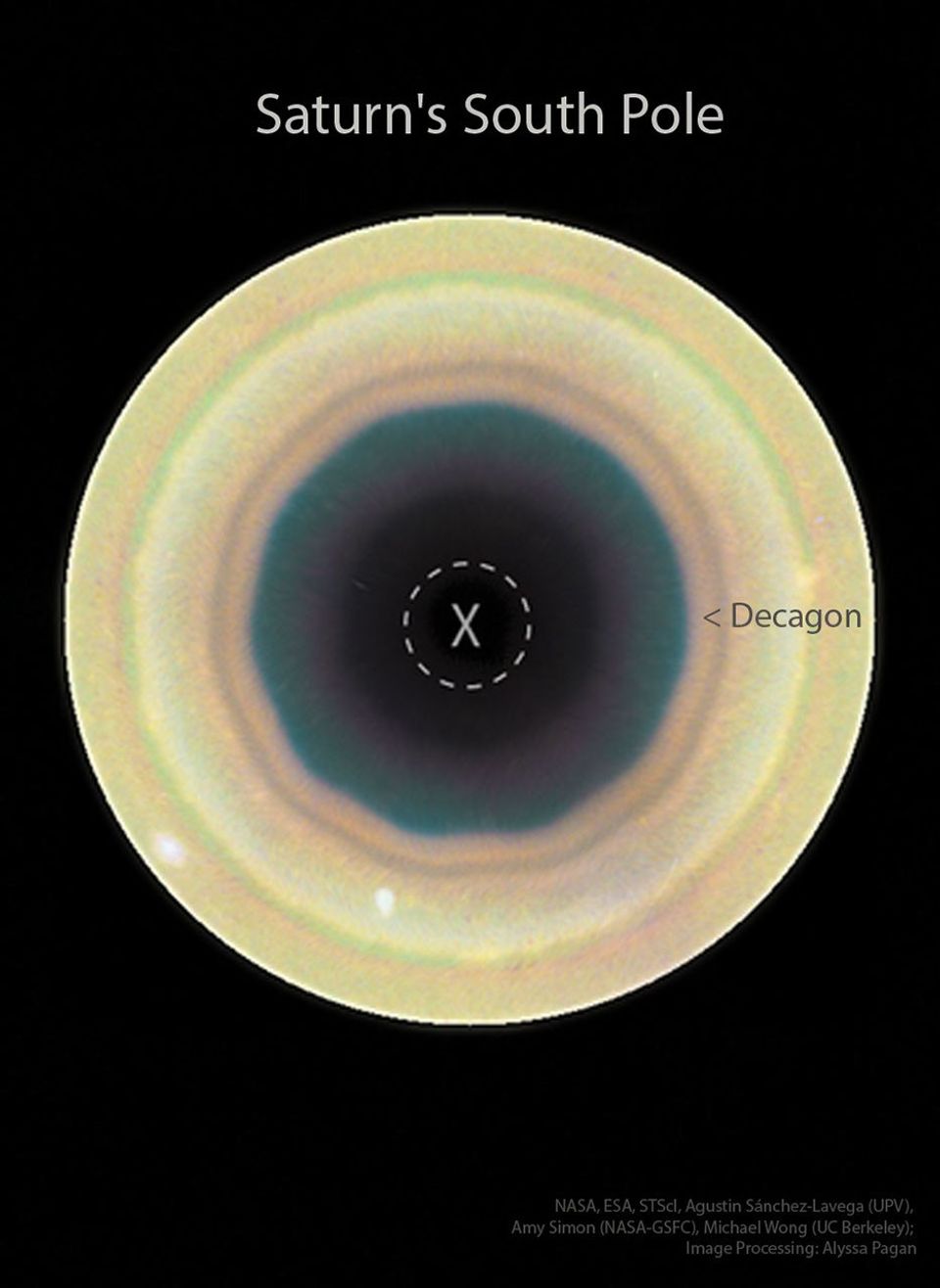
DATA ACQUISITION: SATURN SOUTHERN HEMISPHERE
Deep-space surveillance via the Hubble Space Telescope has identified a new geometric anomaly within the atmosphere of Saturn. According to NASA Breaking News, a stable decagon—a ten-sided atmospheric pattern—is currently encircling the gas giant’s south pole. This observation marks a significant phase in the ongoing monitoring of Saturn’s fluid dynamics.
GEOMETRIC EVOLUTION
Saturn’s atmospheric phenomena are historically characterized by rigid geometric structures, most notably the long-standing hexagon at the north pole. The emergence of a ten-sided configuration at the opposite pole suggests high-velocity jet streams interacting with planetary rotation in ways that challenge current fluid-mechanical models. The data suggests these polygonal structures are not static; they represent the complex intersection of thermal gradients and atmospheric pressure within the planet's deep gas layers.
MULTI-MISSION CONTEXT
This Hubble discovery coincides with broader efforts to map the outer solar system. While NASA’s Dragonfly mission prepares for its deployment to Titan, Hubble and the James Webb Space Telescope (JWST) are maintaining continuous long-range observation of the Saturnian system. These combined telemetry sets allow researchers to track how these massive storms "remember" and react to seasonal shifts over decadal cycles.
TECHNICAL STATUS
The Hubble Space Telescope remains the primary instrument for wide-field ultraviolet and visible light monitoring of these planetary features. The decagon remains under continuous observation to determine its longevity and the specific wind speeds required to maintain ten distinct vertices in a turbulent gas environment.