Saturn’s South Pole Exhibits New Geometric Decagon Feature
Data from the Hubble Space Telescope has identified a ten-sided atmospheric pattern emerging at Saturn’s southern pole, shifting scientific understanding of the planet's fluid dynamics.
Orbital Analysis
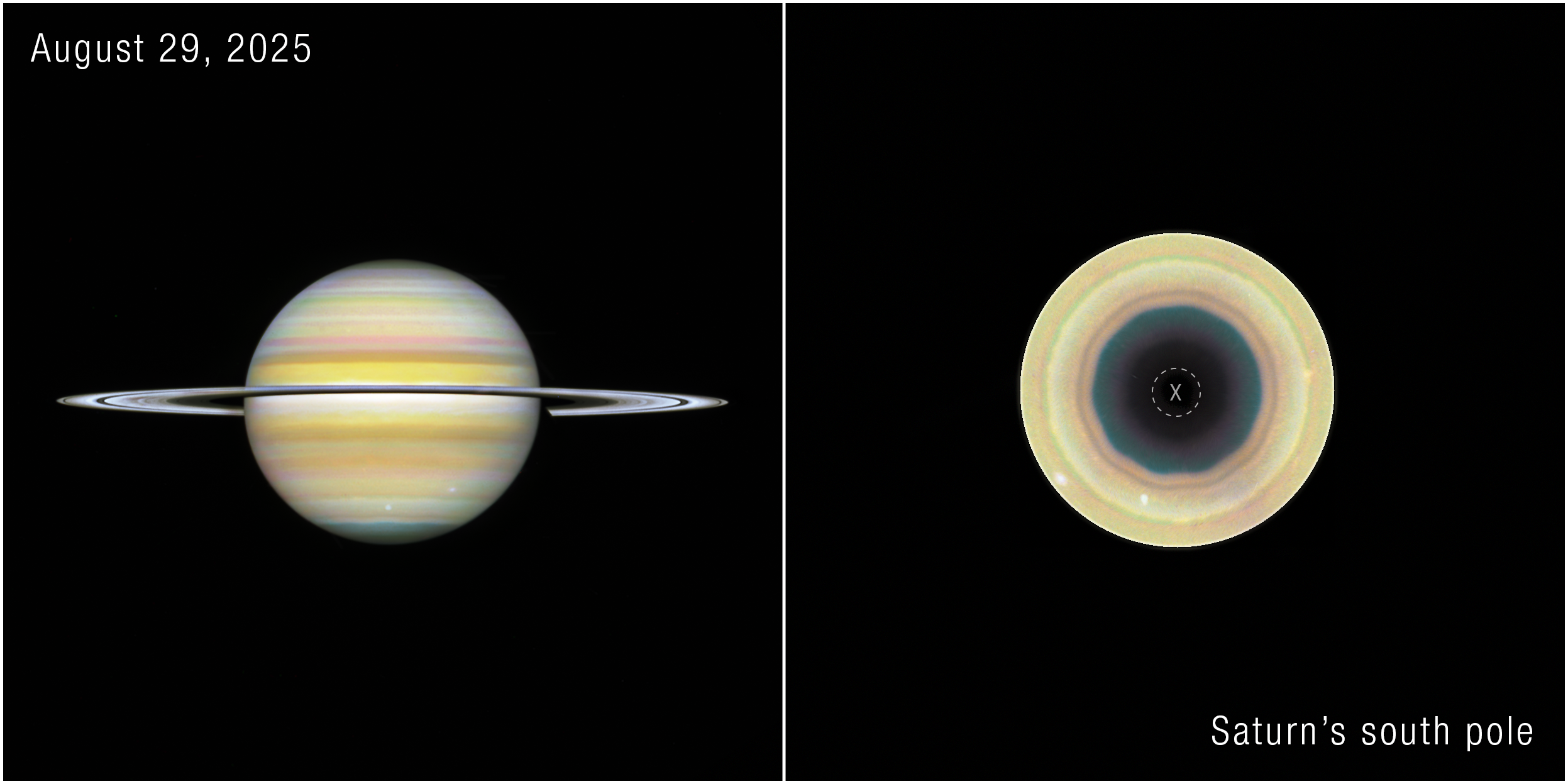
Atmospheric monitoring of the Saturnian system has revealed a new geometric anomaly. According to NASA Breaking News, the Hubble Space Telescope has successfully tracked a distinct decagon—a ten-sided polygon—encircling Saturn’s south pole. This structural formation represents a significant deviation from the long-observed hexagonal pattern located at the planet’s northern pole.
Data Log: Atmospheric Dynamics
The discovery suggests that Saturn’s polar regions are more dynamic than previously modeled. While the northern hexagon is a permanent fixture driven by jet streams and thermal gradients, the emergence of a decagon in the south indicates a shift in fluid dynamics as the planet transitions through its seasonal cycle. The Hubble observations captured the geometric clarity of the feature, providing high-resolution data on the wind speeds and pressure systems maintaining these sharp vertices.
Technical Implications
Researchers at NASA utilize Hubble’s Wide Field Camera 3 to maintain long-term surveillance of gas giant weather systems. The decagon appears to be a temporary or evolving feature, potentially linked to the deepening of the southern summer. This data allows astrophysicists to refine simulations of high-pressure vortex behavior in non-terrestrial environments. The stability of such polygons in a fluid medium remains a primary focus for planetary scientists investigating the deeper internal heat signatures of the ringed planet.