Satellite operators emphasize launch deals in a constrained market
Amid a constrained launch market, satellite operators are emphasizing to investors and customers that they have lined up launch capacity, even if it is uncertain when it will be available. The post Satellite operators emphasize launch deals in a constrained market appeared first

Home / Satellite operators emphasize launch deals in a constrained market
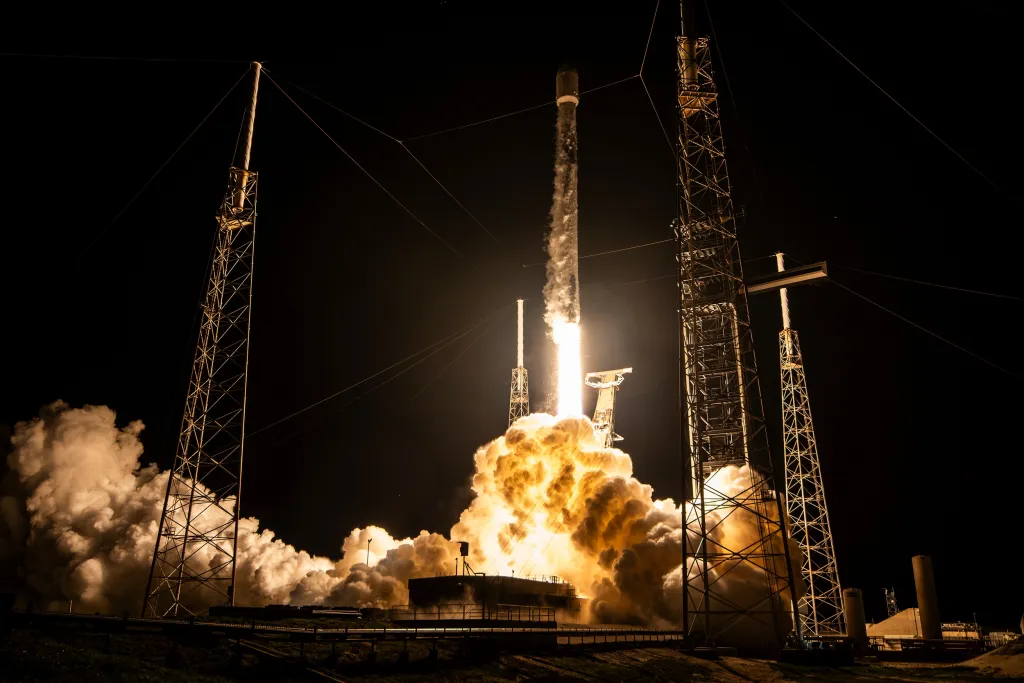
!Falcon 9 BlueBird launchA Falcon 9 lifts off Aug. 5 carrying three BlueBird satellites for AST SpaceMobile. Credit: SpaceX
WASHINGTON — Amid a constrained launch market, satellite operators are increasingly emphasizing to investors and customers that they have lined up launch capacity, even if it is uncertain when those vehicles will be available.
In second-quarter earnings calls over the last week, several companies noted they had secured launches, in some cases two years into the future, for upcoming satellites amid an industrywide scramble to secure access to space.
Among those companies is AST SpaceMobile, which is deploying a broadband direct-to-device constellation. Deployment of that constellation was slowed by the May 28 explosion of a Blue Origin New Glenn rocket, which AST said days later would delay the start of commercial service by three to six months, into the first half of 2027.
In an Aug. 10 earnings call, company executives said they have sufficient launches booked to complete that deployment, which involves placing about 45 satellites into orbit. Counting its five first-generation BlueBird satellites, the company has 12 satellites in orbit, including six launched on two Falcon 9 missions on June 17 and Aug. 5.
The company referred to a slide in its presentation that showed what it called a “detailed cadence of our deployment plan,” showing nine more launches to complete that initial constellation. The plan, though, did not include launch dates but instead when the satellites would be completed, with the satellites for the final launch slated for completion in February 2027. The satellites launched on the recent Falcon 9 missions were completed the month before they were launched.
“We have 10 launches booked with two different providers, and we’re targeting a cadence of every month or two on average,” said Scott Wisniewski, president of AST SpaceMobile, during the call.
Those launches, for the near future, will likely be on Falcon 9 vehicles as New Glenn remains grounded. While Blue Origin is working to rebuild its Cape Canaveral launch pad and return to flight by the end of the year, AST SpaceMobile is not counting on using New Glenn this year.
“They’re targeting this year. We’re not betting on that necessarily,” Wisniewski said. “We’ll be happy if they do it, but we’re not betting on that in our numbers.”
He said that “with a mix of launches, we think we can get to early 2027 for our initial 45 satellites.” However, that will require some New Glenn launches, as Falcon 9 can carry only three BlueBird satellites at a time versus up to eight on New Glenn.
In an earnings call in May, AST SpaceMobile executives mentioned United Launch Alliance’s Vulcan rocket as a potential alternative vehicle. However, Vulcan has not flown since February, when one of its four solid rocket boosters suffered an anomaly, and ULA has not stated when it expects Vulcan launches to resume.
In the Aug. 10 earnings call, Andy Johnson, AST SpaceMobile’s chief financial officer, said the company was weighing “partnerships and/or acquisitions to further vertically integrate our business and mitigate risks associated with third-party launch providers.” There are, though, few options for the company to acquire a launch provider that would provide near-term capacity.
//Securing rideshare capacity
Other companies that have relied on SpaceX rideshare launch services used their earnings calls to state that they have secured future launches for their satellites given industry concerns that SpaceX will scale back or terminate its popular Falcon 9 rideshare programs in the next few years.
In an Aug. 13 earnings call, John Serafini, chief executive of HawkEye 360, said his company has launches booked through 2028 for its satellites, which are used for radio-frequency geolocation applications. The company has used SpaceX rideshare missions for many of its satellites.
“We are fortunate to have all of our launches locked in through 2028, so it is not a near-term emergency or a near-term concern,” he said, but acknowledged uncertainty beyond 2028.
“There are open questions about availability of launch beyond, into 2029, 2030 and beyond, particularly given a feeling in the industry that SpaceX might be reducing or eliminating some of the Falcon 9 Transporter or Bandwagon missions,” he said.
He said HawkEye 360 is considering other launch options from companies such as Firefly Aerospace and Stoke Space, as well as Rocket Lab, which has launched some of its satellites on Electron. The company is also looking into launch brokers who arrange rideshare launches.
“Fortunately, if this is two-plus years out, that gives more time for other platforms to become viable,” he said. “We have the benefit of being locked down for the next two years, but we are looking at and we are considering different options.”
Spire Global offered a similar assessment in its Aug. 13 earnings call. It has been a frequent user of SpaceX rideshare launches for deploying its Lemur cubesats, which provide tracking, weather data and other services.
“With launch capacity reserved through 2028, we can keep adding collection capacity on our own timeline, even in a constrained launch market,” said Theresa Condor, chief executive of Spire, on the call.
_Related_

Jeff Foust
Jeff Foust writes about space policy, commercial space, and related topics for SpaceNews.
He earned a Ph.D. in planetary sciences from the Massachusetts Institute of Technology and a bachelor’s degree with honors in geophysics and planetary science... More by Jeff Foust
Sign in or register
Close
Continue with Google
Or
Enter the code sent to your email
Email address
Enter your password
Sign in by entering the code we sent to , or clicking the magic link in the email.
ContinueResend codeEmail me a one-time code instead Forgot password Go back
Continue Set a password (optional)
We'll send a verification code to %EMAIL%.
Send code
Skip for now
To continue reading this article:
Register now to get
2 more free articles this month.
You’ll also receive our weekly Editor’s Choice, SpaceNews This Week and Opinions newsletters. Opt-out at any time.
Sign up
Sign in to an existing account
Get unlimited access to SpaceNews.com, the SpaceNews app and our digital monthly magazine for less than $5 per week.
$250/year
Subscribe now
_Cancel anytime. Sales tax may apply. No refunds._ _Terms and conditions apply._
Link
Copy link
Digital All-Access Subscription (Monthly) $25.00 / monthDigital All-Access Subscription (Quarterly) $70.00 every 3 monthsDigital All-Access Subscription (Yearly) $250 / yearDigital All-Access Subscription (2 Years) $450 every 2 yearsPurchase
Sign in to an existing account Cancel