Saltzman’s Final Warning: Orbital Readiness is the Only Deterrent
U.S. Space Force Chief Gen. Chance Saltzman concludes his tenure with a directive to shift focus from theoretical deterrence to combat-credible orbital capabilities.
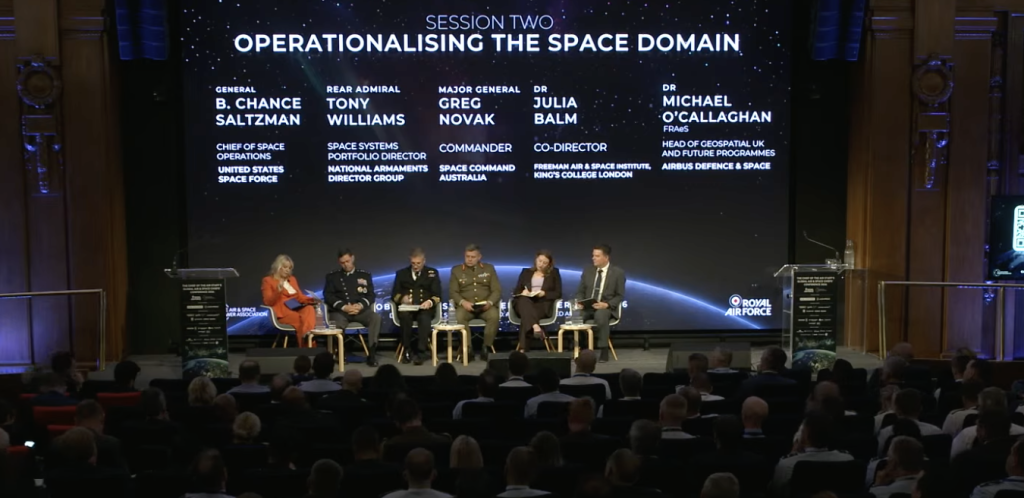
In his final public address before a planned retirement next month, U.S. Space Force Chief of Space Operations Gen. Chance Saltzman issued a stark strategic mandate: to preserve peace in orbit, the military must be unequivocally prepared for war. Speaking at the Global Air & Space Chiefs' Conference in London, Saltzman argued that the unique nature of orbital mechanics renders every nation’s assets vulnerable once a conflict begins. According to SpaceNews, the General emphasized that “orbital mechanics will put all of our space capabilities in a space war zone,” regardless of a nation's neutral status.
Saltzman’s four-year leadership has overseen a fundamental shift in the Space Force’s identity. Since 2022, the service has pivoted from a support-oriented organization—focused on GPS and missile warnings—toward a concentrated effort on "space control." This strategy prioritizes the ability to protect allied access to orbit while actively denying adversaries the same advantages. He characterized this as "Competitive Endurance," a framework designed to avoid operational surprise and develop counterspace tools that function without creating catastrophic debris fields.
Central to his London address was a critique of traditional deterrence. Saltzman argued that commanders should spend less energy calculating an adversary's mindset and more on building a "combat credible force." By fielding systems capable of disrupting and destroying enemy assets, the military creates a tangible deterrent based on capability rather than rhetoric.
Saltzman also stressed the necessity of international coalitions, describing space as the "ultimate team sport." While acknowledging that bureaucratic hurdles like procurement speed and classification sharing may never be fully "solved," he urged allies to manage these frictions through constant interoperability and shared responsibility for the domain's stability.