Rosetta’s Comet Legacy: A Deep-Space Self-Portrait
NASA’s Astronomy Picture of the Day revisit Rosetta’s historic close-up with Comet 67P/Churyumov–Gerasimenko, highlighting the enduring scientific impact of the ESA’s most ambitious comet hunter.
DATA RECOVERY: ROSETTA SYSTEM LOGS
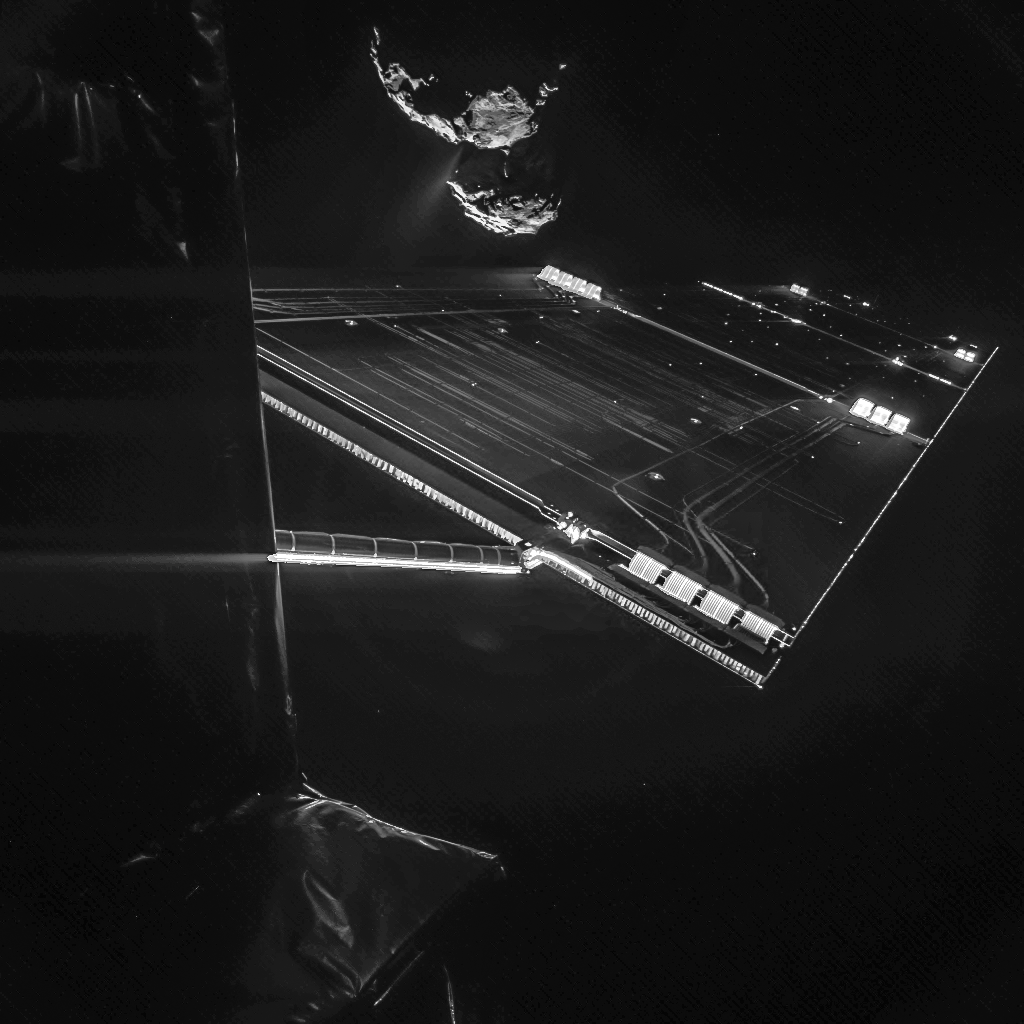
According to NASA Breaking News, the space agency recently highlighted a definitive visual record from one of the most significant European Space Agency (ESA) missions: the Rosetta spacecraft’s self-portrait. This image, curated for the Astronomy Picture of the Day (APOD) on October 24, 2026, serves as a stark reminder of the mission's proximity to the rugged, dual-lobed surface of Comet 67P/Churyumov–Gerasimenko.
The capture showcases the spacecraft’s solar array extending toward the celestial body, framing the contrast between terrestrial engineering and the primitive, icy landscape of the comet. Rosetta arrived at 67P in August 2014, marking the first time a human-made vessel orbited a comet. The mission achieved a historic milestone by deploying the Philae lander to the surface, despite the lander’s turbulent touchdown.
MISSION CONTEXT
While NASA’s recent updates focus on the Psyche mission’s push toward the asteroid belt and the final commissioning of the Roman Space Telescope, the retrospective look at Rosetta anchors the current era of exploration. Rosetta’s decade-long journey and two-year escort of Comet 67P provided unprecedented data on the composition of the early solar system. The mission concluded in September 2016 with a controlled impact on the comet’s surface, but the visual and thermal telemetry recovered continues to inform planetary defense and origin theories today.
TERMINAL STATUS
Rosetta remains a blueprint for long-duration deep-space operations. By revisiting these archival frames, space agencies maintain the technical continuity required for upcoming missions to primitive bodies. The 67P imagery remains a benchmark for high-resolution close-proximity operations in zero-gravity environments.