Rocket Lab wins NASA award for three Electron launches
NASA has selected Rocket Lab to launch a pair of science missions on three Electron rockets in 2027. The post Rocket Lab wins NASA award for three Electron launches appeared first on SpaceNews.

Home / Rocket Lab wins NASA award for three Electron launches
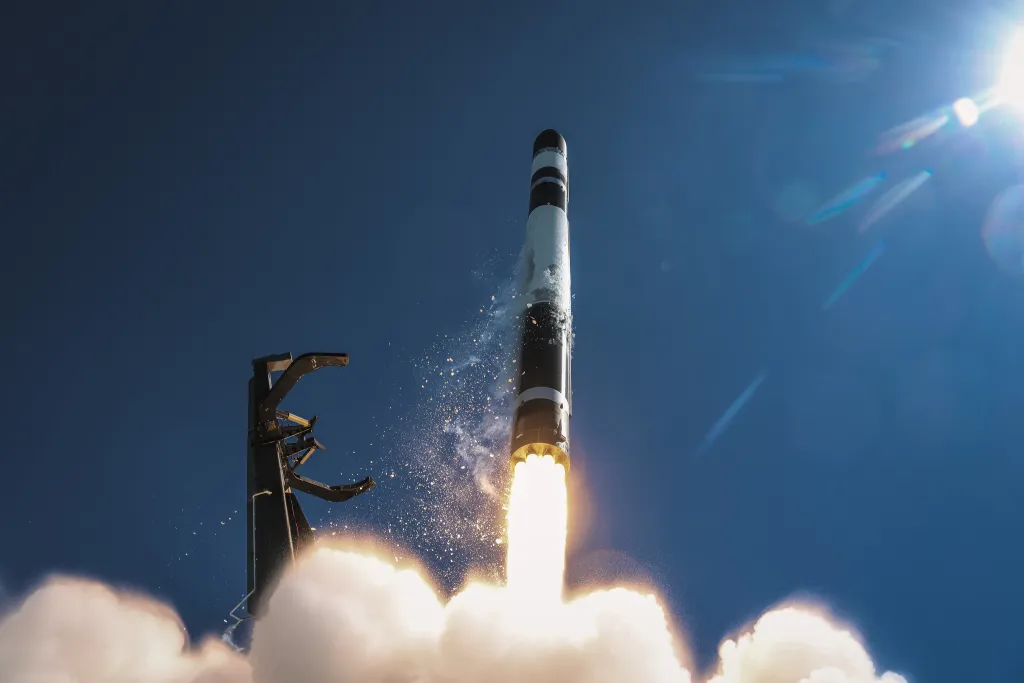
!Electron launchA Rocket Lab Electron lifts off March 5 (U.S. time) carrying a satellite for an undisclosed customer. Credit: Rocket Lab
WASHINGTON — NASA has selected Rocket Lab to launch a pair of science missions on three Electron rockets in 2027.
NASA announced June 25 it selected Rocket Lab to launch its Polarized Submillimeter Ice-cloud Radiometer, or PolSIR, and Total and Spectral Solar Irradiance Sensor-2, or TSIS-2, missions on Electron rockets.
PolSIR consists of two 16U cubesats built by Blue Canyon Technologies that will measure the rise and fall of ice crystals in tropical clouds, as well as how those changes in ice affect storm development. The satellites will operate in separate orbits, each inclined at 52 degrees, allowing them to pass over the same area several hours apart to measure changes over the course of each day.
TSIS-2 is a spacecraft that will be the successor to TSIS-1, an instrument mounted on the exterior of the International Space Station. The spacecraft, built by General Atomics Electromagnetic Systems, carries instruments to measure the amount of solar energy entering Earth’s atmosphere.
The PolSIR spacecraft will launch on back-to-back Electrons from Rocket Lab’s Launch Complex 1 in New Zealand no earlier than June 2027. TSIS-2 will launch on an Electron from Launch Complex 1 in early 2027.
TSIS-2 was originally expected to launch on a Falcon 9 as part of a rideshare mission with other NASA and commercial satellites. The agency did not disclose why it moved TSIS-2 to Electron, but that mission is several years behind its original schedule because of what NASA once described as “challenges” with the spacecraft vendor.
The awards were made under NASA’s Venture-Class Acquisition of Dedicated and Rideshare, or VADR, contract vehicle for procuring launches of small satellites. NASA has repeatedly declined to disclose the value of VADR awards, stating that the task orders used under the contract contain company proprietary information.
“Electron has become synonymous with reliability, precise orbital accuracy and on-demand launch capability, and we’ve been delivering this for NASA missions for almost a decade. We’re proud to deliver this once again for PolSIR and TSIS-2,” Peter Beck, chief executive of Rocket Lab, said in a statement.
In addition to PolSIR and TSIS-2, Rocket Lab has an agreement to launch NASA’s Aspera astrophysics smallsat mission, also through the VADR contract. It is expected to launch later this year.
Rocket Lab is separately preparing to launch LOXSAT, a mission to test cryogenic fluid management technologies for NASA through the agency’s Tipping Point technology demonstration program. The LOXSAT mission, led by Eta Space, uses a Rocket Lab Photon spacecraft and is slated to launch later this year.
_Related_

Jeff Foust
Jeff Foust writes about space policy, commercial space, and related topics for SpaceNews.
He earned a Ph.D. in planetary sciences from the Massachusetts Institute of Technology and a bachelor’s degree with honors in geophysics and planetary science... More by Jeff Foust
Sign in or register
Close
Continue with Google
Or
Enter the code sent to your email
Email address
Enter your password
Sign in by entering the code we sent to , or clicking the magic link in the email.
ContinueResend codeEmail me a one-time code instead Forgot password Go back
Continue Set a password (optional)
We'll send a verification code to %EMAIL%.
Send code
Skip for now
30% OFF ANY NEW SPACENEWS SUBSCRIPTION: Use code UNICORNS30 and save on unlimited access to our news and analysis, including our June cover story tracking the surge in space companies valued at $1 billion or more. _Sale ends June 26._
To continue reading this article:
Register now to get
2 more free articles this month.
You’ll also receive our weekly Editor’s Choice, SpaceNews This Week and Opinions newsletters. Opt-out at any time.
Sign up
Sign in to an existing account
Get unlimited access to SpaceNews.com, the SpaceNews app and our digital monthly magazine for less than $5 per week.
$250/year
Subscribe now
_Cancel anytime. Sales tax may apply. No refunds._ _Terms and conditions apply._
Link
Copy link
Digital All-Access Subscription (Monthly) $25.00 / monthDigital All-Access Subscription (Quarterly) $70.00 every 3 monthsDigital All-Access Subscription (Yearly) $250 / yearDigital All-Access Subscription (2 Years) $450 every 2 yearsPurchase
Sign in to an existing account Cancel