Pentagon missile buildup changing the factory floor
Startups are bringing software, robotics and manufacturing methods developed around commercial space into a defense industry under pressure to produce weapons faster The post Pentagon missile buildup changing the factory floor appeared first on SpaceNews.

Home / Pentagon missile buildup changing the factory floor
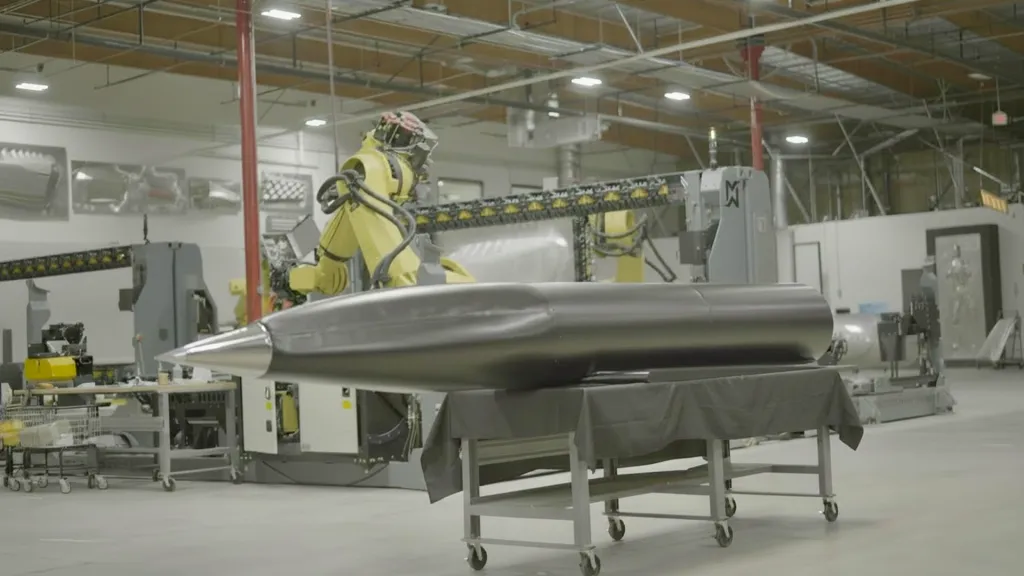
Hypersonic missile fuselage built by Machina Credit: Machina
HUNTSVILLE, Ala. — The Pentagon’s push to replenish missile inventories is creating an opening for a new class of manufacturers that say the problem isn’t simply a shortage of factory space. It is how those factories are built.
Startups such as Machina, Hadrian and Freeform are applying software, robotics and highly automated production techniques to aerospace and defense manufacturing, challenging a model that has long relied on dedicated machinery, specialized tooling and skilled labor to make relatively small numbers of complex parts.
Some of the new manufacturing technology grew out of the commercial space industry.
At this year’s Space and Missile Defense Symposium, Los Angeles-based Machina is displaying a 16-foot fuselage for a hypersonic vehicle that it manufactured for Ursa Major, a company that is expanding from rocket propulsion into complete hypersonic missile systems.
Machina co-founder and chief executive Edward Mehr, who previously worked at SpaceX and Relativity Space, says the hardware is an example of how AI can be applied not to designing weapons, but to controlling the machines that manufacture them.
“Missile programs are not constrained by design. They are constrained by production,” Mehr told _SpaceNews_.
Machina recently received a qualification contract from Lockheed Martin supporting the Joint Air-to-Surface Standoff Missile, or JASSM, a long-range cruise missile built for the Air Force. The agreement is significant for Machina because it puts an assembly made with the company’s manufacturing process through qualification for an operational missile program.

Lockheed is also an investor in Machina through Lockheed Martin Ventures.
Mehr said manufacturing fuselage structures for hypersonic missiles has become “a big area of growth for us.”
Machina’s manufacturing platform, called RoboCraftsman, uses robotic arms to progressively shape sheets of metal into aerospace structures.
The company uses artificial intelligence to give robotic equipment more autonomy over how it performs a physical task.
“Our use of AI and robotics allows us to build flexible manufacturing systems that can switch between processes and geometries while reducing the need for dedicated tooling,” Mehr said.
Mehr said traditional programs can require tens of millions of dollars in dedicated equipment and long setup periods before the first production hardware is available for testing. Machina’s argument is that a programmable factory can compress that transition because much of the change resides in software rather than in a new set of dies and machinery.
Equipment previously producing automotive hardware, for example, could be reprogrammed to begin making a missile structure after receiving the digital design, he said.
“Under the traditional model, a significant design change or a new missile component can require another investment in tooling, equipment and production setup,” Mehr said. “With our system, much of that change can happen through software rather than by building another dedicated manufacturing line.”
Machina is looking to demonstrate that its approach can consistently meet the tolerances, quality requirements and production rates demanded by major weapons programs.
The company is preparing to scale. Machina raised $124 million earlier this year to help finance a new 200,000-square-foot U.S. factory intended to move the technology from lower-volume work into larger production runs. Its customers also include NASA and Toyota.
_Related_

Sandra Erwin
Sandra Erwin writes about military space programs, policy, technology and the industry that supports this sector. She has covered the military, the Pentagon, Congress and the defense industry for nearly two decades as editor of NDIA’s National Defense... More by Sandra Erwin
Sign in or register
Close
Continue with Google
Or
Enter the code sent to your email
Email address
Enter your password
Sign in by entering the code we sent to , or clicking the magic link in the email.
ContinueResend codeEmail me a one-time code instead Forgot password Go back
Continue Set a password (optional)
We'll send a verification code to %EMAIL%.
Send code
Skip for now
To continue reading this article:
Register now to get
2 more free articles this month.
You’ll also receive our weekly Editor’s Choice, SpaceNews This Week and Opinions newsletters. Opt-out at any time.
Sign up
Sign in to an existing account
Get unlimited access to SpaceNews.com, the SpaceNews app and our digital monthly magazine for less than $5 per week.
$250/year
Subscribe now
_Cancel anytime. Sales tax may apply. No refunds._ _Terms and conditions apply._
Link
Copy link
Digital All-Access Subscription (Monthly) $25.00 / monthDigital All-Access Subscription (Quarterly) $70.00 every 3 monthsDigital All-Access Subscription (Yearly) $250 / yearDigital All-Access Subscription (2 Years) $450 every 2 yearsPurchase
Sign in to an existing account Cancel