Orbital Perspective: The 2026 Perseid Peak Captured
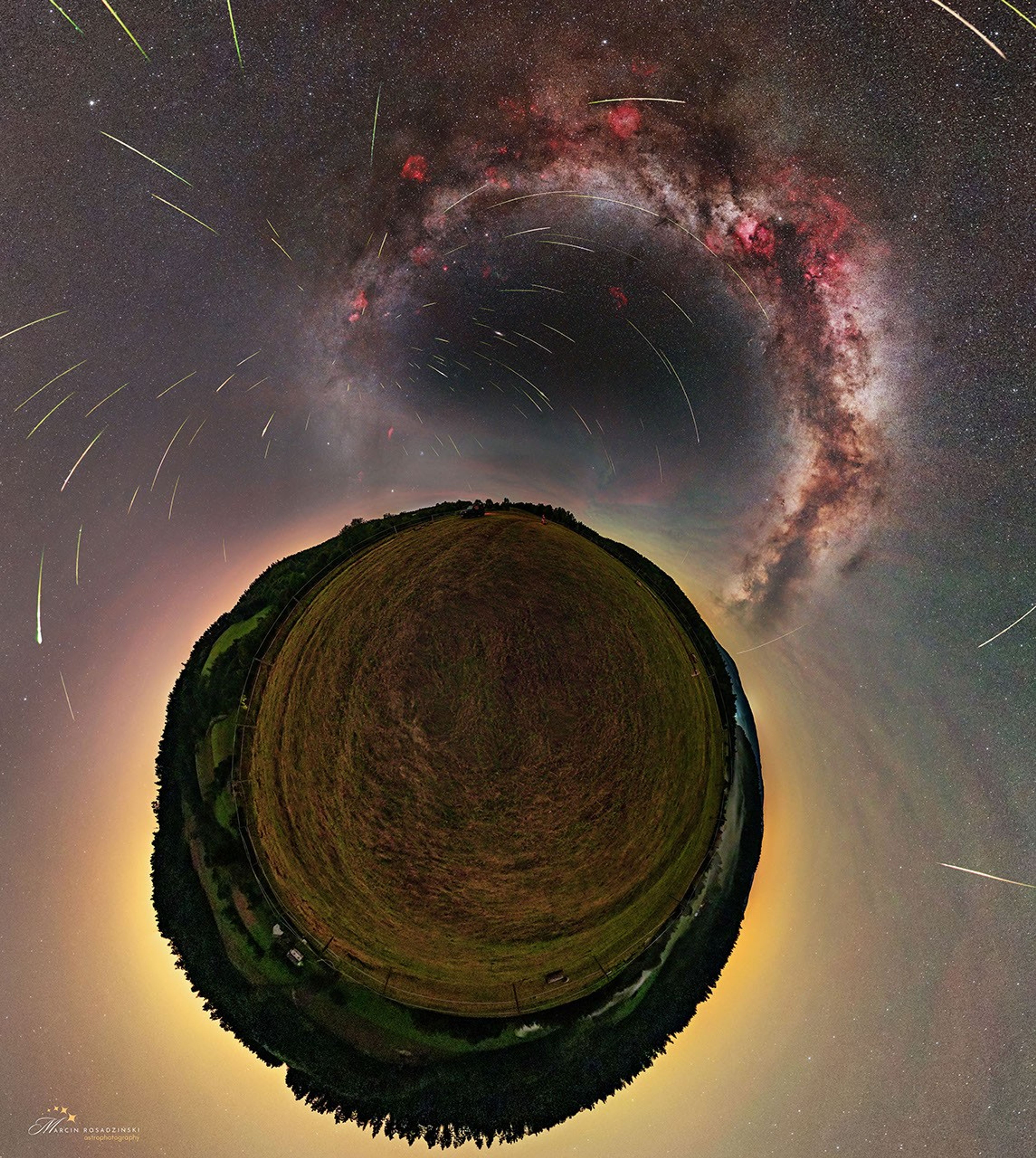
NASA’s Astronomy Picture of the Day for August 12, 2026, features a stunning 'Little Planet' projection of the Perseid meteor shower, highlighting the annual debris trail left by Comet Swift-Tuttle.
Data Ingest: Perseid Maximum
The annual Perseid meteor shower has reached its zenith, manifesting as a high-velocity debris intersection between Earth's atmosphere and the wake of Comet 109P/Swift-Tuttle. According to NASA Breaking News, the August 12, 2026, edition of the Astronomy Picture of the Day (APOD) highlights this phenomenon through a specialized stereographic projection, commonly referred to as a "Little Planet" perspective.
Technical Execution
The featured imagery distorts a wide-angle celestial capture into a spherical terrestrial anchor, centering the observer within a localized horizon while the Perseid radials streak across the dark sky. These meteors, consisting of comet fragments often no larger than a grain of sand, incinerate upon entry at approximately 59 kilometers per second. The resulting ionization trails provide a significant data set for atmospheric researchers and celestial observers alike.
Mission Context
While the Perseids remain a primary focus for terrestrial skywatchers this month, NASA continues to integrate these observations with broader mission objectives. The agency’s current flight manifest includes ongoing ISS research supporting future Moon and Mars trajectories, alongside deep-space analysis via the James Webb and Chandra observatories. Recent data from Chandra has even enabled the creation of high-fidelity 'craft' visualizations from nearby nebulae, bridging the gap between raw astrophysical data and visual representation.
As Earth exits the densest part of the Swift-Tuttle debris cloud, the focus shifts back to orbital logistics and the upcoming SpaceX Crew-2 operations. For European operators, these annual meteor events serve as a reminder of the kinetic environment defining the Near-Earth Object (NEO) landscape.