Orbital Infrastructure Drives $686B Global Space Economy
New data confirms massive 12% growth in the space sector for 2025, fueled by soaring commercial revenue and a shift toward sovereign satellite capabilities across Europe and Asia.
DATA OVERVIEW
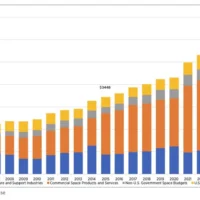
The orbital sector has transitioned from a frontier to critical infrastructure. According to Payload and the Space Foundation’s latest report, the global space economy reached a record $686 billion in 2025, a 12% increase year-over-year. With a compound annual growth rate nearing 10%, the industry shows no signs of plateauing.
SECTOR ANALYSIS
Commercial activity dominates the landscape, accounting for $544.3 billion—nearly 80% of total revenue. While Position, Navigation, and Timing (PNT) and ground equipment remain the primary revenue drivers, the upstream market is accelerating. Satellite manufacturing surged by 67.2%, while launch services grew by 49.4%.
THE SOVEREIGNTY SURGE
Government spending hit $141 billion across 53 nations. While the U.S. remains the primary spender (57%), international allies are aggressively scaling domestic programs to ensure strategic autonomy.
- United Kingdom & France: Reported budget increases exceeding 40%.
- Canada: More than doubled its space spending to $612 million.
- Germany: Committed $41 billion through 2030 to bolster defense assets.
PRIVATE CAPITAL INJECTION
Private investment exceeded $12 billion in 2025. Capital is flowing into high-utility hardware, including Stoke Space (reusable rockets, $860 million total Series D) and Starcloud ($170 million for orbital data centers).
As the Pentagon prepares to push global military space spending past $150 billion by FY27, the focus has shifted toward "sovereignty as a service." Nations like Finland are now arguably more "space-dense" than China, leveraging constellations like ICEYE to maintain localized control over orbital intelligence.