Orbital Geometry: The Mechanics of Total Solar Eclipses
A total solar eclipse is a precise spatial alignment where the Moon's shadow intersects Earth, offering unique data windows for heliophysics.
Celestial Synchronization
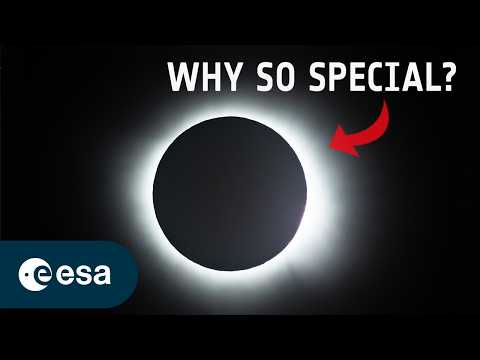
Total solar eclipses are not merely visual spectacles; they are the result of rigorous orbital mathematics. According to ESA YouTube, the phenomenon occurs due to a singular coincidence: the Moon is approximately 400 times smaller than the Sun, while the Sun is roughly 400 times further away from Earth. This ratio allows the lunar disk to precisely mask the solar photosphere from a terrestrial perspective.
The Totality Phase
When the Moon crosses the ecliptic plane—the path of Earth’s orbit—it creates a shadow cone. The central part of this shadow, the umbra, produces the 'path of totality.' Within this narrow corridor, the Sun is entirely obscured, revealing the solar corona. This outer atmosphere is usually invisible due to the overwhelming glare of the solar disk. ESA notes that this alignment allows researchers to observe the corona’s structure and solar winds without specialized space-borne coronagraphs.
Baily's Beads and the Chromosphere
As the Moon completes its transit, sunlight filters through the rugged lunar topography. This creates the 'Baily's Beads' effect—brilliant points of light appearing at the lunar limb. For a few seconds, the chromosphere, a thin red layer of the solar atmosphere, becomes visible to the naked eye. In contrast, locations outside the umbral path experience a partial eclipse, where only the penumbra (the lighter outer shadow) reaches the surface, leaving the Sun partially visible.
Scientific Utility
These events provide high-fidelity data on the solar-terrestrial connection. Monitoring the sudden drop in temperature and changes in ionospheric density during totality helps validate atmospheric models. For European missions like Proba-3, which will simulate eclipses using two formation-flying satellites, these natural events serve as a baseline for artificial occultation technology.