Orbital Fluid Dynamics: Candy Dispersion in Microgravity
A visual experiment conducted aboard the International Space Station demonstrates how surface tension and solubility behave in a weightless environment using a candy-coated peanut.
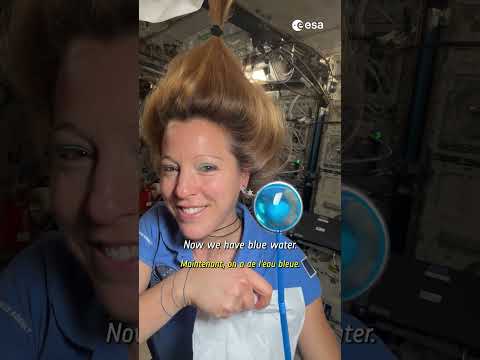
Microgravity Solubility Analysis
Data transmitted from the International Space Station (ISS) has provided a unique visualization of fluid dynamics involving a standard candy-coated peanut and a localized water sphere. According to ESA YouTube footage, the experiment highlights the mechanics of surface tension and pigment dispersion in a microgravity environment.
The Observation Cycle
When the blue-coated confectionery is introduced into a free-floating water bubble, the physics of the interaction deviate significantly from terrestrial expectations. In a 1G environment, gravity would pull the water downward and cause the dissolved sugars to settle. On the ISS, the candy remains suspended within the aqueous volume.
As the blue sugar coating begins to dissolve, the pigment does not sink. Instead, it moves via molecular diffusion and internal fluid currents, gradually tinting the entire sphere. The water acts as a containment field, held together by surface tension, while the object inside remains neutrally buoyant.
Scientific Significance
While the demonstration utilizes a common snack, the implications for European space research are structural. Understanding how solutes behave within liquid volumes is critical for life support systems, waste management, and chemical processing in deep-space habitats. It confirms that without convective forces driven by gravity, mixing is an entirely different mechanical challenge for orbital engineers.