Orbital Analysis: The Tannin-Rich Plumes of Rupert Bay
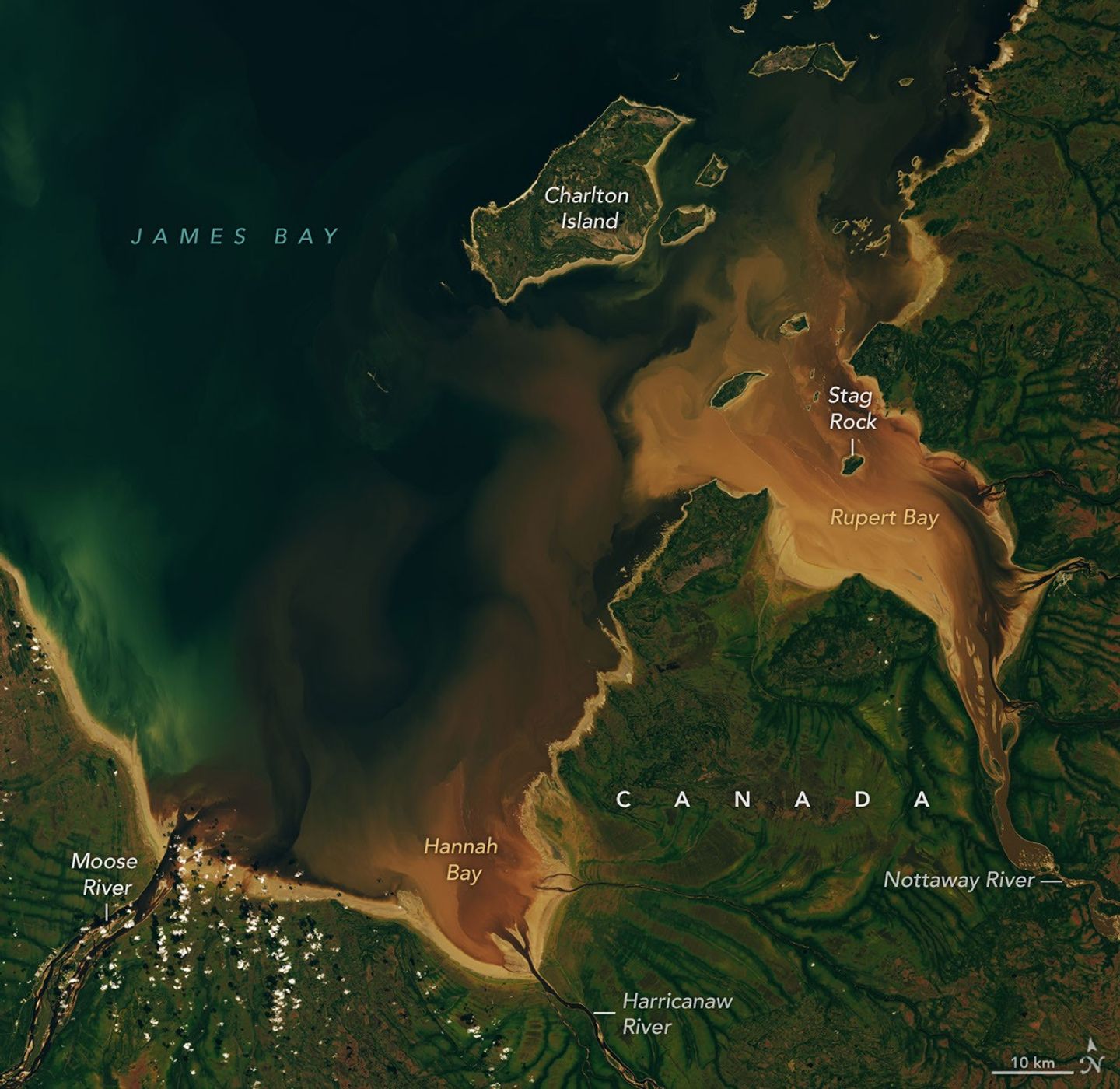
High-resolution satellite imagery reveals the distinct tea-colored currents of Rupert Bay, where organic matter from boreal forests meets the frigid tides of James Bay.
Data Overview
Spectral analysis of Canada’s eastern coastline confirms a persistent chromatic shift in the waters of Rupert Bay. According to NASA Breaking News, orbital observations captured by the Operational Land Imager (OLI) on Landsat 8 reveal a stark, tea-colored contrast where the Nottaway, Broadback, and Rupert rivers discharge into the James Bay basin.
Geophysical Mechanics
This distinctive "beaver-brown" coloration is not the result of industrial pollutants or sediment turbidity alone. Instead, the visual profile is driven by high concentrations of tannins and other Colored Dissolved Organic Matter (CDOM). These substances originate in the surrounding boreal forests and peatlands. As vegetation decays, organic molecules leach into the river systems, functioning as a natural dye that absorbs shorter wavelengths of light, resulting in a dark, yellowish-brown appearance at the surface.
Tidal Interaction
The OLI sensor data illustrates a complex fluid dynamic at the river-mouth interface. The dark, freshwater discharge meets the relatively clearer, saline waters of James Bay, creating intricate swirl patterns. These plumes are further modulated by intense tidal forces, which push and pull the organic-rich discharge across the bay.
Scientific Context
Monitoring these organic flows is essential for understanding the carbon cycle in subarctic environments. As per the NASA Earth Observatory reports, the volume of CDOM serves as a critical indicator of the health of terrestrial ecosystems and their impact on marine chemistry within the Hudson Bay system.