Orbital Analysis: The Hydrological Anomaly of Lençóis Maranhenses
A paradox in the Brazilian landscape, Lençóis Maranhenses combines a hyper-arid desert appearance with massive annual rainfall, creating a unique seasonal ecosystem observable from orbit.
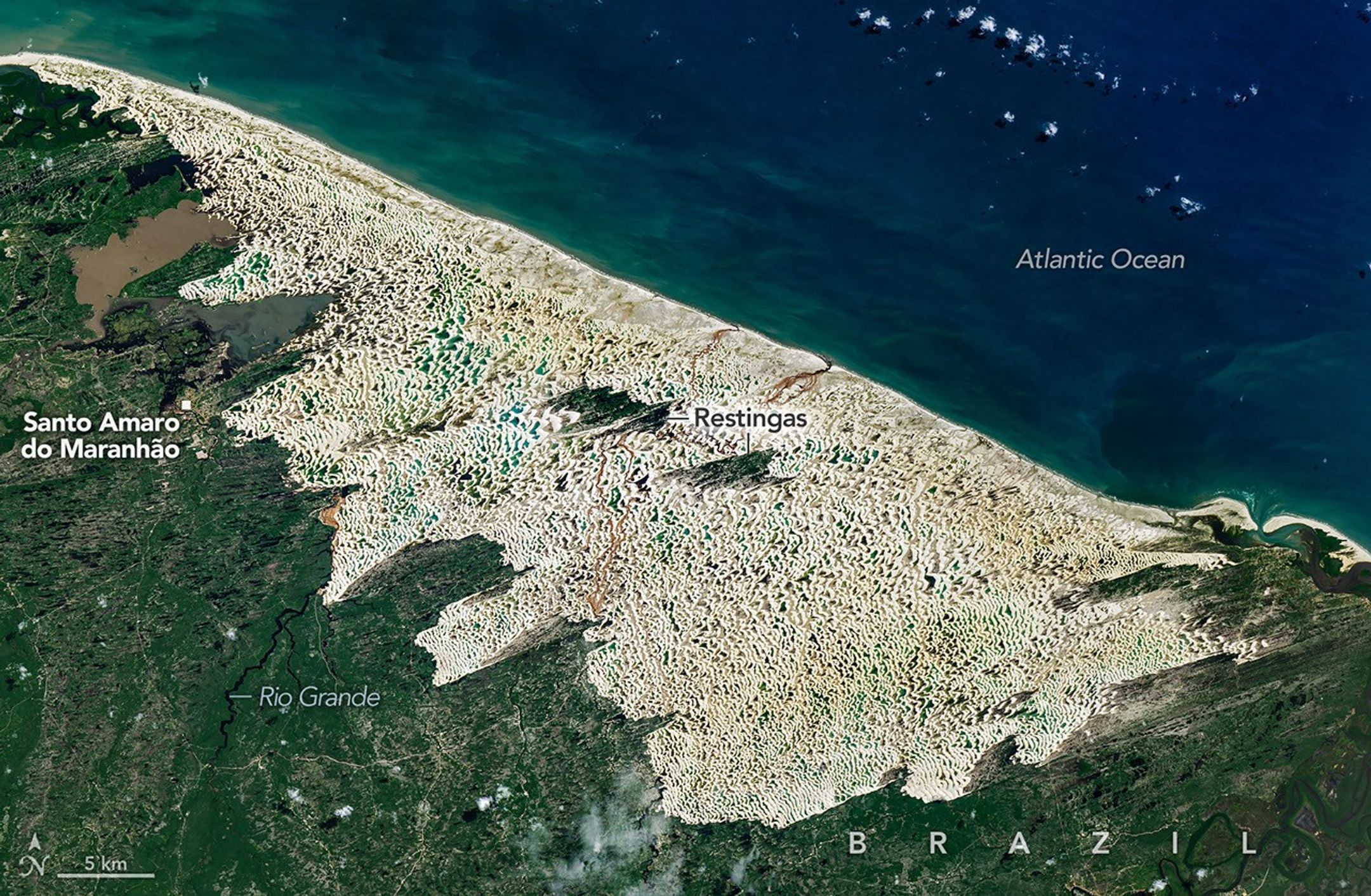
Hydrological Anomaly Detected
According to NASA Breaking News, the Lençóis Maranhenses National Park in northeastern Brazil presents a geographic paradox: a vast field of sweeping white sand dunes that behaves like a wetland. While the region’s topography suggests a desert biome, it is technically an anomaly driven by intense seasonal precipitation.
Data Points: Rainfall vs. Topography
The park receives approximately 1,200 millimeters of rain annually—roughly 100 times the volume of the Sahara. This rainfall is concentrated between January and June. Because the underlying rock is impermeable, the water cannot drain. Instead, it pools in the interdunal troughs, creating thousands of turquoise and emerald lagoons that reach depths of up to three meters.
Biological Persistence
Despite the temporary nature of these lagoons, life persists. When the waters return each year, species like the wolf fish emerge from the mud to hunt. This cycle continues until the dry season, when the lagoons evaporate and the dunes reclaim the landscape. The OLI-2 (Operational Land Imager-2) on Landsat 9 captured high-resolution telemetry of this transition in 2024, highlighting the stark contrast between the white quartz sand and the deep blue water pockets.
Sediment Logistics
The dunes are not static; they are propelled inland by strong winds from the Atlantic, which transport sediment up to 50 kilometers from the coast. This constant movement ensures the landscape remains in flux, a rare example of a "wet desert" that challenges standard terrestrial classification.