Observable Space Secures $184M in Capital and Defense Contracts
Optical technology firm Observable Space closes a $90 million Series A and secures a $94 million Space Force contract to scale its laser communication and tracking infrastructure.
DATA ACQUISITION: THE OPTICAL FRONTIER
According to SpaceNews, Amsterdam-based Observable Space has formalized a significant financial expansion, closing a $90 million Series A funding round. The investment, led by Lux Capital and Upfront Ventures, positions the firm to scale its production of free-space optics—a technology increasingly viewed as the vital backbone for orbital data infrastructure and space domain awareness.
CONTRACTUAL INTEGRATION: U.S. SPACE FORCE
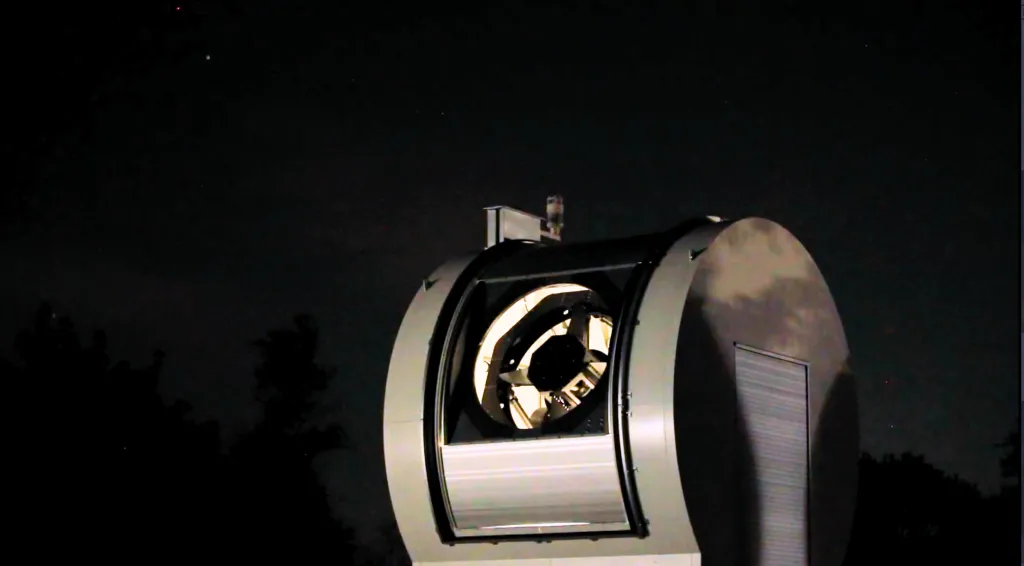
Parallel to the fundraise, the company has secured an Indefinite-Delivery, Indefinite-Quantity (IDIQ) contract from the U.S. Space Force valued at up to $94 million. Initial task orders totaling $22 million have already been activated under the Pentagon’s APFIT program. This mandate focuses on the deployment of "Deployable, Attritable Optical Systems"—robotic, off-grid telescopes designed to provide high-fidelity tracking of orbital assets in a congested environment.
TECHNOLOGY DEMONSTRATION AND MANUFACTURING
CEO Dan Roelker, a former SpaceX executive, frames the hardware as essential for the next era of orbital economy, asserting that controlling light is equivalent to controlling space. Observable Space has already validated its capabilities during the Artemis 2 mission, utilizing a ground station in Australia to maintain a 260 Mbps laser link with the Orion spacecraft.
Hardware development includes:
Iguana: A 200mm multispectral imager scheduled for flight on an Apex spacecraft this year.
Argus Array: Production of 1,200 small telescopes funded by Schmidt Sciences for astronomical observation.
To meet demand, the firm will expand its current Michigan-based manufacturing footprint into a new facility in Detroit, while maintaining specialized labs in Los Angeles. This expansion ensures the vertical integration of lasers, software, and mechanical systems required for terabit-per-second orbital communications.