Nucleosynthesis: Mapping the Origins of the Periodic Table
New data from NASA provides a comprehensive breakdown of the cosmic origins of the elements, tracking every atom in the human body back to its specific stellar catalyst.
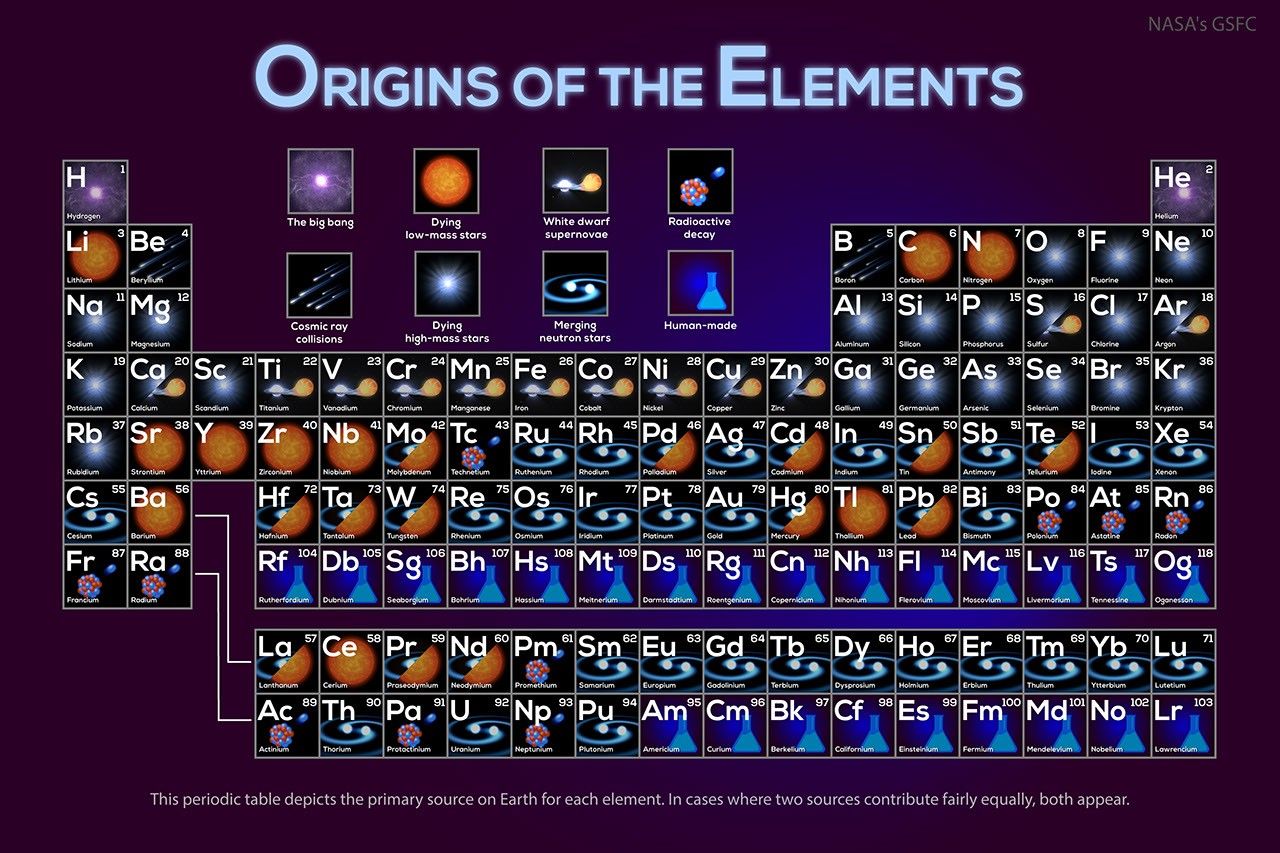
Cosmic Inventory
Every atom comprising human physiology is a relic of high-energy stellar processes. According to NASA Breaking News, the structural elements of our biology and technology—from the hydrogen in water to the gold in circuitry—are the direct products of billion-year lifecycle events in the cosmos.
Origins of the Table
The most primitive element, Hydrogen, originated exclusively from the Big Bang. However, the rest of the periodic table requires significantly more violent catalysts. Low-mass stars, similar to the Sun, are responsible for generating a significant portion of Carbon and Nitrogen through nuclear fusion. Once these stars reach their end-of-life phases, they disperse these life-critical components into the interstellar medium.
More complex elements require extreme pressure environments. Oxygen and Iron are primarily synthesized during the catastrophic collapse of massive stars, known as Type II Supernovae. Meanwhile, heavy elements such as Silver, Gold, and Platinum are forged during the collision of neutron stars—remnants of exploded stellar cores that have collapsed into hyper-dense states.
The Supernova Factor
White dwarfs also play a critical role in the chemical composition of the modern universe. When these dense stellar remnants explode as Type Ia Supernovae, they contribute a massive influx of Iron-group elements. Without these specific high-energy events, the chemical diversity required for planetary formation and biological evolution would not exist. We are, quite literally, the processed exhaust of the universe’s most powerful reactors.