New space transportation policy focuses on increased launch rates
The White House released a new space transportation policy Aug. 20 with an emphasis on enabling a sharp increase in the number of launches and reentries. The post New space transportation policy focuses on increased launch rates appeared first on SpaceNews.
Home / New space transportation policy focuses on increased launch rates
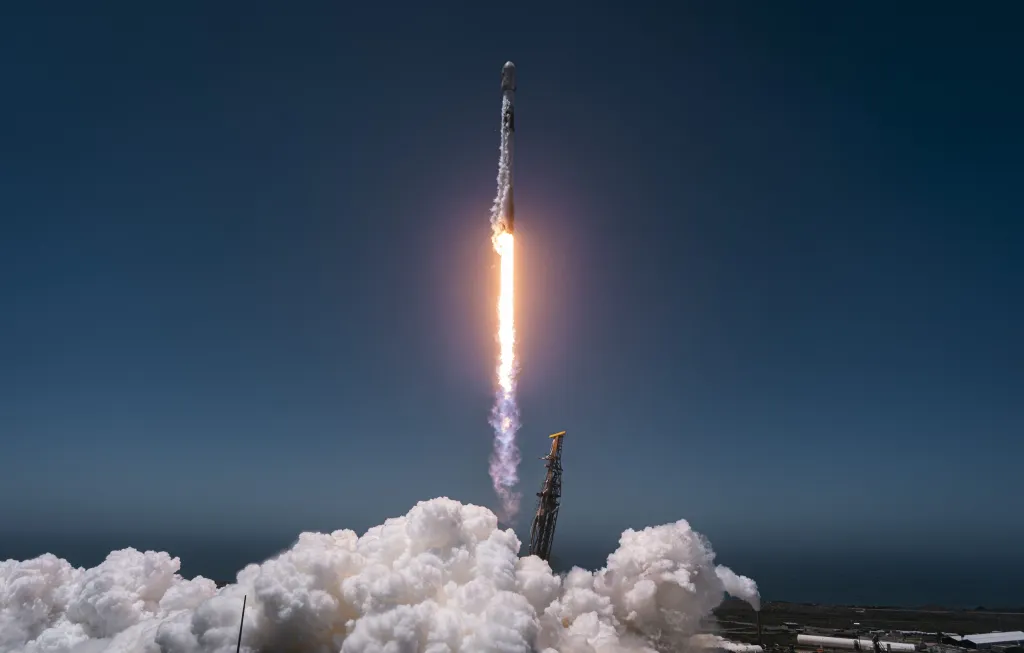
A SpaceX Falcon 9 launches the Space Development Agency’s third Tranche 1 data transport mission to low Earth orbit. Credit: SpaceX
WASHINGTON — The White House released a new space transportation policy Aug. 20 with an emphasis on enabling a sharp increase in the number of launches and reentries.
The National Space Transportation Policy, updated for the first time since 2013, sets a goal of being able to support at least 1,000 launches and reentries a year from U.S. facilities by 2030. In 2025, there were just under 200 launches by vehicles owned by U.S. entities.
“The United States must establish and maintain space transportation capabilities that ensure access to the full range of orbital regimes relevant to United States interests, from suborbital and very-low Earth orbit altitudes to the lunar surface, Lagrange points and deep space,” the policy states.
A major focus of the policy is on launch infrastructure rather than launch vehicles. It calls upon the Defense Department and NASA, which operate federal launch ranges, to “regularly consider and evaluate opportunities to improve launch and reentry infrastructure” and access to it, including co-development of launch infrastructure with the private sector.
The policy also opens the door for additional launch sites. It directs the Pentagon, NASA and Department of Transportation to work with state and local officials to identify “potential locations for additional launch facilities and targeted development or improvement of launch infrastructure.” The policy does not state whether these new facilities would be federal ranges or spaceports operated by others.
It also instructs the Pentagon and NASA, along with other agencies, to develop scheduling criteria for federal launch facilities in the next 180 days to maximize their use for both commercial and federal operations. That includes improving integration of launches into the National Airspace System and designating “priority airspace for critical space launch corridors.”
The policy also pushes for the development of reentry locations. It directs the Department of the Interior, working with other agencies, to identify federal lands in the next 90 days that could be used as an additional federal reentry site. Later milestones include development of reentry safety criteria for use of that new site and a development plan for the site that would allow commercial access to it.
A lack of reentry locations has been an issue for the space industry. After challenges using the Utah Test and Training Range for its first reentry mission, Varda Space Industries opted to use a commercial site in Australia for later missions. Other companies have also decided to use Australia or ocean recovery for reentry vehicles despite additional costs and logistical challenges.
//Other provisions
While launch and reentry infrastructure is the major element of the new policy, it includes other provisions focused on both government and commercial space transportation.
The policy directs the Office of Science and Technology Policy to coordinate a space transportation industrial base strategy within 180 days. That strategy has the goal of supporting a “vibrant, competitive and resilient space transportation industry” that meets the needs of the government and other users, with an emphasis on workforce development topics.
It calls for a review in 120 days, and every two years thereafter, of export policies and programs to support the U.S. launch industry. It also includes language to consider the use of U.S. launch facilities by foreign launch providers.
The new policy reiterates language of previous policies that directs the U.S. government to launch its payloads on U.S. vehicles with limited exceptions, such as international cooperative agreements where launches are provided on a no-exchange-of-funds basis.
It also directs the government to use commercial launch services where possible to meet its needs and for the Pentagon and NASA to coordinate purchases of launch services.
Among the more forward-looking provisions in the policy are those that direct NASA to expand commercial space transportation beyond Earth orbit, including “a lunar logistics architecture” for access to and from the surface of the moon and even “commercial architectures for sending humans to the surface of Mars and returning them to Earth.”
The Pentagon is directed to examine in-space transportation services, such as satellite servicing, and consider them when developing mission architectures. It also supports work on responsive space launch and “novel rapid, responsive and resilient launch architectures.”
The new space transportation policy builds upon other actions by the administration in space policy. A year ago, the White House issued an executive order on commercial space that called for “substantially increasing commercial space launch cadence” by 2030. That included language to amend and streamline launch regulations and support spaceport development.
In response to that order, the Federal Aviation Administration published a proposed rule July 30 that would exempt launch and spaceport licensing from 13 federal environmental laws and associated regulations. The comment period for the proposed rule is open through the end of August.
The Trump administration also published a national space policy in December that included sections on civil, commercial and national security space. It included a goal of “increasing launch and reentry cadence through new and upgraded facilities, improved efficiency and policy reform.”
_Related_

Jeff Foust
Jeff Foust writes about space policy, commercial space, and related topics for SpaceNews.
He earned a Ph.D. in planetary sciences from the Massachusetts Institute of Technology and a bachelor’s degree with honors in geophysics and planetary science... More by Jeff Foust
Sign in or register
Close
Continue with Google
Or
Enter the code sent to your email
Email address
Enter your password
Sign in by entering the code we sent to , or clicking the magic link in the email.
ContinueResend codeEmail me a one-time code instead Forgot password Go back
Continue Set a password (optional)
We'll send a verification code to %EMAIL%.
Send code
Skip for now
To continue reading this article:
Register now to get
2 more free articles this month.
You’ll also receive our weekly Editor’s Choice, SpaceNews This Week and Opinions newsletters. Opt-out at any time.
Sign up
Sign in to an existing account
Get unlimited access to SpaceNews.com, the SpaceNews app and our digital monthly magazine for less than $5 per week.
$250/year
Subscribe now
_Cancel anytime. Sales tax may apply. No refunds._ _Terms and conditions apply._
Link
Copy link
Digital All-Access Subscription (Monthly) $25.00 / monthDigital All-Access Subscription (Quarterly) $70.00 every 3 monthsDigital All-Access Subscription (Yearly) $250 / yearDigital All-Access Subscription (2 Years) $450 every 2 yearsPurchase
Sign in to an existing account Cancel