NEUTRINO SUBSURFACE DETECTION: ANTARCTIC ICE AS COSMIC SENSOR
Astrophysicists are utilizing the dense Antarctic ice sheet as a massive detector to capture ghost-like cosmic neutrinos, providing a unique window into high-energy celestial events.
# NEUTRINO SUBSURFACE DETECTION: ANTARCTIC ICE AS COSMIC SENSOR
According to NASA Breaking News, the pursuit of the universe's most elusive particles has led researchers to the deep Antarctic interior. Utilizing the IceCube Neutrino Observatory, scientists are currently leveraging the extreme clarity and density of the South Pole’s ice sheet to capture high-energy cosmic neutrinos—subatomic particles that rarely interact with matter.
The Detection Mechanism
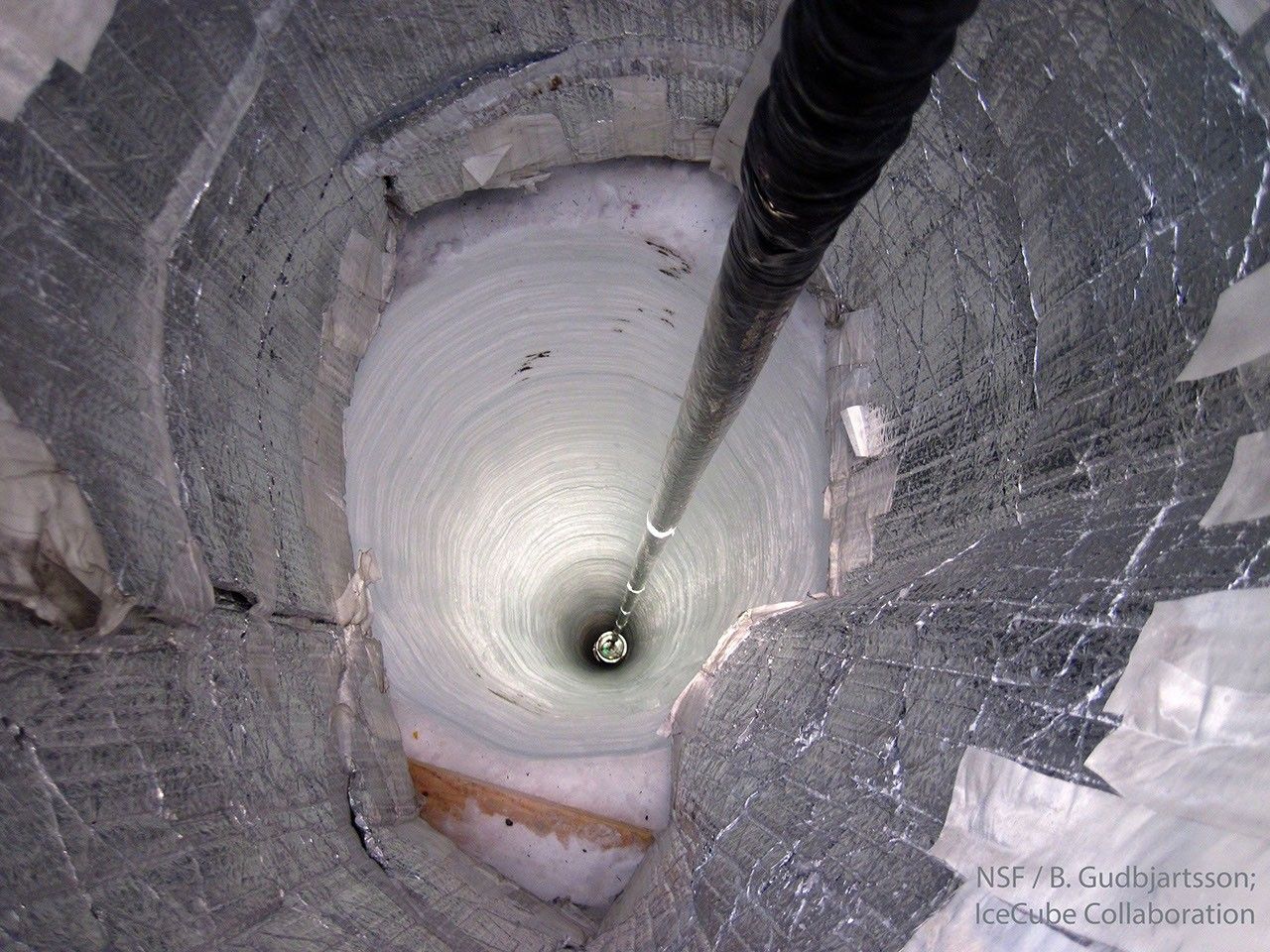
Detection occurs far below the surface, where thousands of optical sensors are suspended in holes drilled nearly 2.5 kilometers deep into the glacier. When a neutrino occasionally collides with an atomic nucleus in the ice, it generates a muon. This secondary particle travels faster than the speed of light in ice, producing a faint blue glow known as Cherenkov radiation.
Scientific Objectives
Unlike photons or charged particles, neutrinos travel in straight lines from their source, unaffected by magnetic fields or dense cosmic clouds. This makes them ideal messengers for mapping the most violent environments in the cosmos, including black hole accretion disks and supernova remnants. The current mission aims to pinpoint the origins of these high-energy particles, which have traveled billions of light-years to reach Earth.
Operational Status
The observatory remains operational, functioning as a silent telescope embedded in the planetary crust. By monitoring these "ghost particles," researchers are essentially using the Earth itself as a shield to filter out atmospheric noise, allowing for a clean signal from deep-space sources.