Nature study identifies a new way to spot nuclear weapons in orbit
NEW YORK — A study published last week in Nature Astronomy has proposed a new satellite design and technique to detect thermonuclear warheads in space. Funded in part by the […] The post Nature study identifies a new way to spot nuclear weapons in orbit appeared first on Sp

Home / Nature study identifies a new way to spot nuclear weapons in orbit
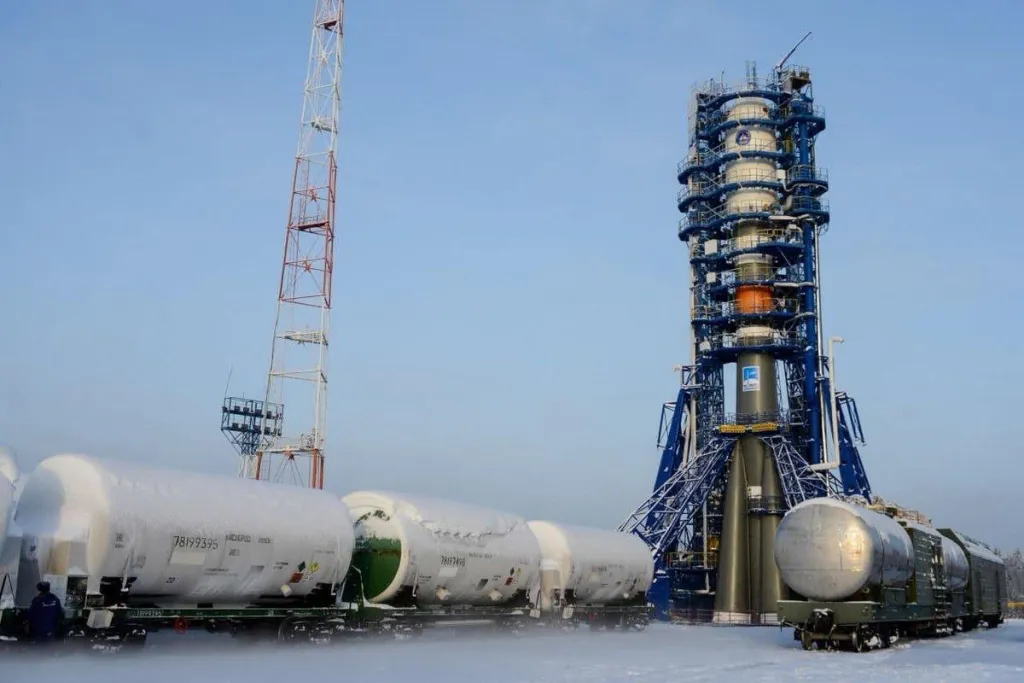
!Russia's Kosmos-2553 spacecraft, alleged to be part of a nuclear weapons program, prior to launch. Credit: Ministry of Defense of the Russian FederationRussia's Kosmos-2553 spacecraft, alleged to be part of a nuclear weapons program, prior to launch. Credit: Ministry of Defense of the Russian Federation
NEW YORK — A study published last week in _Nature Astronomy_ has proposed a new satellite design and technique to detect thermonuclear warheads in space. Funded in part by the United States National Nuclear Security Administration, it’s the first study proposing any technique for identifying orbital warheads in peer-reviewed literature.
Today’s satellites can’t detect nuclear weapons in orbit. This makes it hard to verify the 1967 Outer Space Treaty, which has been signed and ratified by 118 member states of the United Nations and forbids “nuclear weapons or other weapons of mass destruction in orbit.”
In 2024, U.S. intelligence officials alleged a Russian military radar satellite, Kosmos-2553, perched in a radiation-rich zone, was a testbed for developing a potential anti-satellite orbital nuclear weapon.
The new study, from Areg Danagoulian, a nuclear physicist and non-proliferation researcher at MIT, offers a verification mechanism to the treaty using radiation trapped in the earth’s inner magnetosphere to probe for fissionable material in warheads.
“It helps ground the conversation of technical nuclear weapon detection in space with starting-point parameters that describe the required orbital mechanics to make it all happen,” Thomas Gonzalez Roberts, an assistant professor of aerospace engineering and international affairs at Georgia Institute of Technology who was not involved in the study, told SpaceNews.
The radiation-rich zone is the inner Van Allen radiation belt, a region bounded by Earth’s magnetic field roughly 2,000 kilometers in the upper reaches of low Earth orbit. In the event of an attack, the belt would trap radiation from a detonation within its confines, damaging nearby satellites. At lower orbits, radiation has more avenues to escape, limiting destruction.
While Russia has denied developing such a weapon, Danagoulian studied means to spot one. Fissile material leaves a tell-tale signature through spallation, in which a nucleus breaks up and emits particles, including neutrons. Danagoilian noted the Van Allen belt is a rich source of the energetic protons that can trigger spallation in nearby fissile material.
In the study, Danagoulian simulated a 9U CubeSat inspecting satellite equipped with a neutron detector that could detect spallation on a flyby. His design sandwiches a plastic neutron scintillator between a single-crystal diamond detector, which detects the neutrons and vetoes false-positive signals from background noise.
With an improved signal-to-noise ratio, an inspecting satellite positioned 4 kilometers away from a warhead-bearing satellite of Kosmos-2553’s type (made of aluminium and hydrogenous materials), could confirm a thermonuclear signature within a week-long observation window. With about ten satellites, that window shrinks to 15 hours, and further to an hour at 1 kilometer.
While close in-orbit inspections have precedents and aren’t prohibited, they can be seen as escalatory and threatening to a country counterpart. “The concept is most compelling as part of a cooperative treaty verification regime,” Roberts said. “If both parties agree to the inspection, these proximity operations are achievable and politically much more acceptable than unilateral, uncoordinated inspections.”
However, the proposed technique ensures compliance only with satellites operating in the inner Van Allen belt. “It’s a solution for one orbital regime, but it’s not a one size fits all problem,” Isobel Porteous, a space policy expert with the Council for Strategic Risks, and head of business development at EarthTraq Corporation, said. (Porteous studied ways to detect nuclear weapons in space for her undergraduate thesis at Stanford, showing that it’s feasible to X-ray a warhead or detect for gamma rays.)
Angela Di Fulvio, a nuclear physicist in nuclear safety and non-proliferation and one of the study’s peer reviewers, proposed next steps. “It’s a simulation paper. Just like any simulation work, it would be great to validate it and verify it. And I’m looking forward to seeing that validation.”
Danagoulian hopes to do just that. “What I described in a paper is a feasibility study that shows that this is scientifically feasible, but it’s still from an engineering point of view, it’s a very difficult problem,” he said. “My hope is to collaborate with national labs to essentially create such a device, miniature device, test it, do a proof of concept.”
While nuclear weapons are a hot topic, so is the related question in policy circles whether it’s possible to discriminate between them and nuclear propulsion engines. “That’s going to be an important question,” Katherine Melbourne, a space policy analyst at The Aerospace Corporation, said.
The technique can discriminate between a reactor that’s online from a weapon, simply because the former exudes enormous heat, Danagoulian said. However, it can’t discriminate between an offline reactor. “We are currently working on closing that gap.”
_Related_
Karthik Vinod
Karthik Vinod is a freelance journalist with master’s degrees in astrophysics, science and technology studies, as well as journalism from Columbia. More by Karthik Vinod
Sign in or register
Close
Continue with Google
Or
Enter the code sent to your email
Email address
Enter your password
Sign in by entering the code we sent to , or clicking the magic link in the email.
ContinueResend codeEmail me a one-time code instead Forgot password Go back
Continue Set a password (optional)
We'll send a verification code to %EMAIL%.
Send code
Skip for now
To continue reading this article:
Register now to get
2 more free articles this month.
You’ll also receive our weekly Editor’s Choice, SpaceNews This Week and Opinions newsletters. Opt-out at any time.
Sign up
Sign in to an existing account
Get unlimited access to SpaceNews.com, the SpaceNews app and our digital monthly magazine for less than $5 per week.
$250/year
Subscribe now
_Cancel anytime. Sales tax may apply. No refunds._ _Terms and conditions apply._
Link
Copy link
Digital All-Access Subscription (Monthly) $25.00 / monthDigital All-Access Subscription (Quarterly) $70.00 every 3 monthsDigital All-Access Subscription (Yearly) $250 / yearDigital All-Access Subscription (2 Years) $450 every 2 yearsPurchase
Sign in to an existing account Cancel