NASA Welcomes Serbia as Newest Artemis Accords Signatory
The Republic of Serbia signed the Artemis Accords Thursday during a ceremony hosted by NASA at the agency’s Headquarters in Washington, becoming the 69th nation to join a large community of like-minded nations committed to the peaceful, transparent, and responsible exploration of
Search
Suggested Searches
- Climate Change
- Artemis
- Expedition 64
- Mars perseverance
- SpaceX Crew-2
- International Space Station
- View All Topics A-Z
- Home
- Missions
- Humans in Space
- Earth
- The Solar System
- The Universe
- Science
- Aeronautics
- Technology
- Learning Resources
- About NASA
- Español
Featured
  
Back
- Search All NASA Missions
- A to Z List of Missions
- Upcoming Launches and Landings
- Spaceships and Rockets
- Communicating with Missions
- Artemis
- James Webb Space Telescope
- Hubble Space Telescope
- International Space Station
- OSIRIS-Rex
- Explore Earth Science
- Climate Change
- Earth, Our Planet
- Earth Science in Action
- Earth Multimedia
- Earth Data
- Earth Science Researchers
- The Sun
- Mercury
- Venus
- Earth
- The Moon
- Mars
- Jupiter
- Saturn
- Uranus
- Neptune
- Pluto & Dwarf Planets
- Asteroids, Comets & Meteors
- The Kuiper Belt
- The Oort Cloud
- Skywatching
- Exoplanets
- The Search for Life in the Universe
- Stars
- Galaxies
- Black Holes
- The Big Bang
- Dark Energy
- Dark Matter
- Earth Science
- Planetary Science
- Astrophysics & Space Science
- The Sun & Heliophysics
- Biological & Physical Sciences
- Lunar Science
- Citizen Science
- Astromaterials
- Aeronautics Research
- Human Space Travel Research
- Science in the Air
- NASA Aircraft
- Flight Research Innovation
- Supersonic Flight
- Air Traffic Solutions
- Green Aviation Tech
- Drones & You
- Technology Transfer & Spinoffs
- Space Travel
- Living in Space
- Lunar Surface Technology
- Manufacturing and Materials
- Robotics
- Science Instruments
- Computing
- For Kids and Students
- For Educators
- For Colleges and Universities
- For Professionals
- Science for Everyone
- Requests for Exhibits, Artifacts, Speakers & Flyovers
- STEM Engagement at NASA
- NASA's Impacts
- Centers and Facilities
- Directorates
- Organizations
- People of NASA
- Careers
- Internships
- Our History
- Doing Business with NASA
- Get Involved
- Contact
- News Releases
- Recently Published
- Video Series on NASA+
- Podcasts & Audio
- Blogs
- Newsletters
- Social Media
- Media Resources
- Events
- Upcoming Launches & Landings
- Virtual Guest Program
- NASA+
- Images
- NASA Live
- NASA Apps
- Podcasts
- Image of the Day
- e-Books
- 3D Resources
- Interactives
- STEM Multimedia
- NASA Brand & Usage Guidelines
Featured
  
Highlights
  
Highlights
  
Highlights
  
Featured
  
Highlights
  
Highlights
  
Highlights
  
Featured

Featured
  
Highlights
  
4 min read
# NASA Welcomes Serbia as Newest Artemis Accords Signatory
!The headshot image of Lauren E. Low
Lauren E. Low
Jul 16, 2026
Article
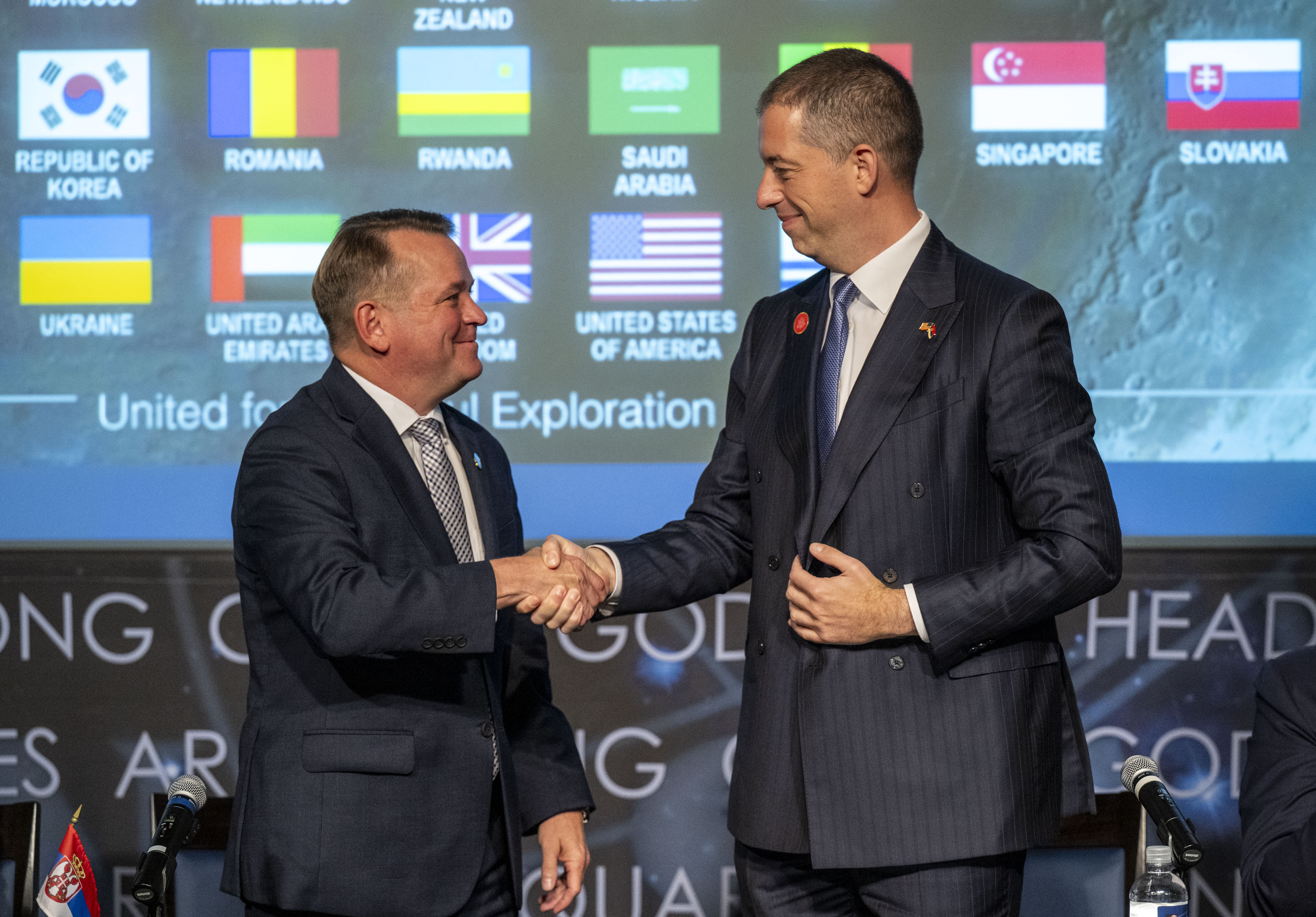
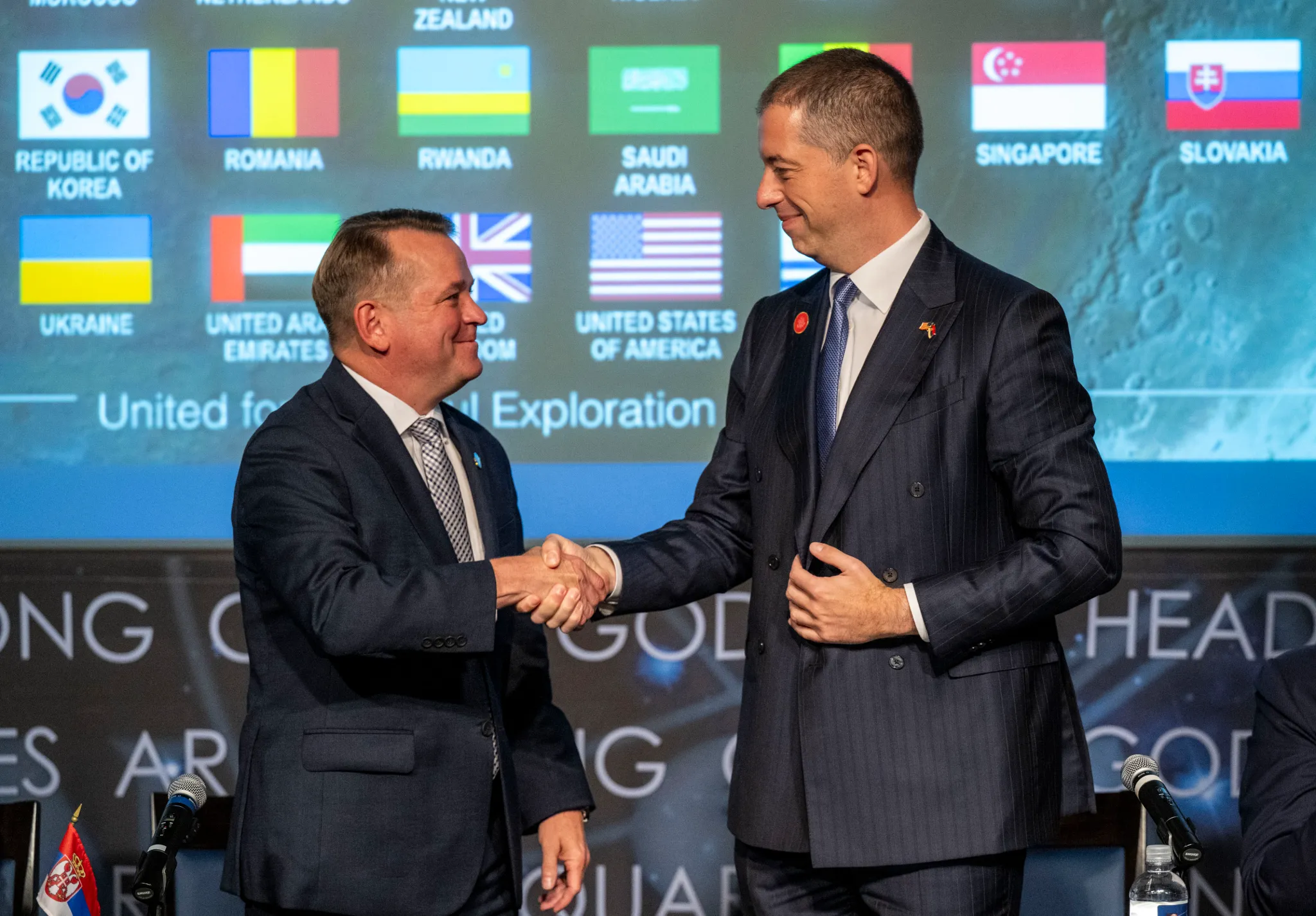
Serbia’s Minister of Foreign Affairs Marko Đurić, right, shakes hands with NASA Deputy Administrator Matt Anderson, left, after signing the Artemis Accords Thursday, July 16, at NASA Headquarters in Washington.
NASA/Keegan Barber
The Republic of Serbia signed the Artemis Accords Thursday during a ceremony hosted by NASA at the agency’s Headquarters in Washington, becoming the 69th nation to join a large community of like-minded nations committed to the peaceful, transparent, and responsible exploration of space.
“Serbia’s connection to NASA reaches back to the Apollo program, when the work of Serbian engineers helped make some of humanity’s greatest achievements in space possible,” said NASA Deputy Administrator Matt Anderson. “Among them was Milojko ‘Mike’ Vučelić, who was awarded the Presidential Medal of Freedom for the critical role he played in bringing the Apollo 13 crew safely home. Their story stands as a reminder that the greatest achievements in space are made possible by talented people working together.”
The broader team of Serbian American engineers played key roles during the Apollo era across systems engineering, propulsion, power systems, spacecraft docking, electronics reliability, and mission coordination. Their expertise supported critical functions ranging from lunar landing analysis to safe spacecraft docking.
Serbia’s Minister of Foreign Affairs Marko Đurić signed the Artemis Accords on behalf of the country.
“The great beyond has always inspired humanity to achieve its greatest feats — from the Roman ‘per aspera ad astra’ to Norman Vincent Peale’s belief that if we aim for the Moon, we will at least land among the stars,” said Đurić. “Those words feel especially fitting today. We come from a nation of great minds like Nikola Tesla and Milutin Milanković, but also from the legacy of David Vujic, one of the pioneers of the Apollo missions and a member of the ‘Serbian Seven,’ a group of engineers and technicians whose contributions to NASA helped make the Moon landing possible. In that spirit, we owe it to both our brave ancestors and our children to keep pushing toward new frontiers — to explore, to inspire one another, and to dare even greater things.”
By signing the Artemis Accords, nations open the door to opportunities for future lunar exploration with NASA, such as providing science and technology payloads for the U.S.-led Moon Base and CubeSats for upcoming Artemis missions, advancing humanity’s return to the Moon, and shaping the Golden Age of space exploration and innovation.
Ambassador of the Republic of Serbia to the United States Dragan Šutanovac; State Secretary for Serbia’s Ministry of Science, Technological Development and Innovation Marija Gnjatović; and U.S. Department of State Assistant Secretary for Oceans and International Environmental and Scientific Affairs Wesley Brooks all participated in Serbia’s signing ceremony.
In 2020, NASA and the Department of State joined with seven other founding nations to establish the Artemis Accords, responding to the growing interest in lunar activities by both governments and private companies. They introduced the first set of practical principles aimed at enhancing the safety and coordination between nations as they explore the Moon, Mars, and beyond, committing nations to:
- explore peaceably and transparently
- render aid to those in need
- enable access to scientific data
- ensure activities do not interfere with those of others
- preserve historically significant sites and artifacts by developing best practices
Five years later, President Donald J. Trump’s National Space Policy directed NASA to establish a sustained lunar outpost. With this Moon Base, NASA is putting the principles of the Artemis Accords into practice, inviting every signatory to take part in the endeavor.
More countries are expected to sign the Artemis Accords in the months and years ahead, as NASA continues its work to establish a safe, peaceful, and prosperous future in space.
Learn more about the Artemis Accords at:
https://www.nasa.gov/artemis-accords
Share
Details
Last Updated
Jul 16, 2026
Location
Related Terms
Was this page helpful?
Δ
Was this page helpful?
Yes
No
×
Notifications