NASA Tests New Refuel Device for Future In-Space Refueling Missions
For NASA’s next generation of deep space exploration missions, spacecraft may need to refuel in Earth orbit before pushing farther into the solar system. Similar to how a gas pump needs a nozzle to fit your fuel tank, future spacecraft could require a special device in order to f
Search
Suggested Searches
- Climate Change
- Artemis
- Expedition 64
- Mars perseverance
- SpaceX Crew-2
- International Space Station
- View All Topics A-Z
- Home
- Missions
- Humans in Space
- Earth
- The Solar System
- The Universe
- Science
- Aeronautics
- Technology
- Learning Resources
- About NASA
- Español
Featured
  
Back
- Search All NASA Missions
- A to Z List of Missions
- Upcoming Launches and Landings
- Spaceships and Rockets
- Communicating with Missions
- Artemis
- James Webb Space Telescope
- Hubble Space Telescope
- International Space Station
- OSIRIS-Rex
- Explore Earth Science
- Climate Change
- Earth, Our Planet
- Earth Science in Action
- Earth Multimedia
- Earth Data
- Earth Science Researchers
- The Sun
- Mercury
- Venus
- Earth
- The Moon
- Mars
- Jupiter
- Saturn
- Uranus
- Neptune
- Pluto & Dwarf Planets
- Asteroids, Comets & Meteors
- The Kuiper Belt
- The Oort Cloud
- Skywatching
- Exoplanets
- The Search for Life in the Universe
- Stars
- Galaxies
- Black Holes
- The Big Bang
- Dark Energy
- Dark Matter
- Earth Science
- Planetary Science
- Astrophysics & Space Science
- The Sun & Heliophysics
- Biological & Physical Sciences
- Lunar Science
- Citizen Science
- Astromaterials
- Aeronautics Research
- Human Space Travel Research
- Science in the Air
- NASA Aircraft
- Flight Research Innovation
- Supersonic Flight
- Air Traffic Solutions
- Green Aviation Tech
- Drones & You
- Technology Transfer & Spinoffs
- Space Travel
- Living in Space
- Lunar Surface Technology
- Manufacturing and Materials
- Robotics
- Science Instruments
- Computing
- For Kids and Students
- For Educators
- For Colleges and Universities
- For Professionals
- Science for Everyone
- Requests for Exhibits, Artifacts, Speakers & Flyovers
- STEM Engagement at NASA
- NASA's Impacts
- Centers and Facilities
- Directorates
- Organizations
- People of NASA
- Careers
- Internships
- Our History
- Doing Business with NASA
- Get Involved
- Contact
- News Releases
- Recently Published
- Video Series on NASA+
- Podcasts & Audio
- Blogs
- Newsletters
- Social Media
- Media Resources
- Events
- Upcoming Launches & Landings
- Virtual Guest Program
- NASA+
- Images
- NASA Live
- NASA Apps
- Podcasts
- Image of the Day
- e-Books
- 3D Resources
- Interactives
- STEM Multimedia
- NASA Brand & Usage Guidelines
Featured
  
Highlights
  
Highlights
  
Highlights
  
Featured
  
Highlights
  
Highlights
  
Highlights
  
Featured

Featured
  
Highlights
  
3 min read
# NASA Tests New Refuel Device for Future In-Space Refueling Missions
Daniel Boyette
Communications Specialist
Jun 26, 2026
Article
To view this video please enable JavaScript, and consider upgrading to a web browser that
Video Player is loading.
Play Video
PlaySkip BackwardSkip Forward
Mute
Current Time 0:00
/
Duration -:-
Loaded: 0%
Stream Type LIVE
Seek to live, currently behind liveLIVE
Remaining Time --:-
1x
Playback Rate
Chapters
- Chapters
Descriptions
- descriptions off, selected
Captions
- captions settings, opens captions settings dialog
- captions off, selected
Audio Track
Picture-in-PictureFullscreen
This is a modal window.
The media could not be loaded, either because the server or network failed or because the format is not supported.
Beginning of dialog window. Escape will cancel and close the window.
TextColorWhiteBlackRedGreenBlueYellowMagentaCyanOpacityOpaqueSemi-TransparentText BackgroundColorBlackWhiteRedGreenBlueYellowMagentaCyanOpacityOpaqueSemi-TransparentTransparentCaption Area BackgroundColorBlackWhiteRedGreenBlueYellowMagentaCyanOpacityTransparentSemi-TransparentOpaque
Font Size50%75%100%125%150%175%200%300%400%Text Edge StyleNoneRaisedDepressedUniformDrop shadowFont FamilyProportional Sans-SerifMonospace Sans-SerifProportional SerifMonospace SerifCasualScriptSmall Caps
ResetDone
Close Modal Dialog
End of dialog window.
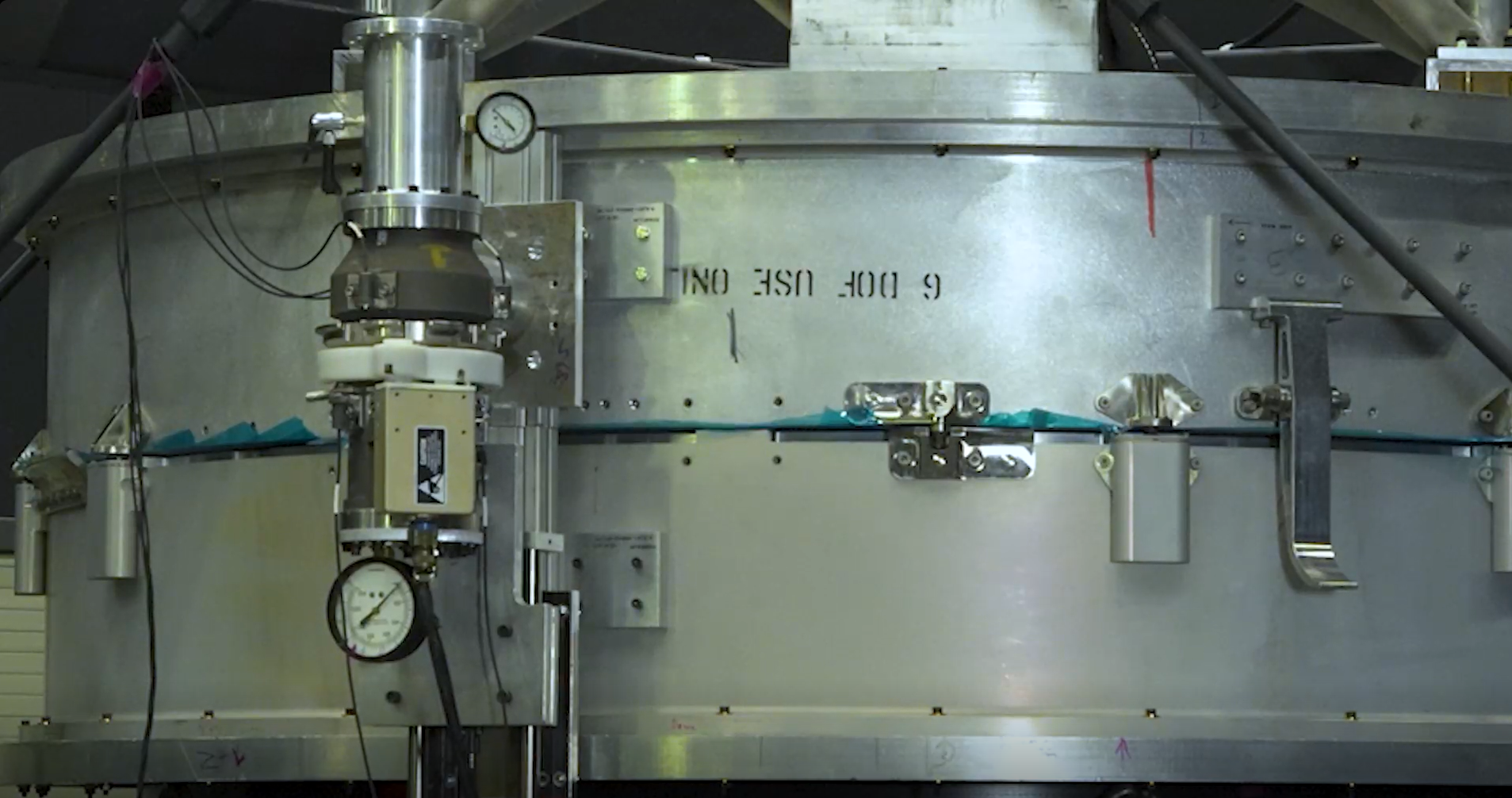
Engineers from NASA’s Marshall Space Flight Center in Huntsville, Alabama, and L3Harris con-duct operational testing on a developmental cryocoupler, a vital technology for future in-orbit spacecraft refueling.
NASA/Tyson Eason
For NASA’s next generation of deep space exploration missions, spacecraft may need to refuel in Earth orbit before pushing farther into the solar system. Similar to how a gas pump needs a nozzle to fit your fuel tank, future spacecraft could require a special device in order to fill up prior to departure, known as a cryocoupler.
Cryocouplers would allow spacecraft to connect to future orbital propellant depots, which would serve as the gas stations of space. The technology comes with the challenge of reliably transferring cryogenic, or super-cold, fluids without losing propellant or performance. Cryogenic propellants like liquid hydrogen and liquid oxygen must stay chilled to hundreds of degrees below zero Fahrenheit, placing strict demands on the materials, seals, and mechanisms that move them.
“In-orbit cryogenic refueling between two spacecraft has yet to be done and remains one of the toughest engineering challenges in spaceflight,” said Travis Belcher, cryocoupler project manager at NASA’s Marshall Space Flight Center in Huntsville, Alabama. “These propellant transfers are essential for the kinds of missions NASA wants to fly in the future, so developing a coupler that can handle ultra-cold propellants is a critical step toward making that capability real.”
Ground-based couplers like those used to fill the SLS (Space Launch System) for Artemis missions are not an option for orbiting propellant transfers. Those couplers release quickly while a rocket is launching and must be manually reconnected for the next flight. They also are not designed to operate in the harsh environment of space and are much larger than what would be used to refill an orbiting spacecraft’s fuel tank.
To meet these challenges, NASA tested a cryocoupler developed by L3Harris.
“The cryocouplers we’re working on can attach and detach multiple times and are fully automated, so astronauts won’t have to perform a spacewalk to transfer propellant,” said Belcher. “They’re rigorously designed to withstand space and sized for the expected tank designs.”
A joint NASA and L3Harris team recently conducted two types of tests at NASA Marshall. To ensure the cryocoupler can handle the extremely cold temperatures it will be exposed to, they ran liquid nitrogen at minus 321 degrees Fahrenheit through multiple connected and disconnected configurations to observe how the coupler reacts to thermal contraction, flow, and significant temperature differences between propellant and materials.
The team also put the cryocoupler through operational tests to determine its performance limits. In this setup, one coupler half was mounted to a robotic table that could move and rotate in any direction, allowing it to simulate misaligned docking with the other half, which remained stationary above the table. The cryocoupler is designed to accommodate some misalignment in case a spacecraft and depot are not perfectly aligned when docking.
“These cryocouplers are very early in development, so the testing is mostly focused on basic functionality,” said Belcher. “Future test campaigns will design them for specific missions and assess them more meticulously based on that mission’s requirements.”
The cryocoupler testing was done as part of a 2022 Announcement of Collaboration Opportunity, a partnership where NASA centers provide select companies with expertise, facilities, hardware, and software at no cost.
The Cryogenic Fluid Management Portfolio project, a cross-agency team based at NASA Marshall and NASA’s Glenn Research Center in Cleveland, oversees cryocoupler development.
To learn more about cryogenic fluid management, visit:
Share
Details
Last Updated
Jun 26, 2026
Editor
Lee Mohon
Contact
Joel Wallace
Location
Related Terms
- Cryogenic Fluid Management (CFM)
- Marshall Space Flight Center
- Missions
- Space Technology Mission Directorate
- Technology Demonstration
- Technology Demonstration Missions Program
Explore More


Keep Exploring
Discover More Topics From NASA
Cryogenic Fluid Management (CFM)\\
\\
 Technology Demonstration Missions (TDM)\\
\\
 Space Technology Mission Directorate\\
\\
 Space Nuclear Propulsion\\
\\

Was this page helpful?
Δ
Was this page helpful?
Yes
No
×
Notifications