NASA selects successor to CAPSTONE lunar mission
NASA has selected Advanced Space to fly a successor to a cislunar smallsat mission that will test rendezvous and proximity operations around the moon. The post NASA selects successor to CAPSTONE lunar mission appeared first on SpaceNews.
brand-new-space-spacenews-970x250
Home / NASA selects successor to CAPSTONE lunar mission
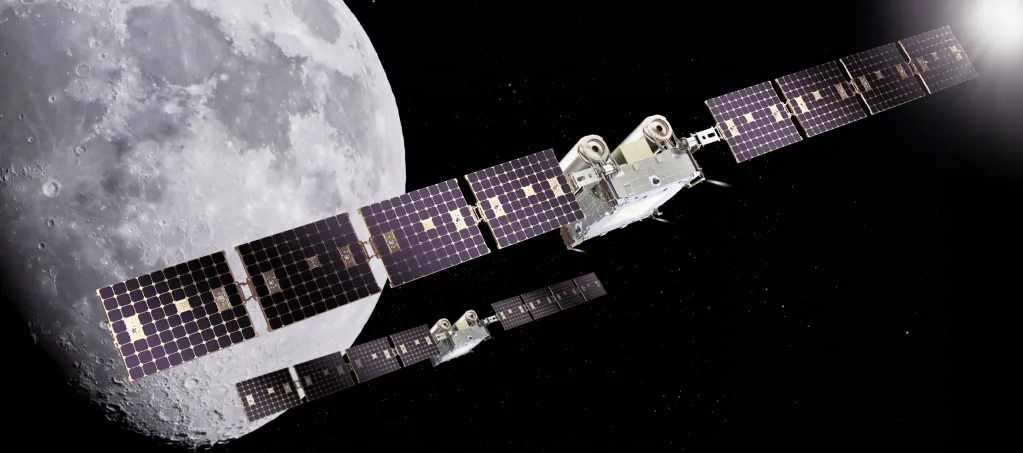
!CAPSTONE 02CAPSTONE 02 will use twin 400-kilogrma spacecraft to test rendezvous and proximity operations in cislunar space. Credit: Terran Orbital
WASHINGTON — NASA has selected Advanced Space to fly a successor to a cislunar smallsat mission that will test rendezvous and proximity operations around the moon.
NASA announced July 24 it awarded a contract to Advanced Space for the CAPSTONE 02 mission, a pair of small satellites planned to launch in 2027.
The twin 400-kilogram satellites, built by Lockheed Martin subsidiary Terran Orbital, will operate in cislunar space. The spacecraft will test the ability to operate in proximity to one another under the influence of both terrestrial and lunar gravity, while also performing navigation and communications demonstrations and measuring the radiation environment around the moon.
The two spacecraft will perform rendezvous and proximity operations, or RPO, with the spacecraft switching between the target and the chaser. The spacecraft will carry an advanced imager from Lawrence Livermore National Laboratory that will be used for those RPO tests as well as for imaging the moon.
Both NASA and Advanced Space billed CAPSTONE 02 as a risk-reduction activity ahead of Artemis missions that will require the Orion spacecraft to dock with landers in lunar orbit.
“With CAPSTONE 02, we are taking the next step toward routine, resilient operations in cislunar space,” Brad Cheetham, president and chief executive of Advanced Space, said in a statement.
“By maturing autonomous rendezvous and proximity operations in this complex environment, we are directly enabling the future of lunar exploration, development, and long-term presence,” he said. “CAPSTONE 02 can reduce risk for Moon Base, Artemis and every lunar mission that follows.”
“Achieving our most ambitious space exploration goals requires iterative, risk-tolerant demonstrations in partnership with industry,” said Christopher Baker, lead for the in-space infrastructure portfolio in NASA’s Research and Technology Mission Directorate, in an agency statement. “Technology development through flight testing is how we convert hard problems into the lasting capabilities needed for a permanent presence at the moon.”
CAPSTONE 02 is a follow-on to the original CAPSTONE, or Cislunar Autonomous Positioning System Technology Operations and Navigation Experiment, mission. That used a single cubesat-class spacecraft, built by Terran Orbital for Advanced Space, that tested operations in a near-rectilinear halo orbit around the moon that NASA had planned to use for the lunar Gateway.
CAPSTONE launched on a Rocket Lab Electron in 2022. NASA concluded a series of extended missions for the spacecraft in June, testing autonomous navigation technologies and delay-tolerant networking.
“CAPSTONE demonstrated what is possible in cislunar operations with small-satellite technology and rapid mission timelines,” said Alec Forsman, chief engineer for CAPSTONE 02 at Advanced Space, in a statement. “The CAPSTONE 02 mission will push that envelope even further by demonstrating RPO in a three-body orbit, enabling demonstration of cislunar communications architectures and proving autonomy capabilities that future lunar missions will depend on.”
Neither NASA nor Advanced Space disclosed the value of the contract for the CAPSTONE 02 mission. The agency provided few details about CAPSTONE 02 before the contract announcement. House appropriators, in a report accompanying a fiscal year 2027 spending bill in May, directed NASA to spend at least $20 million, and up to $60 million, on CAPSTONE 02 in 2027.
_Related_

Jeff Foust
Jeff Foust writes about space policy, commercial space, and related topics for SpaceNews.
He earned a Ph.D. in planetary sciences from the Massachusetts Institute of Technology and a bachelor’s degree with honors in geophysics and planetary science... More by Jeff Foust
Sign in or register
Close
Continue with Google
Or
Enter the code sent to your email
Email address
Enter your password
Sign in by entering the code we sent to , or clicking the magic link in the email.
ContinueResend codeEmail me a one-time code instead Forgot password Go back
Continue Set a password (optional)
We'll send a verification code to %EMAIL%.
Send code
Skip for now
To continue reading this article:
Register now to get
2 more free articles this month.
You’ll also receive our weekly Editor’s Choice, SpaceNews This Week and Opinions newsletters. Opt-out at any time.
Sign up
Sign in to an existing account
Get unlimited access to SpaceNews.com, the SpaceNews app and our digital monthly magazine for less than $5 per week.
$250/year
Subscribe now
_Cancel anytime. Sales tax may apply. No refunds._ _Terms and conditions apply._
Link
Copy link
Digital All-Access Subscription (Monthly) $25.00 / monthDigital All-Access Subscription (Quarterly) $70.00 every 3 monthsDigital All-Access Subscription (Yearly) $250 / yearDigital All-Access Subscription (2 Years) $450 every 2 yearsPurchase
Sign in to an existing account Cancel