NASA Seeks Industry Input to Accelerate Lunar Surface Technologies
Long-term lunar exploration requires technology, infrastructure, and operations that function together cohesively on the surface of the Moon. To accelerate the development of key lunar surface systems and reduce risk, NASA and industry must work together in the design, developmen
Search
Suggested Searches
- Climate Change
- Artemis
- Expedition 64
- Mars perseverance
- SpaceX Crew-2
- International Space Station
- View All Topics A-Z
- Home
- Missions
- Humans in Space
- Earth
- The Solar System
- The Universe
- Science
- Aeronautics
- Technology
- Learning Resources
- About NASA
- Español
Featured
  
Back
- Search All NASA Missions
- A to Z List of Missions
- Upcoming Launches and Landings
- Spaceships and Rockets
- Communicating with Missions
- Artemis
- James Webb Space Telescope
- Hubble Space Telescope
- International Space Station
- OSIRIS-Rex
- Explore Earth Science
- Climate Change
- Earth, Our Planet
- Earth Science in Action
- Earth Multimedia
- Earth Data
- Earth Science Researchers
- The Sun
- Mercury
- Venus
- Earth
- The Moon
- Mars
- Jupiter
- Saturn
- Uranus
- Neptune
- Pluto & Dwarf Planets
- Asteroids, Comets & Meteors
- The Kuiper Belt
- The Oort Cloud
- Skywatching
- Exoplanets
- The Search for Life in the Universe
- Stars
- Galaxies
- Black Holes
- The Big Bang
- Dark Energy
- Dark Matter
- Earth Science
- Planetary Science
- Astrophysics & Space Science
- The Sun & Heliophysics
- Biological & Physical Sciences
- Lunar Science
- Citizen Science
- Astromaterials
- Aeronautics Research
- Human Space Travel Research
- Science in the Air
- NASA Aircraft
- Flight Research Innovation
- Supersonic Flight
- Air Traffic Solutions
- Green Aviation Tech
- Drones & You
- Technology Transfer & Spinoffs
- Space Travel
- Living in Space
- Lunar Surface Technology
- Manufacturing and Materials
- Robotics
- Science Instruments
- Computing
- For Kids and Students
- For Educators
- For Colleges and Universities
- For Professionals
- Science for Everyone
- Requests for Exhibits, Artifacts, Speakers & Flyovers
- STEM Engagement at NASA
- NASA's Impacts
- Centers and Facilities
- Directorates
- Organizations
- People of NASA
- Careers
- Internships
- Our History
- Doing Business with NASA
- Get Involved
- Contact
- News Releases
- Recently Published
- Video Series on NASA+
- Podcasts & Audio
- Blogs
- Newsletters
- Social Media
- Media Resources
- Events
- Upcoming Launches & Landings
- Virtual Guest Program
- NASA+
- Images
- NASA Live
- NASA Apps
- Podcasts
- Image of the Day
- e-Books
- 3D Resources
- Interactives
- STEM Multimedia
- NASA Brand & Usage Guidelines
Featured
  
Highlights
  
Highlights
  
Highlights
  
Featured
  
Highlights
  
Highlights
  
Highlights
  
Featured

Featured
  
Highlights
  
3 min read
# NASA Seeks Industry Input to Accelerate Lunar Surface Technologies
!The headshot image of Loura Hall
Loura Hall
Jun 29, 2026
Article
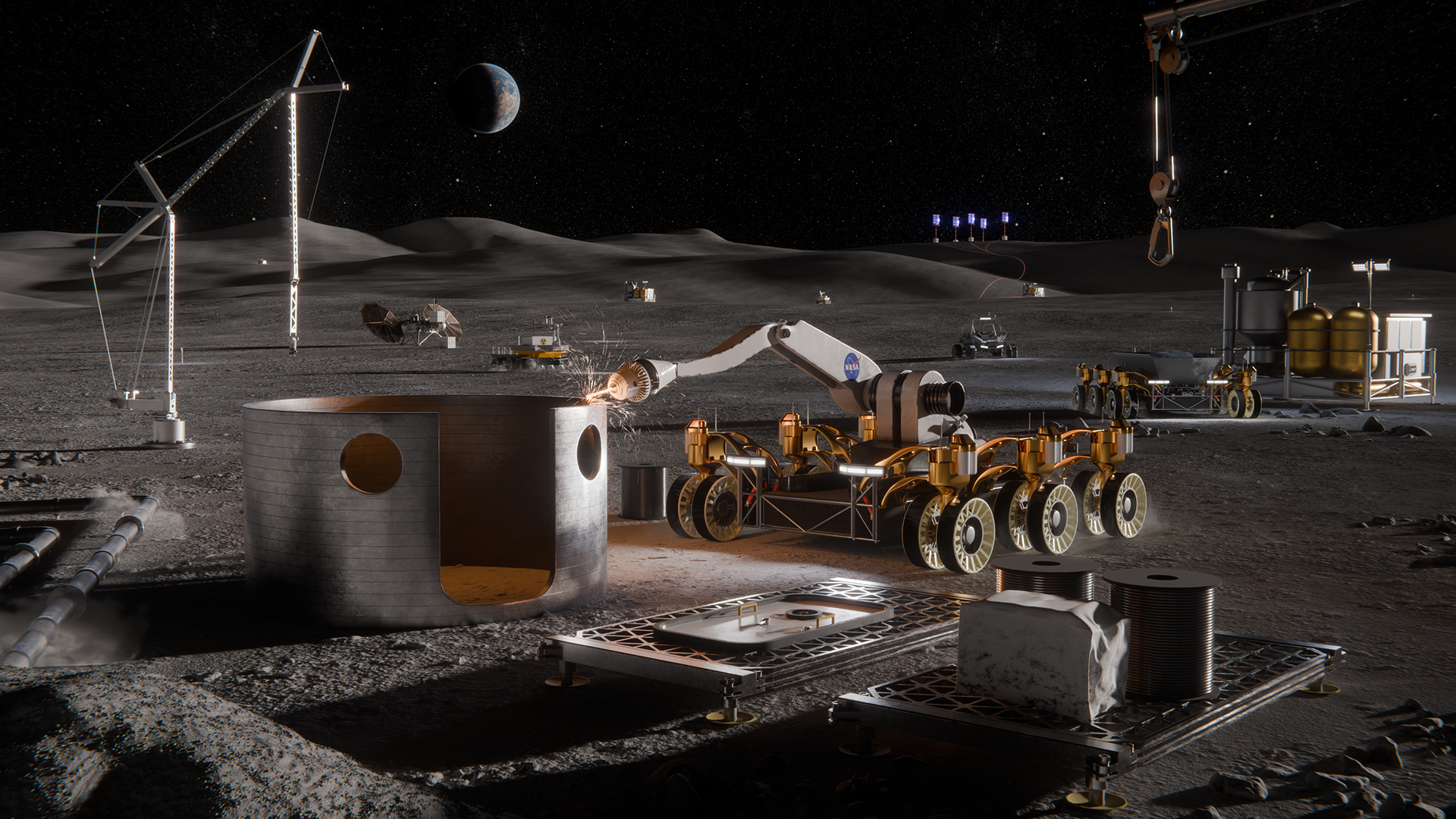
Artistic concept of lunar surface technologies and infrastructure capabilities, including in-situ resource utilization oxygen production systems, surface power systems, in‑space manufacturing tools, and advanced nanomaterials production.
NASA
Long-term lunar exploration requires technology, infrastructure, and operations that function together cohesively on the surface of the Moon. To accelerate the development of key lunar surface systems and reduce risk, NASA and industry must work together in the design, development, testing, and evaluation of innovative solutions that support U.S. space priorities.
NASA is seeking feedback on a draft solicitation for the Lunar Enabling Infrastructure Accelerator, an effort to help develop emerging capabilities in surface power, in-situ resource utilization, advanced manufacturing, and innovative nanomaterials. The draft is available for review by U.S. organizations, including industry, educational institutions, and non-profits.
Investments in space technology development unlock the near-impossible for NASA and the nation. A sustained human presence at the Moon requires breakthrough ideas from a competitive U.S industrial base, and we are proud to work toward that vision with our commercial partners.
Greg Stover
Director of the Advanced Research and Technology Division, Research and Technology Mission Directorate at NASA Headquarters in Washington
This review period allows NASA an opportunity to gather feedback on the draft solicitation, including the requirements, schedules, proposal instructions, and evaluation approaches. NASA strongly encourages industry to carefully review the draft and identify any areas of ambiguity, or concerns. Industry input will help inform the solicitation’s final requirements, acquisition planning, and solicitation parameters.
The Lunar Enabling Infrastructure Accelerator includes five topics that address gaps in technology needed for exploring the Moon and the cislunar region between Earth and the Moon as identified in NASA’s Civil Space Shortfalls. The topics focus on near-term mission priorities:
Surface power: Access to continuous, localized, and scalable power generation throughout the lunar day and night is essential for initial phases of the Moon Base plan. NASA’s needs include power generation, power management and distribution, and energy storage.
Radioisotope power: A type of nuclear energy technology that uses heat to produce electric power for operating spacecraft systems in the darkest, dustiest, and most remote places in our solar system.
In-situ resource utilization: As a sustained presence grows at the Moon, opportunities to harvest lunar resources could lead to safer, more efficient operations with less dependence on Earth. Advancing in-situ resource utilization technologies could support production of fuel, water, and oxygen from local materials, expanding exploration capabilities.
In-space advanced manufacturing: Long-term human presence beyond Earth orbit requires autonomous in-space production of essential tools and materials. Advancing in-space manufacturing will be critical to reducing reliance on Earth resupply, as well as optimizing mission flexibility and resilience at the Moon, Mars, and elsewhere in deep space.
Innovative nanomaterials: U.S. objectives related to the commercialization of low Earth orbit, building a sustained presence on the lunar surface, and pursuing deeper space exploration will involve work in demanding operational environments and under stringent mission constraints. To meet the agency’s most ambitious space exploration goals, this topic seeks to advance the commercial availability, performance, quality, and uniformity of nanomaterials to address environmental, mass, and performance challenges.
Lunar Enabling Infrastructure Accelerator awardees will be expected to design, develop, and demonstrate prototype systems and generate validated performance data, analytical models, and operational insights through testing and demonstration activities to mature technology and manufacturing applications.
The solicitation, Next Space Technologies for Exploration Partnerships-3 (NextSTEP-3) Appendix A Lunar Enabling Infrastructure Accelerator (Solicitation No: 80GRC026R0008), is available on SAM.gov and is open for comment through July 17, 2026.
For more information about NASA’s space technology website as a reference for current technology strategy and priorities, visit:
https://www.nasa.gov/resources/
Facebook logo
Share
Details
Last Updated
Jun 29, 2026
Editor
Loura Hall
Related Terms
Explore More


Was this page helpful?
Δ
Was this page helpful?
Yes
No
×
Notifications