NASA’s Newest Wind Tunnel Builds on Legacy of Innovation
For more than 100 years, wind tunnels at NASA’s Langley Research Center in Hampton, Virginia, have helped shape the future of flight.   Now, two of NASA’s longest-serving facilities — the 12-Foot Low-Speed Tunnel and the 20-Foot Vertical Spin Tunnel — will pass the torch to
Search
Suggested Searches
- Climate Change
- Artemis
- Expedition 64
- Mars perseverance
- SpaceX Crew-2
- International Space Station
- View All Topics A-Z
- Home
- Missions
- Humans in Space
- Earth
- The Solar System
- The Universe
- Science
- Aeronautics
- Technology
- Learning Resources
- About NASA
- Español
Featured
  
Back
- Search All NASA Missions
- A to Z List of Missions
- Upcoming Launches and Landings
- Spaceships and Rockets
- Communicating with Missions
- Artemis
- James Webb Space Telescope
- Hubble Space Telescope
- International Space Station
- OSIRIS-Rex
- Explore Earth Science
- Climate Change
- Earth, Our Planet
- Earth Science in Action
- Earth Multimedia
- Earth Data
- Earth Science Researchers
- The Sun
- Mercury
- Venus
- Earth
- The Moon
- Mars
- Jupiter
- Saturn
- Uranus
- Neptune
- Pluto & Dwarf Planets
- Asteroids, Comets & Meteors
- The Kuiper Belt
- The Oort Cloud
- Skywatching
- Exoplanets
- The Search for Life in the Universe
- Stars
- Galaxies
- Black Holes
- The Big Bang
- Dark Energy
- Dark Matter
- Earth Science
- Planetary Science
- Astrophysics & Space Science
- The Sun & Heliophysics
- Biological & Physical Sciences
- Lunar Science
- Citizen Science
- Astromaterials
- Aeronautics Research
- Human Space Travel Research
- Science in the Air
- NASA Aircraft
- Flight Research Innovation
- Supersonic Flight
- Air Traffic Solutions
- Green Aviation Tech
- Drones & You
- Technology Transfer & Spinoffs
- Space Travel
- Living in Space
- Lunar Surface Technology
- Manufacturing and Materials
- Robotics
- Science Instruments
- Computing
- For Kids and Students
- For Educators
- For Colleges and Universities
- For Professionals
- Science for Everyone
- Requests for Exhibits, Artifacts, Speakers & Flyovers
- STEM Engagement at NASA
- NASA's Impacts
- Centers and Facilities
- Directorates
- Organizations
- People of NASA
- Careers
- Internships
- Our History
- Doing Business with NASA
- Get Involved
- Contact
- News Releases
- Recently Published
- Video Series on NASA+
- Podcasts & Audio
- Blogs
- Newsletters
- Social Media
- Media Resources
- Events
- Upcoming Launches & Landings
- Virtual Guest Program
- NASA+
- Images
- NASA Live
- NASA Apps
- Podcasts
- Image of the Day
- e-Books
- 3D Resources
- Interactives
- STEM Multimedia
- NASA Brand & Usage Guidelines
Featured
  
Highlights
  
Highlights
  
Highlights
  
Featured
  
Highlights
  
Highlights
  
Highlights
  
Featured

Featured
  
Highlights
  
5 min read
# NASA’s Newest Wind Tunnel Builds on Legacy of Innovation
Joe Atkinson
Public Affairs Officer, NASA Langley Research Center
Jun 29, 2026
Article
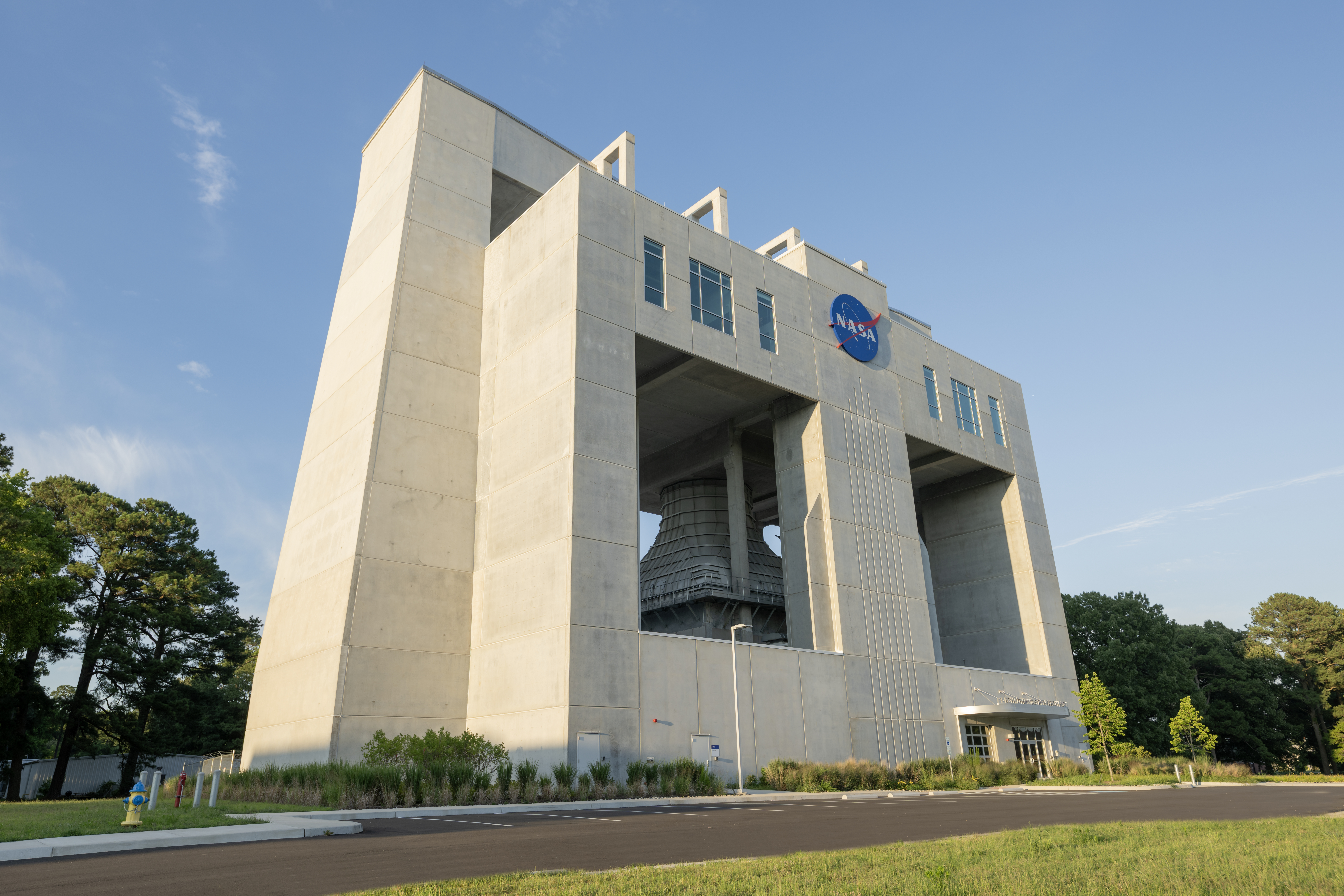
The Flight Dynamics Research Facility, located at NASA’s Langley Research Center in Hampton, Virginia, is the agency’s first major wind tunnel built in more than 40 years.
NASA/Mark Knopp
For more than 100 years, wind tunnels at NASA’s Langley Research Center in Hampton, Virginia, have helped shape the future of flight.
Now, two of NASA’s longest-serving facilities — the 12-Foot Low-Speed Tunnel and the 20-Foot Vertical Spin Tunnel — will pass the torch to the Flight Dynamics Research Facility (FDRF), the first major NASA wind tunnel built in more than 40 years.
NASA’s Newest Wind Tunnel Builds on Legacy of Innovation - YouTube
Tap to unmute
NASA’s Newest Wind Tunnel Builds on Legacy of Innovation NASA Langley Research Center
NASA Langley Research Center78K subscribers
“The FDRF has a combination of features found in no other single facility in the world,” said Mike Fremaux, retired chief engineer for the Intelligent Flight Systems division at NASA Langley. “It’s a high-performance vertical wind tunnel with a large test section capable of conducting all manner of tests to assess the dynamics of flight vehicles.”
When the FDRF opens later this year, it will provide enhanced versions of the capabilities offered by the two legacy facilities. The FDRF’s test section will allow researchers to drop models into a rising vertical airflow. This will offer researchers the ability to conduct spin tests of aircraft and free-flight tests of vehicles designed to re-enter Earth’s atmosphere from space.
The FDRF will play an integral role in conducting research that supports NASA’s aeronautics, science, and space exploration missions. Like many NASA facilities, the FDRF’s story is rooted in a history of innovation.
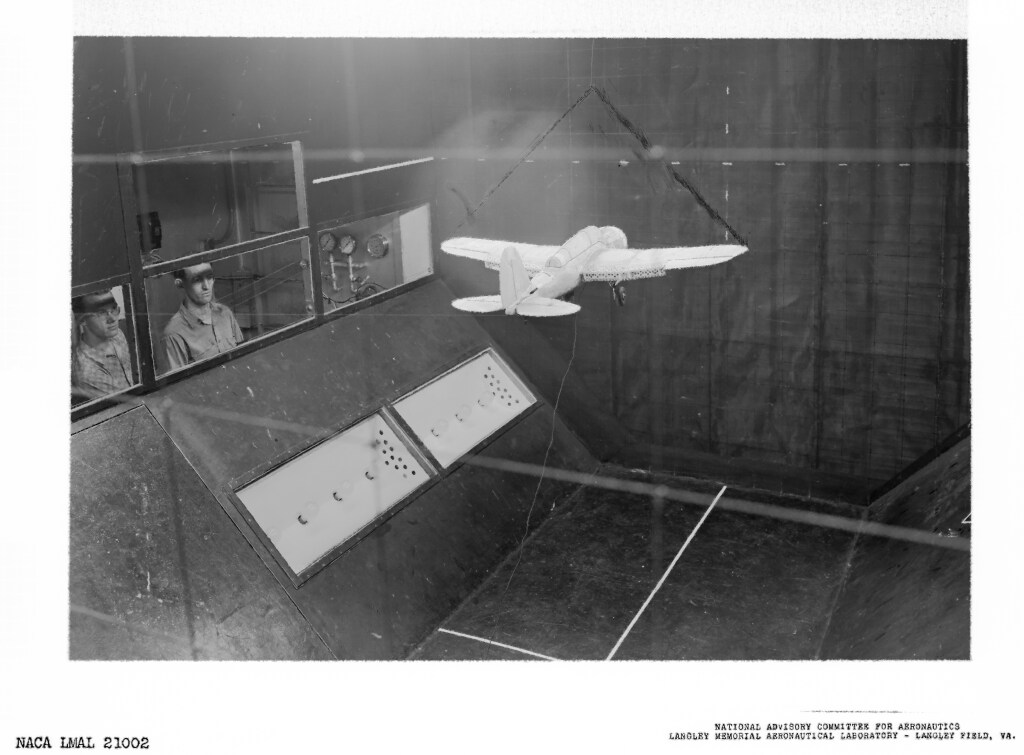
A 1/12th scale model of the SBN-1 is tested in the 12-Foot Free-Flight Tunnel’s test section in 1940.
NASA
# 12-Foot Low-Speed Tunnel
When the 12-Foot Low-Speed Tunnel began operations in 1939, aviation looked very different than it does today.
It was built for NASA’s predecessor agency, the National Advisory Committee for Aeronautics (NACA) to study the controllability of airplanes using free flight. Aircraft models flew unsupported in the wind it generated, instead of being mounted to supports. Multiple operators used rudimentary remote controls to operate the models in the tunnel.
The facility that housed the tunnel boasted a unique design: a 60-foot diameter sphere. The configuration allowed the tunnel to move and adapt to the flight paths of free flying models. “Pilots” could use hydraulic actuators, pivoting the tunnel’s test section to match the models’ movements. The spherical design made it easy for air from the facility’s fan to recirculate through the tunnel, regardless of the pitch angle of the test section.
In 1958, NASA moved the free-flight tests to another Langley tunnel. The agency deactivated the 12-Foot’s hydraulic actuators, fixing its test section into a horizontal position, and began using it for more conventional testing, looking at how aerodynamic force affected the stability and control of strut-mounted models.
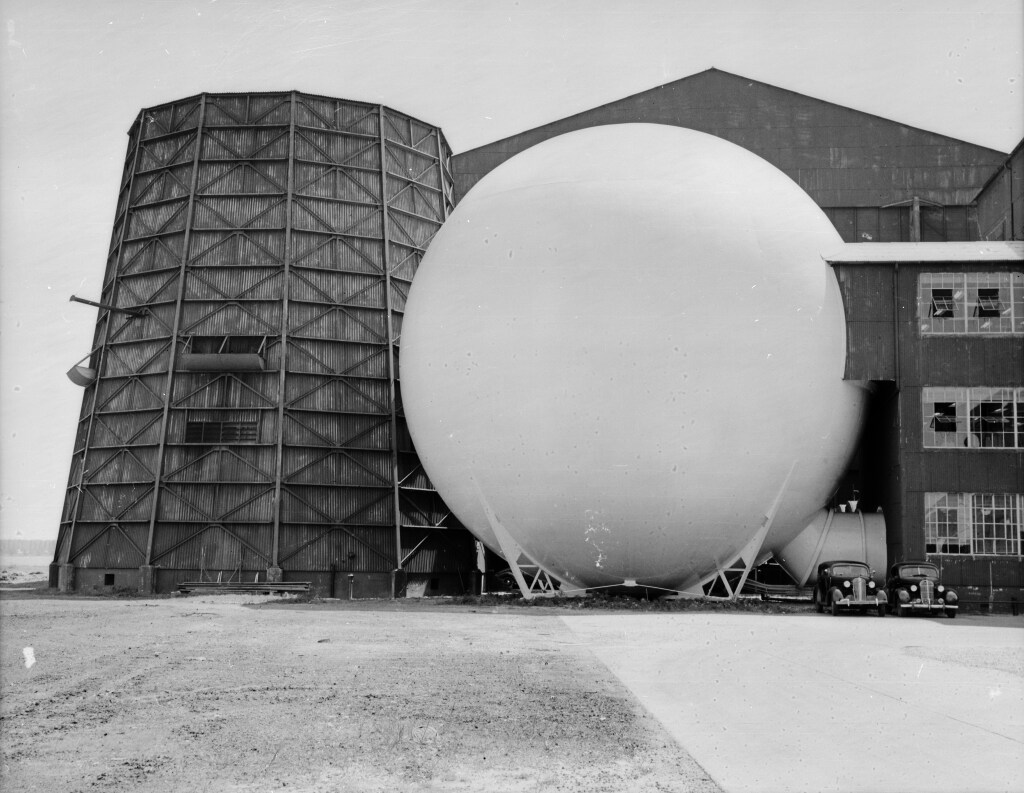
The 20-Foot Vertical Spin Tunnel (left) and the 12-Foot Free-Flight Tunnel (later the 12-Foot Low-Speed Tunnel) in 1946.
NASA
The 12-Foot supported major projects throughout its 86 years of service, from the transition from bi-planes to monoplanes between two world wars, through the development of supersonic aircraft. Revolutionary designs saw testing in the 12-Foot, from the forward-swept-wing X-29 and the X-31 Enhanced Fighter Maneuverability Demonstrator, to the more recent X-59 quiet supersonic research aircraft, and the aeroshell for NASA’s Dragonfly, a unique rotorcraft designed to explore Titan, Saturn’s largest moon.
The 12-Foot closed in 2025, but its legacy will be both felt and seen at the FDRF. Six wooden fan blades and the central metal fan hub from the 12-Foot are on display inside the FDRF’s control room.
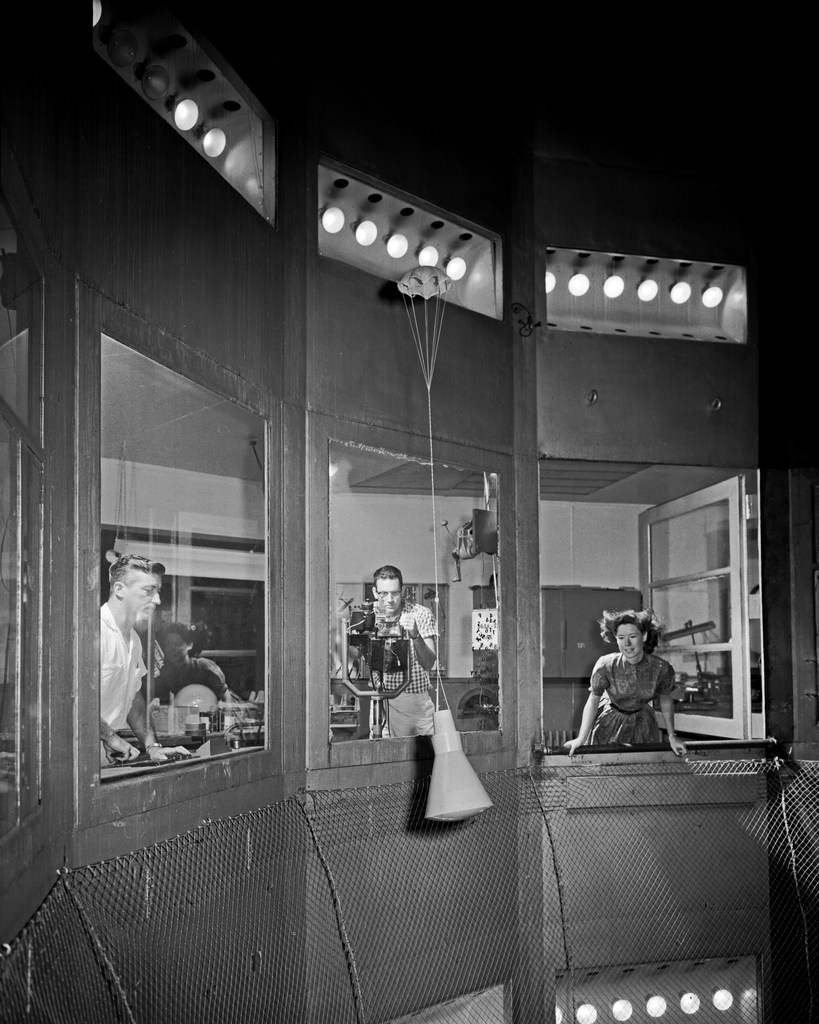
Researchers at NASA’s Langley Research Center in Hampton, Virginia test a Mercury capsule model in 1959.
NASA
# 20-Foot Vertical Spin Tunnel
While the 12-Foot tested new ideas for aircraft and components, the 20-Foot Vertical Spin Tunnel played a critical role in aviation safety.
Opened in 1941, the Vertical Spin Tunnel was designed to study aircraft stall and spin characteristics. Its aim was to prevent deadly accidents in which an aircraft enters an uncontrolled spin. The vertical design allowed models to fall into the rising airflow, simulating how aircraft behave during a spin. Researchers hand-launched models into the tunnel’s vertically rising airstream to evaluate those characteristics.
The tunnel quickly became one of the most important spin-testing facilities in the world. Research supported commercial aviation, parachute design systems, NASA space missions, and the development of nearly every U.S. military aircraft designed since World War II.
Models from many of those tests will be on display in the FDRF’s lobby, a testament to the Vertical Spin Tunnel’s rich history.
“It is great to showcase the legacy of work that started in the NACA days and will continue going forward for decades to come,” Fremaux said.
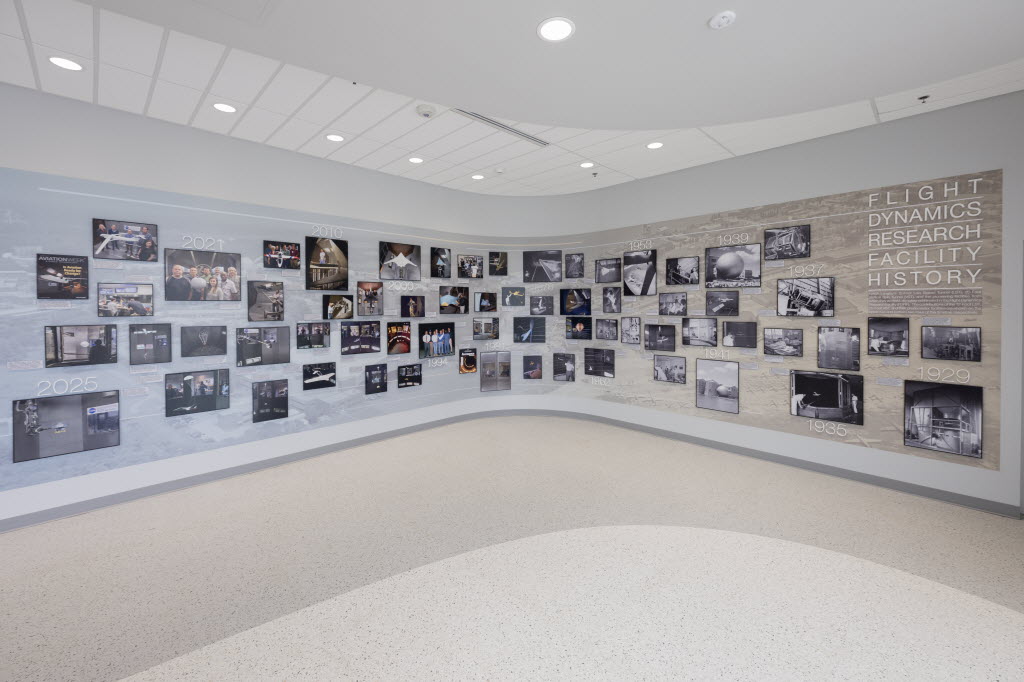
The lobby of the Flight Dynamics Research Facility, located at NASA’s Langley Research Center in Hampton, Virginia, features a timeline that details the histories of the 12-Foot Low-Speed Tunnel and the 20-Foot Vertical Spin Tunnel.
NASA/Mark Knopp
# New era of flight research
The FDRF will continue NASA’s commitment to world-class facilities and the unique expertise of the agency’s workforce.
“That’s what kept those other facilities going,” Fremaux said. “Not just the buildings, the fans, and the motors, but also the expertise associated with those facilities. You can’t have one without the other.”
The FDRF will build not only on the history of the 12-Foot tunnel and the Vertical Spin Tunnel, but on their equipment, including many of their major test rigs, instrumentation, and data systems, were repurposed for use in the FDRF, reducing costs and development time.
As NASA returns astronauts to the Moon through the Artemis program, the FDRF will play a vital role in testing the technologies for entry, descent, and landing that will ensure a safe return to Earth. Research within the FDRF also will support science missions to planets and moons with atmospheres, such as Venus and Saturn’s moon, Titan. The 25,000-square-foot facility will play a major role in experimental research for NASA’s development of X-planes, autonomous flight vehicles, and drones.
“For me, seeing FDRF come alive and being prepared to begin supporting important agency missions, after 30 years of working on the concept behind the scenes with formal and informal teams of motivated, innovative coworkers, is the most rewarding capstone I could have in my career,” Fremaux said.
Just as the 12-Foot Low-Speed Tunnel and the 20-Foot Vertical Spin Tunnel supported decades of aerospace innovation, the FDRF is ready to shape the future of flight.
_Kimiko Booker_
_NASA Langley Research Center_
Share
Details
Last Updated
Jun 29, 2026
Related Terms
Explore More


Was this page helpful?
Δ
Was this page helpful?
Yes
No
×
Notifications