NASA’s ESCAPADE SmallSats Exit Earth Orbit for 2027 Mars Arrival
Twin spacecraft 'Blue' and 'Gold' have successfully executed historic powered flybys of Earth, transitioning from a year-long loiter at L-2 to an intercept trajectory with Mars.
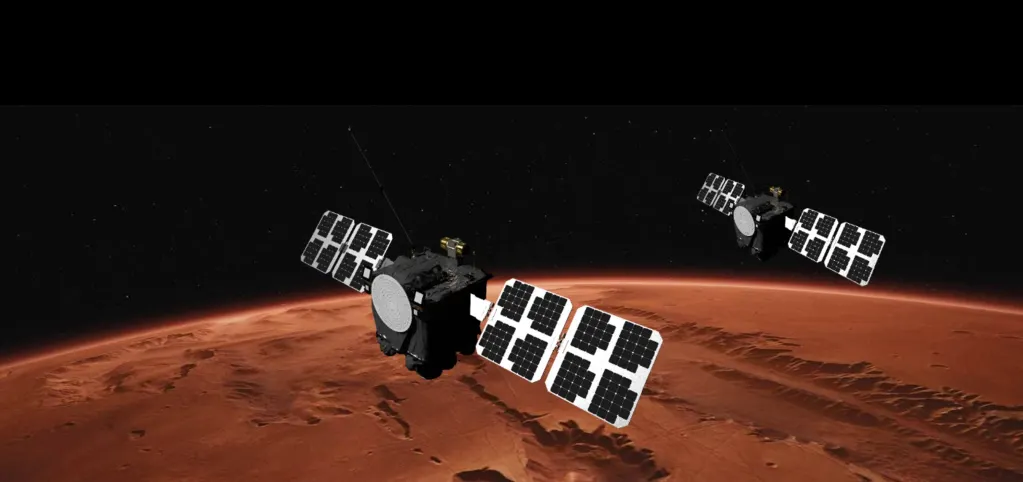
Trajectory Confirmed: Mars Intercept Initialized
NASA’s twin Escape and Plasma Acceleration and Dynamics Explorers, designated ESCAPADE, have officially transitioned from Earth-proximity loitering to a Mars-bound trajectory. The Rocket Lab-built spacecraft, nicknamed Blue and Gold, successfully executed high-precision powered flybys on November 7 and November 9, respectively. According to SpaceNews, this marks the first time NASA has utilized a powered Earth flyby maneuver to propel a mission toward the Red Planet.
The Oberth Advantage
During the maneuvers, the probes dipped as low as 1,050 kilometers above the Earth’s surface. By firing their main engines at this periapsis, the mission utilized the Oberth effect—a technique where engine burns are more efficient when a spacecraft is moving at high velocity deep within a gravity well.
This non-traditional flight path, developed by Advanced Space, allowed the mission to launch via Blue Origin’s New Glenn last November and "loiter" near the Earth-Sun L-2 point for nearly a year. This strategy decouples Mars launches from the restrictive two-year planetary alignment windows typically required for direct transit.
Science Objectives and Legacy
Upon arrival in September 2027, the twins will enter separate orbits to analyze the interaction between solar winds and the Martian magnetosphere.
ESCAPADE represents the final operational survivor of NASA’s SIMPLEx (Small Innovative Missions for Planetary Exploration) program. Following the failures of the Janus, Lunar Trailblazer, and LunaH-Map missions, ESCAPADE remains the sole proof-of-concept for low-cost, small-satellite planetary science. Success in 2027 would validate the use of small-scale hardware for high-priority deep space exploration.