NASA’s Curiosity Mars Rover Discovers Field of Honeycomb Textures
As NASA’s Curiosity rover recently began climbing up a Martian valley nicknamed “Valle Grande,” it sent back images that were a familiar sight to mission scientists: honeycomb-like textures called polygonal fractures, each one about 1.5 to 3 inches (4 to 8 centimeters) across. Th
Search
Suggested Searches
- Climate Change
- Artemis
- Expedition 64
- Mars perseverance
- SpaceX Crew-2
- International Space Station
- View All Topics A-Z
- Home
- Missions
- Humans in Space
- Earth
- The Solar System
- The Universe
- Science
- Aeronautics
- Technology
- Learning Resources
- About NASA
- Español
Featured
  
Back
- Search All NASA Missions
- A to Z List of Missions
- Upcoming Launches and Landings
- Spaceships and Rockets
- Communicating with Missions
- Artemis
- James Webb Space Telescope
- Hubble Space Telescope
- International Space Station
- OSIRIS-Rex
- Explore Earth Science
- Climate Change
- Earth, Our Planet
- Earth Science in Action
- Earth Multimedia
- Earth Data
- Earth Science Researchers
- The Sun
- Mercury
- Venus
- Earth
- The Moon
- Mars
- Jupiter
- Saturn
- Uranus
- Neptune
- Pluto & Dwarf Planets
- Asteroids, Comets & Meteors
- The Kuiper Belt
- The Oort Cloud
- Skywatching
- Exoplanets
- The Search for Life in the Universe
- Stars
- Galaxies
- Black Holes
- The Big Bang
- Dark Energy
- Dark Matter
- Earth Science
- Planetary Science
- Astrophysics & Space Science
- The Sun & Heliophysics
- Biological & Physical Sciences
- Lunar Science
- Citizen Science
- Astromaterials
- Aeronautics Research
- Human Space Travel Research
- Science in the Air
- NASA Aircraft
- Flight Research Innovation
- Supersonic Flight
- Air Traffic Solutions
- Green Aviation Tech
- Drones & You
- Technology Transfer & Spinoffs
- Space Travel
- Living in Space
- Lunar Surface Technology
- Manufacturing and Materials
- Robotics
- Science Instruments
- Computing
- For Kids and Students
- For Educators
- For Colleges and Universities
- For Professionals
- Science for Everyone
- Requests for Exhibits, Artifacts, Speakers & Flyovers
- STEM Engagement at NASA
- NASA's Impacts
- Centers and Facilities
- Directorates
- Organizations
- People of NASA
- Careers
- Internships
- Our History
- Doing Business with NASA
- Get Involved
- Contact
- News Releases
- Recently Published
- Video Series on NASA+
- Podcasts & Audio
- Blogs
- Newsletters
- Social Media
- Media Resources
- Events
- Upcoming Launches & Landings
- Virtual Guest Program
- NASA+
- Images
- NASA Live
- NASA Apps
- Podcasts
- Image of the Day
- e-Books
- 3D Resources
- Interactives
- STEM Multimedia
- NASA Brand & Usage Guidelines
Featured
  
Highlights
  
Highlights
  
Highlights
  
Featured
  
Highlights
  
Highlights
  
Highlights
[![Request for Information – Potential [Placeholder for Prize]](https://assets.science.nasa.gov/dynamicimage/assets/science/psd/solar/2023/09/s/solarsystem_0.jpg?w=1024)\\
\\
1 min read\\
\\
Request for Information – Potential \[Placeholder for Prize\]\\
\\
article5 days ago](https://science.nasa.gov/technology/workshops/request-for-information-response/)  
Featured

Featured
  
Highlights
  
3 min read
# NASA’s Curiosity Mars Rover Discovers Field of Honeycomb Textures
Jet Propulsion Laboratory
Jul 29, 2026
Article

NASA’s Curiosity rover discovered an expanse of terrain covered in surface features called polygons. Scientists have never seen so many of these features in one place and are unsure how they formed.
NASA/JPL-Caltech/MSSS
As NASA’s Curiosity rover recently began climbing up a Martian valley nicknamed “Valle Grande,” it sent back images that were a familiar sight to mission scientists: honeycomb-like textures called polygonal fractures, each one about 1.5 to 3 inches (4 to 8 centimeters) across. The mission has spotted small patches of these geometric shapes several times before, but nothing at the scale discovered in Valle Grande.
In a 360-degree panorama that the rover captured on June 19 and 20, the 4,930th and 4,931st Martian days, or sols, of the mission, the polygonal shapes spread in all directions for as far as the rover can see. They even wrap around the sides of a nearby butte nicknamed “Miraflores,” which stands 20 feet (6 meters) tall and is topped with a thick cap of sand.
“We’ve seen a lot of fascinating landscapes through Curiosity’s eyes, but this sea of polygons took our breath away,” said the mission’s project scientist, Ashwin Vasavada of NASA’s Jet Propulsion Laboratory in Southern California. “We measured their shapes and chemistry carefully and are hopeful there are clues in the data as to how these features formed.”
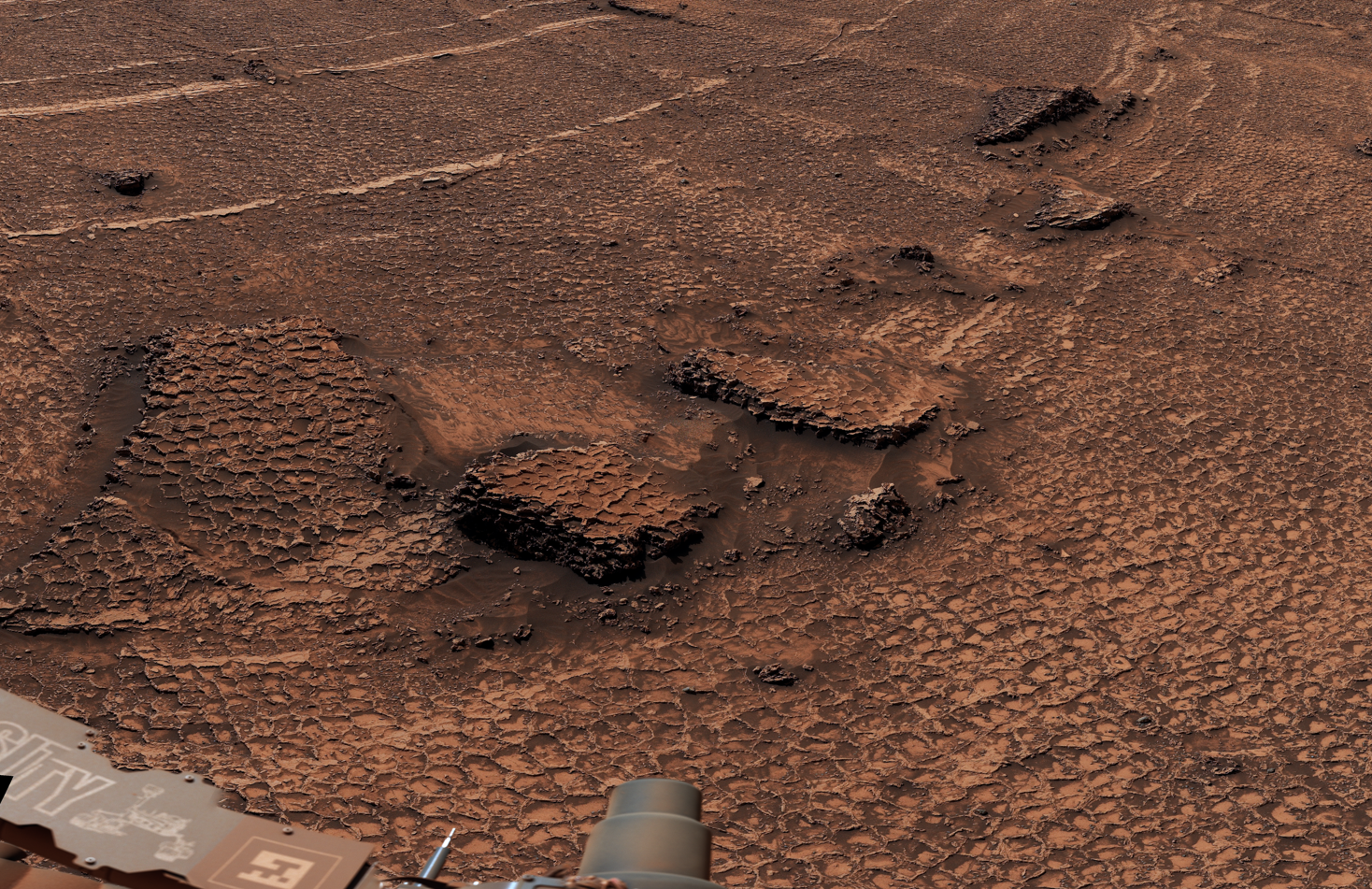
A close-up of the polygon fractures discovered by NASA’s Curiosity Mars rover highlights their honeycomb-like textures
NASA/JPL-Caltech/MSSS
Some of the polygons that the mission has spotted in the past clearly formed as mud cracks, though a variety of processes can contribute to their honeycomb textures, including cycles of warm and cold temperatures or compression that squeezed water out of the sediment when the surface was buried.
These newly discovered polygons are among the many surprises Curiosity has trundled across since landing on Mars 14 years ago, on Aug. 5, 2012. Besides sulfur crystals, shiny meteorites, and other interesting geologic features, the rover has made major discoveries about the ancient Martian environment — most importantly, that it had the water, chemistry, and nutrients to support microbial life.
Billions of years ago, lakes and streams dappled the lower foothills of Mount Sharp, a 3-mile-tall (5-kilometer-tall) mountain that Curiosity has been ascending since 2014. The rover has previously uncovered chemistry left over from Mars’ watery history, including carbon-based molecules believed to be precursors to RNA and DNA, two nucleic acids that carry genetic information. Scientists have no way of knowing whether these organic molecules were created by biologic or geologic processes — either path is possible — but their discovery reconfirmed that ancient Mars had the right chemistry to support life.
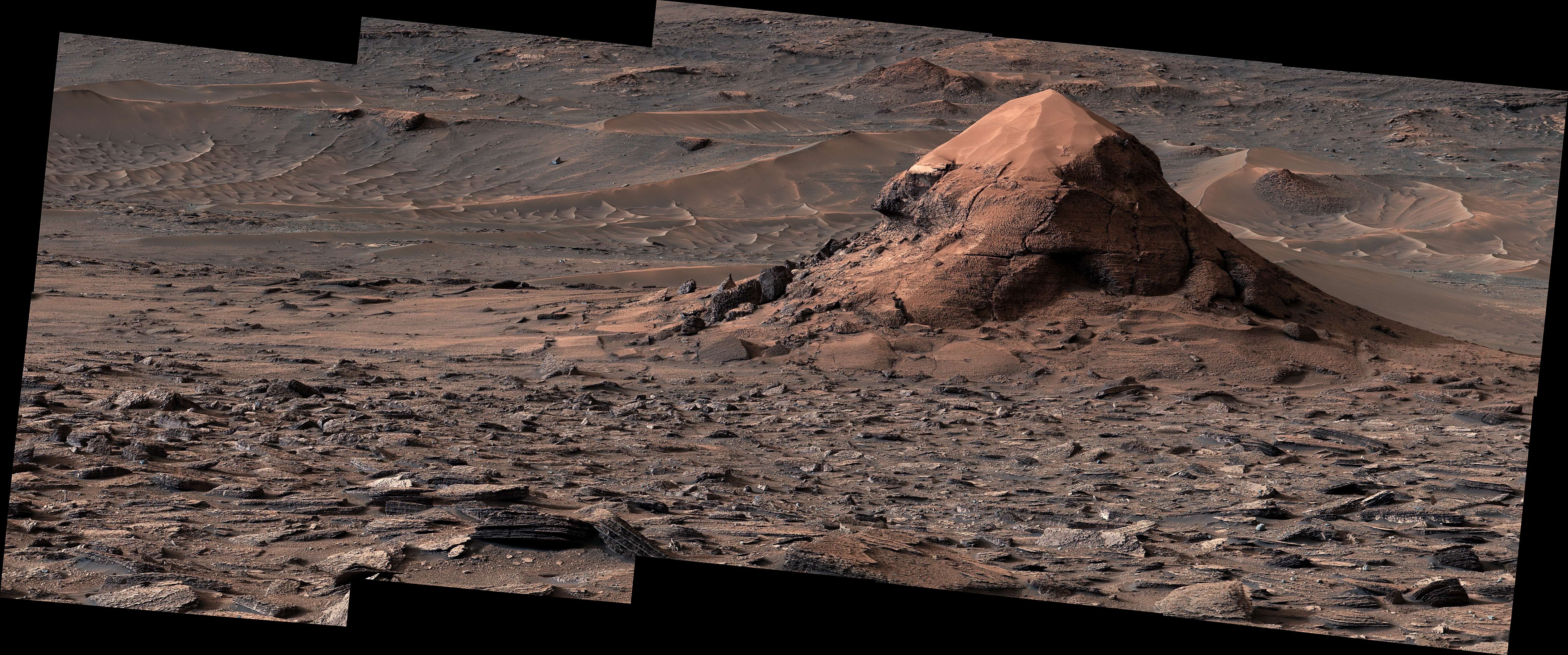
NASA’s Curiosity Mars rover captured this sand-capped butte, nicknamed “Miraflores,” estimated to be about 20 feet (6 meters) tall, on June 11, 2026. The surrounding area includes an expanse of terrain covered in surface features called polygons.
NASA/JPL-Caltech/MSSS
Managed by Caltech in Pasadena, JPL built Curiosity and leads the mission on behalf of NASA’s Science Mission Directorate in Washington as part of the agency’s Mars Exploration Program portfolio.
To learn more about Curiosity, visit:
https://science.nasa.gov/mission/msl-curiosity
News Media Contacts
Andrew Good
Jet Propulsion Laboratory, Pasadena, Calif.
818-393-2433
Karen Fox / Alana Johnson
NASA Headquarters, Washington
240-285-5155 / 202-672-4780
karen.c.fox@nasa.gov / alana.r.johnson@nasa.gov
2026-051
Share
Details
Last Updated
Jul 29, 2026
Related Terms
- Curiosity (Rover)
- Jet Propulsion Laboratory
- Mars
- Mars Exploration Program
- Radioisotope Power Systems (RPS)
Explore More


Keep Exploring
Discover Related Topics
Mars Science Laboratory: Curiosity Rover \\
\\
Part of NASA’s Mars Science Laboratory mission, at the time of launch, Curiosity was the largest and most capable rover…\\
\\
 Curiosity Science Highlights \\
\\
Curiosity Finds Evidence of Persistent Liquid Water in the Past Just after landing, Curiosity found smooth, rounded pebbles that likely…\\
\\
 Mars Exploration \\
\\
Mars is the only planet we know of inhabited entirely by robots. Learn more about the Mars Missions.\\
\\
 Planetary Science \\
\\
NASA’s planetary science program explores the objects in our solar system to better understand its history and the distribution of…\\
\\

Was this page helpful?
Δ
Was this page helpful?
Yes
No
×
Notifications