NASA’s Chandra Examines Milky Way at Arms’ Length
A new result using NASA’s Chandra X-ray Observatory shows that the outer spiral arms in the Milky Way galaxy may reach wider than previously thought. This finding may lead astronomers to adjust their understanding of our home galaxy’s structure. A team of astronomers made this di
Search
Suggested Searches
- Climate Change
- Artemis
- Expedition 64
- Mars perseverance
- SpaceX Crew-2
- International Space Station
- View All Topics A-Z
- Home
- Missions
- Humans in Space
- Earth
- The Solar System
- The Universe
- Science
- Aeronautics
- Technology
- Learning Resources
- About NASA
- Español
Highlights
  
Back
- Search All NASA Missions
- A to Z List of Missions
- Upcoming Launches and Landings
- Spaceships and Rockets
- Communicating with Missions
- Artemis
- James Webb Space Telescope
- Hubble Space Telescope
- International Space Station
- OSIRIS-REx
- Explore Earth Science
- Climate Change
- Earth, Our Planet
- Earth Science in Action
- Earth Multimedia
- Earth Data
- Earth Science Researchers
- The Sun
- Mercury
- Venus
- Earth
- The Moon
- Mars
- Jupiter
- Saturn
- Uranus
- Neptune
- Pluto & Dwarf Planets
- Asteroids, Comets & Meteors
- The Kuiper Belt
- The Oort Cloud
- Skywatching
- Exoplanets
- The Search for Life in the Universe
- Stars
- Galaxies
- Black Holes
- The Big Bang
- Dark Matter
- Dark Energy
- Earth Science
- Planetary Science
- Astrophysics & Space Science
- The Sun & Heliophysics
- Biological & Physical Sciences
- Lunar Science
- Citizen Science
- Astromaterials
- Aeronautics Research
- Human Space Travel Research
- Science in the Air
- NASA Aircraft
- Flight Innovation
- Supersonic Flight
- Air Traffic Solutions
- Green Aviation Tech
- Drones & You
- Technology Transfer & Spinoffs
- Space Travel Technology
- Technology Living in Space
- Manufacturing and Materials
- Robotics
- Science Instruments
- Computing
- For Kids and Students
- For Educators
- For Colleges and Universities
- For Professionals
- Science for Everyone
- Requests for Exhibits, Artifacts, or Speakers
- STEM Engagement at NASA
- NASA's Impacts
- Centers and Facilities
- Directorates
- Organizations
- People of NASA
- Careers
- Internships
- Our History
- Doing Business with NASA
- Get Involved
- Contact
- NASA+
- Images
- NASA Live
- NASA Apps
- Podcasts
- Image of the Day
- e-Books
- 3D Resources
- Interactives
- STEM Multimedia
- NASA Brand & Usage Guidelines
Highlights
  
Highlights
  
Highlights
  
Highlights
  
Highlights
  
Highlights
  
Highlights
  
Highlights
  
Highlights

Highlights
  
Highlights
  
5 min read
# NASA’s Chandra Examines Milky Way at Arms’ Length
Lee Mohon
Jul 01, 2026
Article
To view this video please enable JavaScript, and consider upgrading to a web browser that
supports HTML5 video
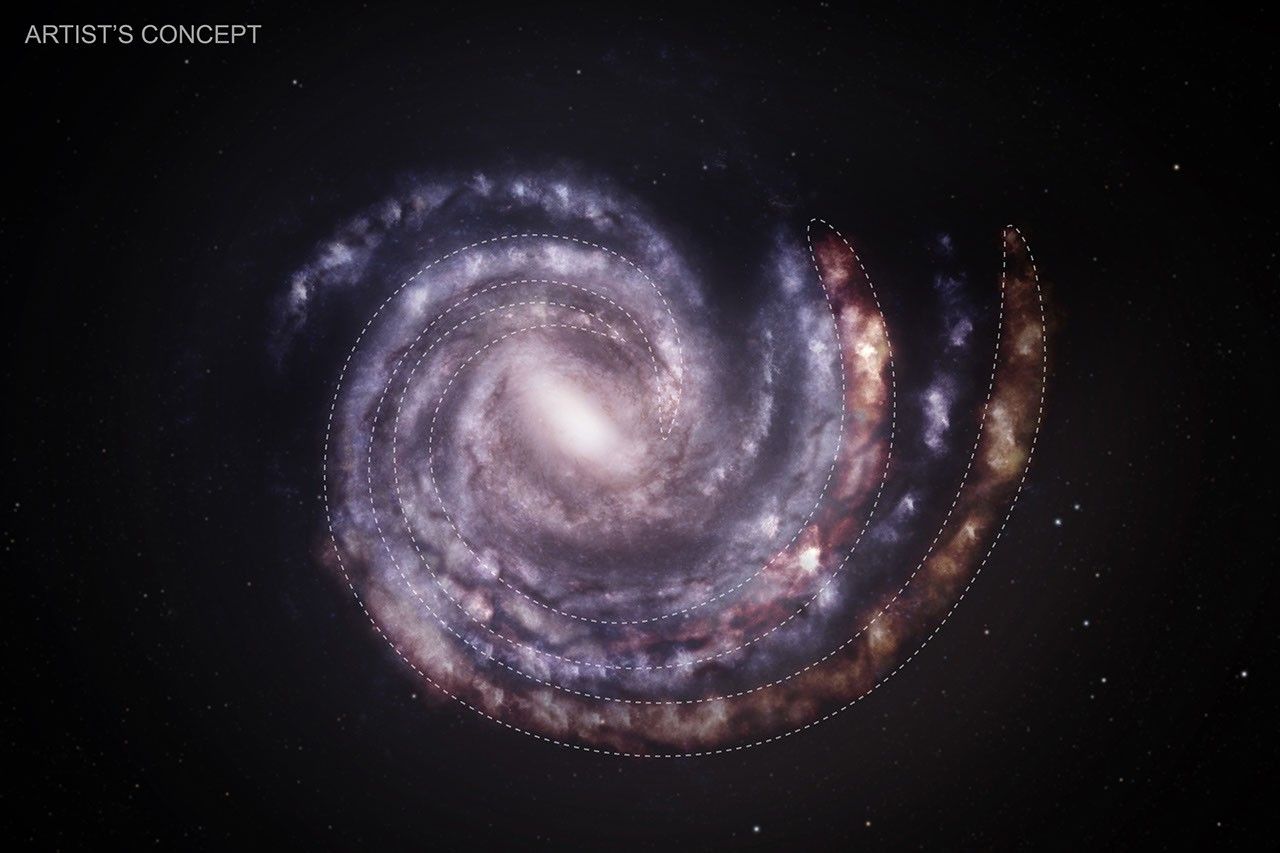
This sequence begins with an artist’s concept showing the Milky Way galaxy as seen from above, with the estimated positions of spiral arms based on previous data. Next is an updated artist’s concept of the Milky Way, where the positions of the two spiral arms most distant from the center of the galaxy have been adjusted based on newly processed X-ray data from NASA’s Chandra X-ray Observatory and ESA’s XMM-Newton. Both arms may be more distant than previously thought.
NASA/CXC/A. Hobart
A new result using NASA’s Chandra X-ray Observatory shows that the outer spiral arms in the Milky Way galaxy may reach wider than previously thought. This finding may lead astronomers to adjust their understanding of our home galaxy’s structure.
A team of astronomers made this discovery by making precise measurements of distances to dust clouds in the Milky Way’s spiral arms using data from both NASA’s Chandra and XMM-Newton, an ESA (European Space Agency) mission with NASA contributions. The results are described in a new paper published Wednesday in the Astronomy & Astrophysics journal.
The researchers determined the distances by studying rings around gamma-ray bursts, some of the brightest bursts of light in the universe, which arise from the collapse of massive stars or the merger of neutron stars. They are located at enormous distances, well beyond the confines of our galaxy.
An artist’s concept showing the Milky Way galaxy as seen from above, with the estimated positions of spiral arms based on previous data, in blue. Overlaid on this is an updated view of the Milky Way showing different positions for the two outermost spiral arms, shown in red and bordered by dashed lines. Both arms may be more distant than previously thought, based on newly processed X-ray data from Chandra and XMM.
NASA/CXC/SAO/M.Weiss
This distance measurement technique capitalized on the phenomenon of light echoes, where the light from the gamma-ray burst bounced off dust clouds in the spiral arms. The diameters of the rings in X-rays give the distances to Earth, with larger rings being generated by dust clouds closer to us.
“This is a very direct way – relying only on geometry – to precisely measure distances to the Milky Way’s spiral arms,” said Beatrice Vaia, who led the study while a PhD student in a joint program between Scuola Universitaria Superiore IUSS Pavia and University of Trento in Italy. “Most other methods rely on assumptions about how the Milky Way rotates, which become increasingly uncertain in the outer regions of our galaxy."
Despite a century of awareness of the Milky Way’s spiral arms, astronomers are still working toward precise characterization of its arms because of Earth’s position within one. Dust and gas also block the view to other arms.
The researchers used three different gamma-ray bursts to determine the distances to three spiral arms in the Milky Way. In order of increasing distances from the Galactic Center, they are the Perseus, the Outer, and the Outer Scutum-Centaurus arms. Along the direction of one of the bursts, they found that both the Outer and Outer Scutum-Centaurus arms are about 10% more distant than astronomers previously thought.
“The differences are small, but any revision of these distances is important because they are so fundamental for understanding our galaxy,” said co-author Ilaria Fornasiero, who was a PhD student in the same program as the leading author. “For example, this could mean that astronomers have to revise estimates of the mass of the galaxy, because that affects how wide the arms stretch.”
The images include X-ray data from Chandra and optical data from Pan-STARRS. The composite image shows X-ray rings generated by a gamma-ray burst (GRB), a bright X-ray source located outside our galaxy. In a phenomenon called light echoes, the X-rays from the GRB bounced off dust clouds in the spiral arms of our galaxy. The diameters of the rings in the Chandra data give the distances of the dust clouds to Earth, with larger rings being generated by dust clouds closer to us. The GRB is located at the center of the circles defining the rings, to the left of the X-ray data outlined by the white square.
X-ray: NASA/CXC/INAF/B. Vaia et al.; Optical: Pan-STARRS; Image processing: NASA/CXC/SAO/N.Wolk & P.Edmonds
The team also used their data to estimate that the dust cloud in the most distant arm is about 3,500 light-years wide. These findings show that their measurements apply to the full thickness of the spiral arm, rather than a random, isolated dust cloud that may not fully be representative of the arm’s location.
While this technique provided major improvements in accuracy according to the researchers, it may be difficult to use it for further measurements because bright gamma-ray bursts that are visible through the plane of the galaxy are rare.
“We’re relying on the universe to provide us with these events, and so far, over 25 years, we’ve only found a handful that we can use,” said co-author Andrea Tiengo of Scuola Universitaria Superiore IUSS Pavia. “That said, we will continue to be on the lookout for more.”
NASA's Marshall Space Flight Center in Huntsville, Alabama, manages the Chandra program. The Smithsonian Astrophysical Observatory's Chandra X-ray Center controls science operations from Cambridge, Massachusetts, and flight operations from Burlington, Massachusetts.
Read more from NASA’s Chandra X-ray Observatory
To learn more about Chandra, visit:
To learn more about NASA’s Chandra mission, visit:
Visual Description
This release features a short video and a series of images, all related to an updated understanding of our home galaxy's structure. By studying rings of X-ray light echoes, researchers now believe that two of the Milky Way's spiral arms may be more distant from the center of the galaxy than previously thought.
The updated understanding of the structure of the Milky Way is highlighted in a short video, which compares two artist concept images. In both images, our spiral Milky Way galaxy is shown face-on. It has a bright white core with several arms that spiral out from the center, like long thin clouds corkscrewing counterclockwise. The two longest arms make a full rotation of the spiral galaxy, and curve all the way around to the upper right of the images.
The first image in the video shows the previous understanding of the Milky Way. Here, the two longest arms are curled around the core in a fairly tight spiral. In the second image, which represents the updated understanding, the two longest arms are more loosely spiraled. Visually, this means there is more open space between the curving arms, which are further away from the bright galaxy core. The video fades back and forth between the two artist concept images to illustrate the structural differences between the two understandings.
These findings are further shown by a static image which overlays the new understanding on top of the earlier understanding. In this artist's concept illustration, dotted lines and different colors are used to differentiate between the two.
A team of astronomers made this discovery by studying gamma-ray bursts that bounce off of dust clouds in the galaxy's spiral arms. The resulting rings of X-rays, known as light echoes, were detected and mapped by NASA's Chandra X-ray Observatory and ESA's XMM-Newton. In a supplemental data image, the light echoes resemble concentric arches of neon blue dots trailing across a speckled sky.
Identifying the position of the Milky Way's spiral arms through X-ray light echoes has allowed astronomers to use geometry, rather than assumptions about galaxy rotation, to better understand the structure of our galaxy.
Share
Details
Last Updated
Jul 01, 2026
Editor
Lee Mohon
Contact
Joel Wallace
Megan Watzke
Location
Marshall Space Flight Center
Related Terms
- Chandra X-Ray Observatory
- Astrophysics
- Galaxies
- Marshall Astrophysics
- Marshall Space Flight Center
- The Milky Way
- The Universe
Share
Details
Last Updated
Jul 01, 2026
Editor
Lee Mohon
Contact
Joel Wallace
Megan Watzke
Location
Marshall Space Flight Center
Related Terms
- Chandra X-Ray Observatory
- Astrophysics
- Galaxies
- Marshall Astrophysics
- Marshall Space Flight Center
- The Milky Way
- The Universe
Explore More


Keep Exploring
Discover More Topics From NASA
Chandra X-ray Observatory\\
\\
 James Webb Space Telescope \\
\\
Webb is the premier observatory of the next decade, serving thousands of astronomers worldwide. It studies every phase in the…\\
\\
 Hubble Space Telescope \\
\\
Since its 1990 launch, the Hubble Space Telescope has changed our fundamental understanding of the universe.\\
\\
 Solar System\\
\\

Δ
Did you find what you were looking for?(Required)
Yes
No
Partly
What were you looking for?(Required)
What were you hoping to accomplish by visiting our website?(Required)
×
Notifications