NASA Praises Blue Origin’s Mishap Progress, Announces Moon Base Contracts
NASA said the vendors plan to fly “updated versions of already-flown lander designs” to try to meet the agency’s goal of monthly landings with NASA payloads. The post NASA Praises Blue Origin’s Mishap Progress, Announces Moon Base Contracts appeared first on Payload.
Blue Origin appears to be recovering well from its New Glenn explosion last month—all thanks to some clever engineering.
Blue maintains it will fly again this year. CEO Dave Limp said yesterday that the company will ramp up flights quickly with a new pad design. The company plans to join rocket stages in a facility, ferry an already integrated New Glenn to the launch pad, crane the rocket there to a vertical position, and then mate payloads.
NASA, however, hasn’t decided if these changes will be enough to meet its ambitious lunar plans. Blue has received several Moon contracts from NASA, and remains one of the vendors being considered to fly with Artemis III NET 2027.
“We’re working with Blue Origin very closely to understand their timelines to recovery, and also looking at other options,” Moon Base Program Executive Carlos García-Galán said yesterday during a livestreamed Moon Base update.
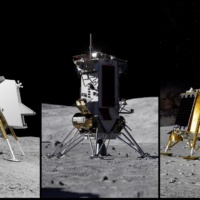
6, not 7: At the Moon Base event, which the agency is now planning to hold monthly, NASA also announced ~$600M in new CLPS contracts:
- Astrobotic Technology for two Peregrine missions, collectively worth $297.9M;
- Intuitive Machines for a Nova-C mission, worth $148.3M;
- Firefly Aerospace for a Blue Ghost mission, worth $144.2M.
NASA said the vendors plan to fly “updated versions of already-flown lander designs” to try to meet the agency’s goal of monthly landings with NASA payloads. And there’s more. In an effort to use every available resource, NASA may send a Mars Perseverance rover prototype—standing by as a twin for engineers to diagnose issues for its Martian sibling—lunarside to “prospect for resources.” The proposed mission is called PROMISE (Polar Rover for Observation, Mapping, and In-Situ Exploration).
Looking ahead: NASA’s next steps include asking industry for lander proposals to send payloads such as “a power and avionics technology demonstration,” an unspecified “science manifest,” and an optical payload to the lunar surface. NASA is planning to roll out even more contracts soon.
“NASA also will share an open solicitation for Moon Base technology demonstrations, and seek a lunar communication and navigation relay constellation to enable improved communication between Moon Base elements and Earth,” the agency stated.
Related Stories

Exclusive: Lunar Forge Unveils Plans to Build Lunar Infrastructure Out of Dust
Lunar Forge’s idea is to drastically reduce the cost required to set up fission reactors, by using regolith to build the majority of the support structure to house and shield the reactor core.

Firefly Acquires Autonomous Space Ops Company
Firefly Aerospace announced yesterday that it acquired Space-ng, which is an AI-powered vision navigation and autonomous guidance systems provider.

Instinct Space Unveils Plans for Low-Cost Lunar Landers
Instinct Space announced a significant pivot today from helping lunar surface missions find their way to getting in on the surface action itself.

Artemis III Astronauts Will Meet SpaceX, Blue Origin Landers in Earth Orbit
SpaceX and Blue Origin plan to each provide a lander for the 2027 mission to Earth orbit, which will serve as a test run for Moon landings starting as soon as the following year, NASA confirmed at a Tuesday event.
More Stories
Get in, landers, we’re going to the Moon.
Background: NASA established the Commercial Lunar Payload Services (CLPS) program in 2018, in response to the call in Space Policy Directive-1 to return people to the Moon. Under the program, NASA awards contracts for commercial lander companies to bring space agency payloads to the lunar surface. The companies can then sell extra space on each of these NASA-subsidized missions to commercial payloads looking for a ride to the Moon.
CLPS is intended to build on NASA’s successful commercial cargo and crew programs, allowing the agency to support a still-young commercial lunar delivery economy with the goal of eventually being one customer of many.
Load More
Payload in your inbox
Payload _Our daily flagship newsletter_
Payload Pro _Weekly, curated insights, analysis, and data_
Payload Europe _Our weekly deep dive into EU space news_
Polaris _Our weekly look at policy news_
Marketing & Events _Periodic emails about company news and events_
Sign Up
You are now subscribed to our list.
Be sure to add us to your contacts, so we don’t end up in your spam folder!
!Payload Pro
In-depth research, exclusive data, and expert analysis on the business and policy of space. Get ahead of the competition.
Popular Stories
Aetherflux Rebrands, Pivots Business—and Raises $275M
May 11, 2026May 11, 2026
Exclusive: LEAP Launches its First Rocket
May 13, 2026May 13, 2026
Lt. Gen. Schiess Nominated to Lead Space Force
May 4, 2026May 4, 2026
Anduril Names Its SBI Team For Golden Dome
May 5, 2026May 5, 2026
Business • Equities • Technology
York Space Systems to Acquire Solestial
May 19, 2026May 19, 2026
Upcoming Events
live event
Salt Lake City Happy Hour
Poplar Street Pub, Salt Lake City, UT
25Aug
Thanks for signing up
Check your inbox for an email from general@payloadspace.com. Make sure to check your spam folder and add us to your Safe Senders list. Please allow up to 48 hours for the messages to
come through. Still don't see it? Send us a note
×