NASA Delivers Braking Engines for ESA Rosalind Franklin Mars Mission
NASA has delivered the first braking engines for the European Space Agency’s (ESA) Rosalind Franklin mission to Mars. The braking engines are one of three major contributions NASA has committed to the mission, along with launch services and Radioisotope Heater Units (RHUs) to kee
- News
- Launch
- Contracts
- Business
- Defence
- Technology
- Legislation
- Science
- Launch Schedule
- 2026
- 2025
- 2024
- Rockets
- Orbital Rockets
- Suborbital Rockets
- Space Map
- Newsletter
- Download
- Shop
- Posters
- T-shirts
- Merch
Search

No products in the cart.

- News
- Launch
- Contracts
- Business
- Defence
- Technology
- Legislation
- Science
- Launch Schedule
- 2026
- 2025
- 2024
- Rockets
- Orbital Rockets
- Suborbital Rockets
- Space Map
- Newsletter
- Download
- Shop
- Posters
- T-shirts
- Merch
Search
- News
- Launch
- Contracts
- Business
- Defence
- Technology
- Legislation
- Science
- Launch Schedule
- 2026
- 2025
- 2024
- Rockets
- Orbital Rockets
- Suborbital Rockets
- Space Map
- Newsletter
- Download
- Shop
- Posters
- T-shirts
- Merch
Search
Facebook X Pinterest Linkedin ReddIt
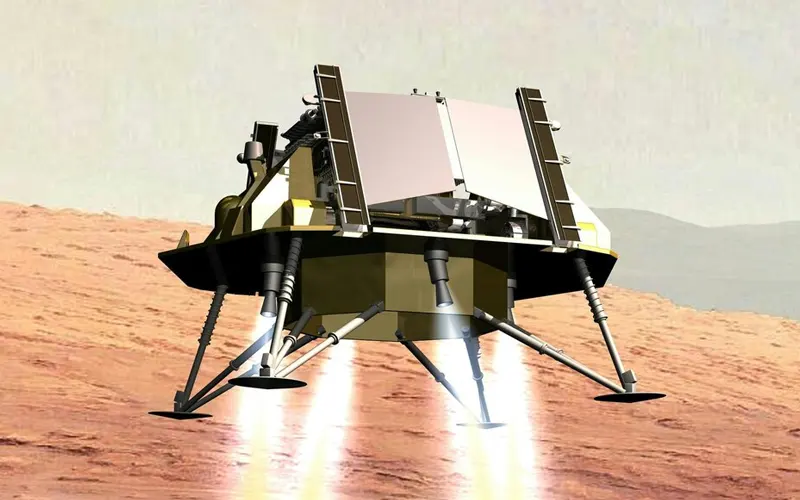
!NASA has delivered the first braking engines for ESA’s Rosalind Franklin Mars mission. Work to secure the required RHUs continues.Credit: Airbus
NASA has delivered the first braking engines for the European Space Agency’s (ESA) Rosalind Franklin mission to Mars. The braking engines are one of three major contributions NASA has committed to the mission, along with launch services and Radioisotope Heater Units (RHUs) to keep the rover’s instruments warm during cold Martian nights.
The US space agency’s involvement in the mission is a relatively recent development, the result of ESA’s decision to cut ties with its original partner. That break came in March 2022, when the agency suspended all work on the mission following Russia’s invasion of Ukraine, leaving the rover without the Russian-built landing platform and Proton-M launch service around which the mission had been designed.
Europe is managing the replacement of the bulk of the Russian-built hardware, including the landing platform, under a €522 million contract awarded to Thales Alenia Space in April 2024. For its part, NASA will supply three key elements for the mission under a Memorandum of Understanding signed in May 2024. However, there has been uncertainty about NASA’s contribution, with the agency’s FY2027 budget request appearing to cut funding for its involvement.
During a press briefing following ESA’s 347th Council meeting, Daniel Neuenschwander, the agency’s director of human and robotic exploration, gave an update on NASA’s contributions to the mission. Neuenschwander explained that the launch service had been confirmed, with NASA announcing in April 2026 that it had selected a SpaceX Falcon Heavy rocket. He gave an equally positive update on the braking engines, stating that “the first braking engines” had been delivered. Finally, on the status of the RHUs, Neuenschwander was more guarded.
“The third and last topic is the procurement of RHUs. And there we are on a very good path,” said Neuenschwander. “This is still something which needs to progress until launch, and we will have to take a number of decisions but I can underline that also here it looks good so far.”
This uncertainty is notable as Europe does not currently have its own flight-ready RHU capability. The agency is, however, working to change that. Through its ENDURE programme, ESA plans to foster the development of a European-made RHU, and the results of that work are already tangible. The first flight-ready unit, produced by UK-led Perpetual Atomics, is currently expected to fly aboard the Rosalind Franklin rover’s landing platform. That unit is, however, a demonstrator. The RHUs provided by NASA are mission-critical and will keep the rover’s electronics warm as it searches for signs of ancient life.
Keep European Spaceflight Independent
Your donation will help European Spaceflight to continue digging into the stories others miss. Every euro keeps our reporting alive.
€1 €10 €20 €50 Custom Amount
€
Make Donation
//RELATED ARTICLES MORE FROM AUTHOR

ESA Details Next Steps for Agency’s Gateway Contributions

Anomaly Delays Full-Scale Space Rider Drop Test Until October

Italy Skips Crew Allocation Queue Thanks to Astronaut’s Test Pilot Experience
LEAVE A REPLY Cancel reply
Please enter your comment!
Please enter your name here
You have entered an incorrect email address!
Please enter your email address here
Save my name, email, and website in this browser for the next time I comment.
Δ
The Company
European Spaceflight LTD
Company number: 14287328
Registered address: Unit 13 Freeland Park, Wareham Road, Lytchett Matravers,
BH16 6FA, Poole, UK
Contact number: +44 7873 215465
The Shop
The Fine Print
© European Spaceflight (2022)
×
Keep European Spaceflight Independent
Your donation will help European Spaceflight to continue digging into the stories others miss. Every euro keeps our reporting alive.
€1 €10 €20 €50 Custom Amount
€
Make Donation