NASA Commits $600 Million to Massive Lunar Lander Expansion
NASA awards nearly $600 million to Astrobotic, Firefly, and Intuitive Machines for four concurrent lunar missions as the agency eyes a repurposed Mars rover for the moon.
Mission Directives Phase-2028
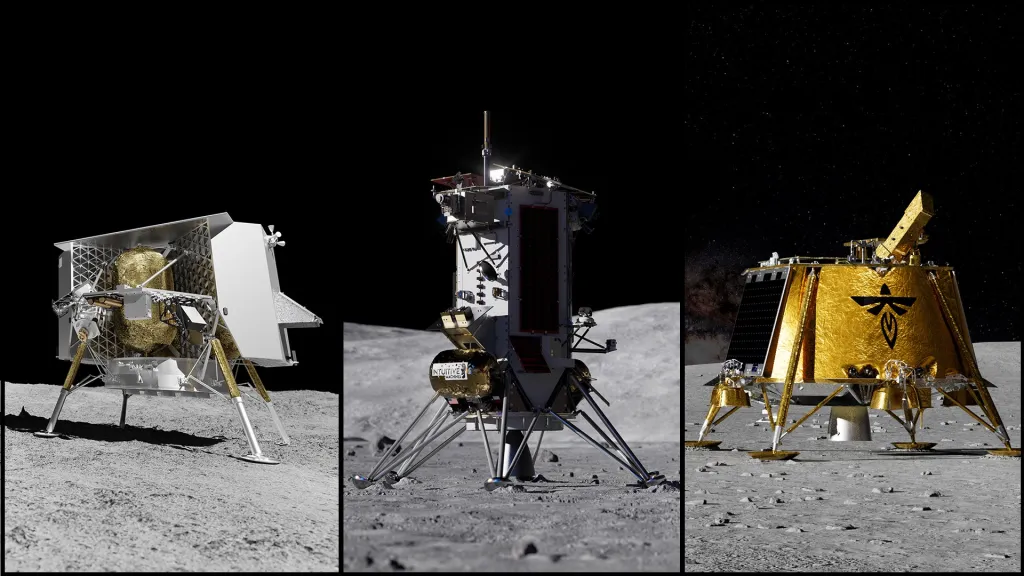
NASA has expanded its tactical footprint on the lunar surface, awarding four robotic lander missions to a trio of private contractors. According to SpaceNews, the contracts—valued at a combined $590.4 million—utilize the Astrobotic Peregrine, Firefly Blue Ghost, and Intuitive Machines Nova-C platforms for launches scheduled for late 2028.
Astrobotic secured the largest share at $297.9 million for two flights targeting the Gruithuisen Domes. Firefly Aerospace and Intuitive Machines received $144.2 million and $148.3 million respectively. Notably, the Intuitive Machines contract includes a $79.7 million performance incentive aimed at accelerating the transition from custom engineering to mass-produced lunar infrastructure.
Standardized Sensor Arrays
To ensure data continuity, all four landers will carry identical sensor suites:
SCALPSS: Regolith plume analysis during landing.
LETS: Radiation monitoring in transit and on-site.
* Laser Retroreflector Array: Passive rangefinding benchmarks.
NASA officials state this redundancy transforms individual landers into a global environmental sensor network, essential for permanent base operations.
Hardware Repurposing: The PROMISE Rover
In a strategic "pantry raid," NASA is evaluating the deployment of PROMISE—an engineering model of the Curiosity/Perseverance Mars rovers—to the lunar surface. Unlike the solar-dependent VIPER rover, PROMISE would utilize a Radioisotope Thermoelectric Generator (RTG). This nuclear power source enables survival in permanently shadowed craters, though it faces resource competition from future flagship missions requiring limited plutonium stocks.
Launch Manifest Stability
Despite a recent New Glenn pad explosion, NASA remains committed to Launch Plan A, maintaining Blue Origin’s New Glenn as the primary vector for forthcoming Moon Base hardware. Experience gained from current Griffin-1 and Blue Moon Mark 1 missions is being integrated into these 2028 operational cycles.