NASA Awards 2026 Innovative Technology Concepts
The NASA Innovative Advanced Concepts (NIAC) program has created 18 new awards to support visionary ideas to improve aerospace technologies in areas ranging from the exploration of the solar system to understanding the universe. The 18 NIAC Phase I awards total $3.2 million. Each
Search
Suggested Searches
- Climate Change
- Artemis
- Expedition 64
- Mars perseverance
- SpaceX Crew-2
- International Space Station
- View All Topics A-Z
- Home
- Missions
- Humans in Space
- Earth
- The Solar System
- The Universe
- Science
- Aeronautics
- Technology
- Learning Resources
- About NASA
- Español
Featured
  
Back
- Search All NASA Missions
- A to Z List of Missions
- Upcoming Launches and Landings
- Spaceships and Rockets
- Communicating with Missions
- Artemis
- James Webb Space Telescope
- Hubble Space Telescope
- International Space Station
- OSIRIS-Rex
- Explore Earth Science
- Climate Change
- Earth, Our Planet
- Earth Science in Action
- Earth Multimedia
- Earth Data
- Earth Science Researchers
- The Sun
- Mercury
- Venus
- Earth
- The Moon
- Mars
- Jupiter
- Saturn
- Uranus
- Neptune
- Pluto & Dwarf Planets
- Asteroids, Comets & Meteors
- The Kuiper Belt
- The Oort Cloud
- Skywatching
- Exoplanets
- The Search for Life in the Universe
- Stars
- Galaxies
- Black Holes
- The Big Bang
- Dark Energy
- Dark Matter
- Earth Science
- Planetary Science
- Astrophysics & Space Science
- The Sun & Heliophysics
- Biological & Physical Sciences
- Lunar Science
- Citizen Science
- Astromaterials
- Aeronautics Research
- Human Space Travel Research
- Science in the Air
- NASA Aircraft
- Flight Research Innovation
- Supersonic Flight
- Air Traffic Solutions
- Green Aviation Tech
- Drones & You
- Technology Transfer & Spinoffs
- Space Travel
- Living in Space
- Lunar Surface Technology
- Manufacturing and Materials
- Robotics
- Science Instruments
- Computing
- For Kids and Students
- For Educators
- For Colleges and Universities
- For Professionals
- Science for Everyone
- Requests for Exhibits, Artifacts, Speakers & Flyovers
- STEM Engagement at NASA
- NASA's Impacts
- Centers and Facilities
- Directorates
- Organizations
- People of NASA
- Careers
- Internships
- Our History
- Doing Business with NASA
- Get Involved
- Contact
- News Releases
- Recently Published
- Video Series on NASA+
- Podcasts & Audio
- Blogs
- Newsletters
- Social Media
- Media Resources
- Events
- Upcoming Launches & Landings
- Virtual Guest Program
- NASA+
- Images
- NASA Live
- NASA Apps
- Podcasts
- Image of the Day
- e-Books
- 3D Resources
- Interactives
- STEM Multimedia
- NASA Brand & Usage Guidelines
Featured
  
Highlights
  
Highlights
  
Highlights
  
Featured
  
Highlights
  
Highlights
  
Highlights
 [![Request for Information – Potential [Placeholder for Prize]](https://assets.science.nasa.gov/dynamicimage/assets/science/psd/solar/2023/09/s/solarsystem_0.jpg?w=1024)\\
\\
1 min read\\
\\
Request for Information – Potential \[Placeholder for Prize\]\\
\\
article5 days ago](https://science.nasa.gov/technology/workshops/request-for-information-response/) 
Featured

Featured
  
Highlights
  
5 min read
# NASA Awards 2026 Innovative Technology Concepts
!The headshot image of Jennifer M. Dooren
Jennifer M. Dooren
Jul 29, 2026
RELEASE26-057
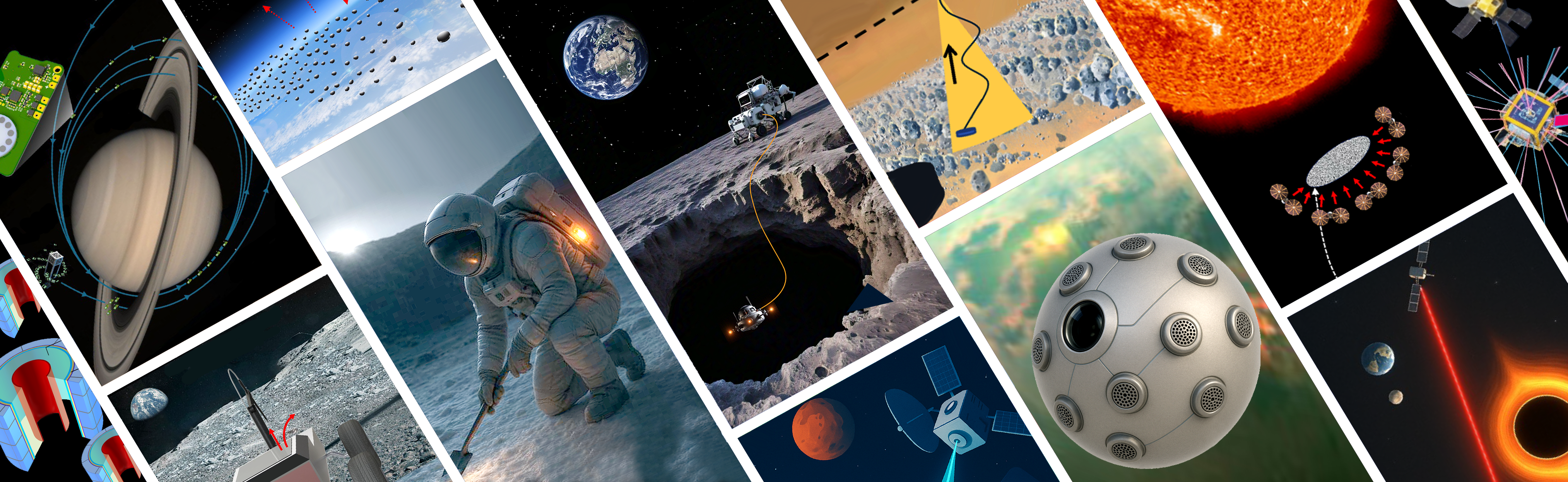
A collage of artist concepts highlighting the novel approaches proposed by the 2026 NIAC awardees.
Credit: NASA
The NASA Innovative Advanced Concepts (NIAC) program has created 18 new awards to support visionary ideas to improve aerospace technologies in areas ranging from the exploration of the solar system to understanding the universe.
The 18 NIAC Phase I awards total $3.2 million. Each award provides up to $175,000 for a nine-month initial investigation. The NIAC projects are about early-stage concept development and are not considered official NASA missions.
“NASA has outlined an ambitious vision for the future of space exploration, we’re returning the Moon to stay, advancing to Mars, and pushing to deepen our understanding of space,” said Greg Stover, director of the Advanced Research and Technology division within the Research and Technology Mission Directorate at NASA Headquarters in Washington. “Achieving that will require more than incremental technological advancement. It means we need great leaps. These awards are the kinds of innovation the world needs NASA to help foster.”
As an innovation incubator, NIAC funds early development of potential breakthrough technologies. Concepts for award consideration must have both transformative potential and possible feasibility for eventual implementation.
“Every innovation, every leap in technology, starts with a seed of an idea,” said Phillip Williams, NIAC’s acting program executive. “The NIAC program allows NASA to germinate those seeds and determine if there’s something that could be grown to benefit future space missions and our nation’s aerospace economy.”
As NASA and its partners push for sustained lunar presence, some of the 2026 awardees focused on ways to help explore the Moon and build infrastructure there. These include a system to support hovering robots to explore lava tubes under the Moon’s surface, a method to manage temperatures for small mobile exploration robots, and a way to incorporate radioisotopic heat sources into suits to help keep astronauts warm when operating in the Moon’s nearly two-week-long lunar nights.
Other concepts focus on exploring some of the solar system’s most remarkable features. Venus, with its hot atmosphere, presents an imposing challenge for research vehicles, so one NIAC awardee explores methods for hardening instruments for longer missions.
Two other concepts could help study planetary rings. One would use a swarm of 10,000 tiny satellites to map and analyze the rings of Saturn, while another would create a system for collecting samples from rings such as those circling Saturn, Uranus, and Neptune.
Some NIAC awardees will look far beyond the solar system, exploring ways to power interstellar spacecraft, map out continents on exoplanets, observe the photon rings around black holes, and detect subtle gravitational waves to explain how galaxies formed. Others will work to answer questions directly related to life on Earth, like the potential use of spaceborne dust to reduce solar radiation, and awareness about the debris orbiting Earth.
Researchers, known as NIAC Fellows, will investigate their concepts and identify potential challenges and opportunities for further development.
The 18 selections for 2026 NIAC Phase 1 grants are:
- Saptarshi Bandyopadhyay, NASA Jet Propulsion Laboratory, Pasadena, California: Dimming the Sun Using Controllable Dust Cloud to Reduce Solar Insolation (DimSun)
- David Bugby, NASA Jet Propulsion Laboratory: Combinatory Architecture offering Neomobility, on-Venus Adaptability, and Survivability (CANVAS)
- A.C. Charania, Zeno Power Systems, Inc., Washington:
Extended Astronaut Radioisotope-EVA in Nighttime and Deep-space Icy Landscapes (EARENDIL)
- Anish Damodaran, University of Central Florida, Orlando: PS21: Transforming Submillimeter Space Interferometry with Photonic Technologies
- Artur Davoyan, University of California, Los Angeles: Coilable Stacked Solar Sails for Very High delta-V Missions
- Daniel Drew, University of Hawaii, Honolulu: Solid-state Propulsion for Autonomous Reconnaissance of Karst (SPARK)
- Gilly Elor, Stone Aerospace, Inc., Del Valle, Texas: Power-over-Fiber to Enable a Lunar Underground eXplorer (LUX)
- Zhaoyan Liu, NASA Ames Research Center, California’s Silicon Valley: Quantum Wind Lidar Applications for Planetary and Earth Science Missions
- Jeff Nosanov, Orbital Velocity, LLC, Decatur, Georgia: OBLIVIAN: Observing Black hole LIght Via Intensity cOrrelatioN (OBLIVIAN)
- Keunhan Park, University of Utah, Salt Lake City: Plasmon-Enhanced Radioisotope Thermophotovoltaic (PRTPV) Power Generation for Interstellar Missions
- Austin Phoenix, Virginia Polytechnic Institute and State University, Blacksburg, Virginia: Efficient variable Conductivity Lunar Insulator for Passive Surveyor Environmental Control (ECLIPSE)
- Marco Quadrelli, NASA Jet Propulsion Laboratory: PRAXIS: Planetary Rings Autonomous EXploration with In-situ Sampling (PRAXIS)
- Michael Rubenstein, Northwestern University, Chicago: Actively Steerable Femtosat Constellations for In-situ Exploration of Saturn’s Rings, Atmosphere, and Magnetosphere
- Benjamin Schafer, Rarefied Technologies Inc., Albuquerque, New Mexico: : Photophoretic Tracers for Near-Space Remote Sensing at 30-100 km Altitudes
- David Smith, Duke University, Durham, North Carolina: Robotically Assembled Electromagnetic Metamaterials for Long-Range Space Situational Awareness
- Pablo Sobron, Search for Extraterrestrial Intelligence Institute, Mountain View, California: Interworld Slingshot Resource Surveys
- Paul Stankus, Brookhaven Science Associates, Upton, New York: Mapping Alien Continents: Achieving Optical VLBI for Exoplanet Imaging
- Paul Stankus, Brookhaven Science Associates, Upton, New York: Precision Astrometry Using Optically Independent Spacecraft for Gravitational Wave Detection
To learn more about NASA’s NIAC program, visit:
https://www.nasa.gov/about-niac
-end-
Rob Margetta
Headquarters, Washington
202-358-0918
Share
Details
Last Updated
Jul 29, 2026
Editor
Jennifer M. Dooren
Location
Related Terms
Was this page helpful?
Δ
Was this page helpful?
Yes
No
×
Notifications