MAVEN Decodes Martian Aurora Complexity
New data from NASA’s MAVEN orbiter reveals how the Martian magnetic environment creates three distinct types of auroras, providing critical insights into the Red Planet's atmospheric loss.
DATA LOG: MARS ATMOSPHERIC ANALYSIS
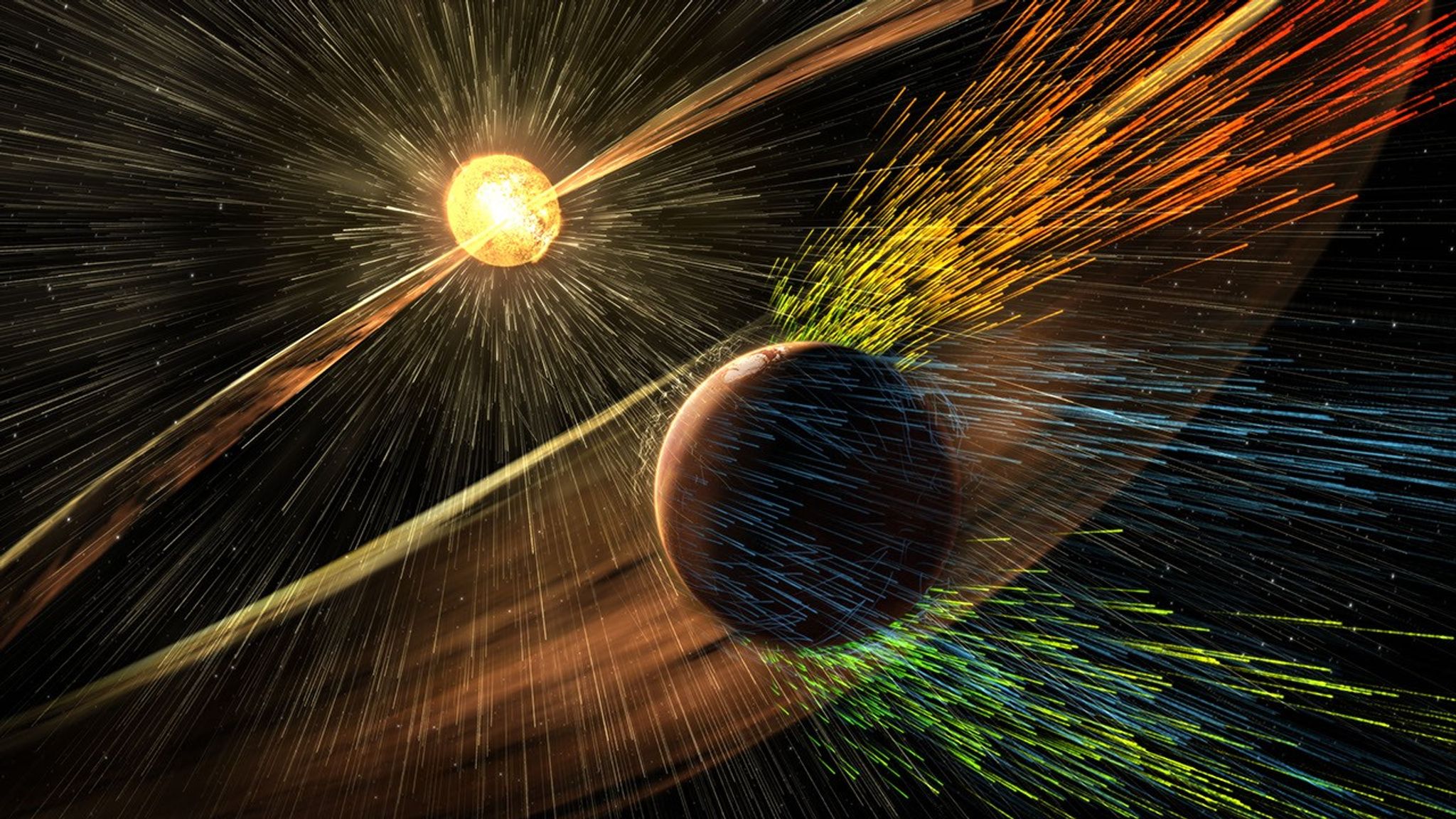
New telemetry from the Mars Atmosphere and Volatile EvolutioN (MAVEN) mission has provided a definitive map of the Red Planet’s auroral activity. Unlike Earth’s global magnetic shield, Mars is characterized by a fragmented magnetic environment, leading to the formation of three distinct localized light phenomena.
According to NASA Breaking News, researchers have categorized these events into proton auroras, diffuse auroras, and discrete auroras. Each is driven by specific interactions between the solar wind and the planet’s unique crustal magnetic fields.
//Phenomenon Classification
1. Proton Auroras: Occur when solar wind protons bypass the bow shock and enter the atmosphere directly. These are often widespread but invisible to the human eye, detectable only in ultraviolet.
2. Diffuse Auroras: Result from massive solar storms. High-energy particles flood the Martian atmosphere, triggering planet-wide glows regardless of local magnetic activity.
3. Discrete Auroras: The most complex variant. These occur over the planet's southern hemisphere, where localized magnetized crust creates magnetic loops. Electrons spiral down these loops, striking the atmosphere in concentrated pockets.
//Atmospheric Erosion
MAVEN’s primary objective remains the study of how Mars lost its atmosphere. These auroras serve as indicators of energy transfer. By measuring the frequency and intensity of these events, scientists can calculate how much gas is being stripped away into the vacuum of space. The data suggests that solar activity significantly accelerates this process, turning the Martian sky into a laboratory for atmospheric archaeology.
Ongoing monitoring is essential for future mission planning and understanding the long-term habitability profile of the Martian surface.