Mapping the Starburst: Deep Imaging of Messier 82
New visualizations from ESA reveal the chaotic internal structures of M82, a starburst galaxy located 12 million light-years away in the constellation Ursa Major.
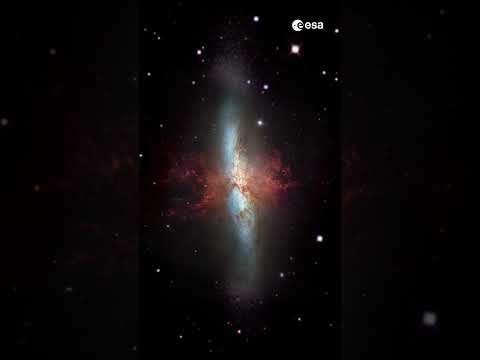
Terminal Feed: Observation Log M82
Messier 82 (M82), frequently designated as the Cigar Galaxy, is undergoing a phase of intense stellar production known as a starburst. According to ESA YouTube, recent high-resolution imaging and visualization efforts have provided a deep-zoom perspective into the chaotic heart of this edge-on spiral system. Located approximately 12 million light-years from Earth in the constellation Ursa Major, M82 remains a primary target for understanding the mechanics of galactic evolution and stellar birth.
Kinetic Activity and Outflows
The galaxy is characterized by its high-velocity galactic winds—massive plumes of hydrogen gas and dust being driven out of the galactic plane. This activity is triggered by a close encounter with its larger neighbor, Messier 81. The gravitational interaction between the two bodies has compressed gas clouds across M82, igniting a rate of star formation roughly ten times faster than that observed in our own Milky Way.
Multi-Spectral Analysis
Visualizations provided by the European Space Agency show the intricate distribution of hot, ionized gas and the dark, obscuring dust lanes that define the galaxy’s silhouette. These observations are critical for mapping the feedback loops where newborn stars influence their surrounding medium. The zoom-in sequence highlights the sheer density of star clusters at the core, where the energy output is sufficient to carve out vast cavities in the interstellar medium. By isolating these features, researchers can better quantify the mass loss M82 experiences as it literally blows itself apart through radiative pressure.