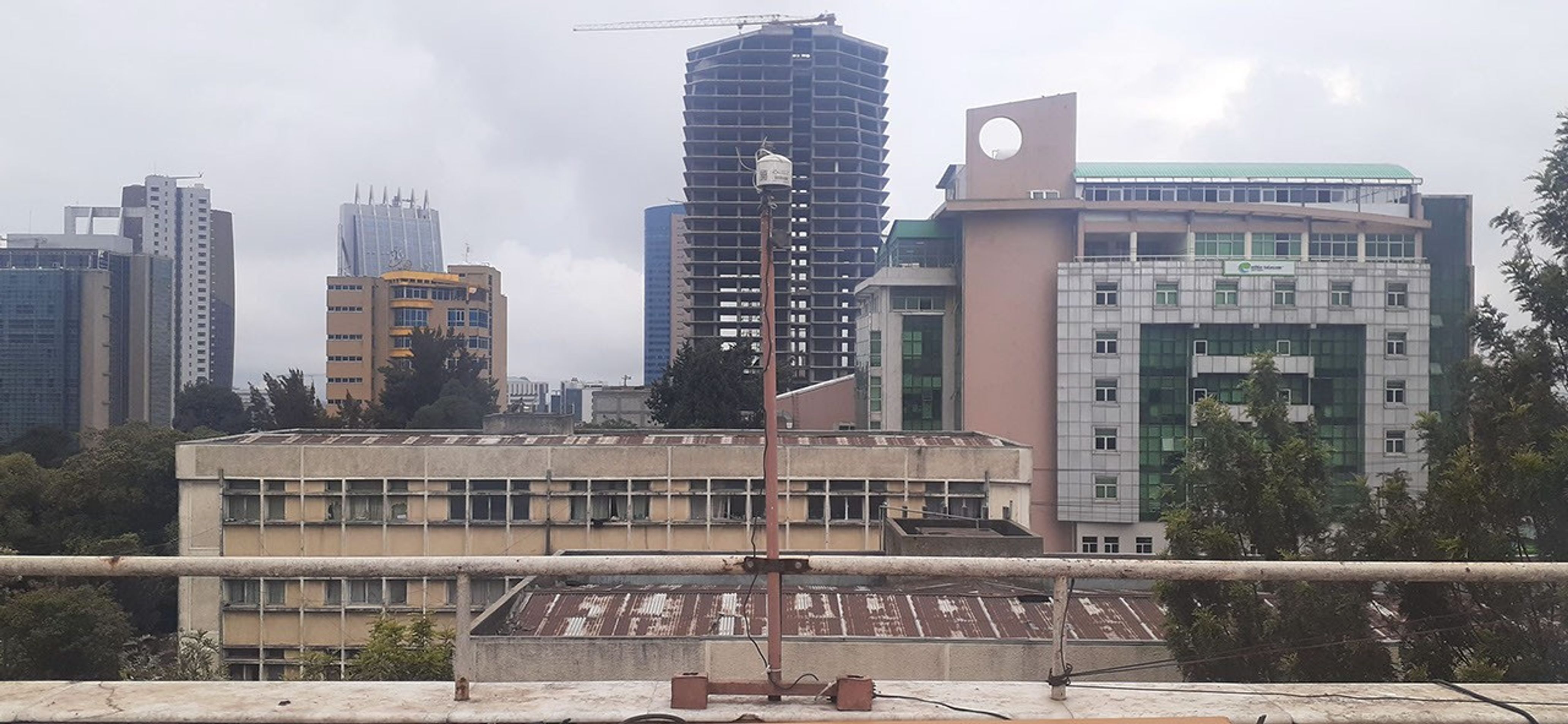
MAIA Air Sensor at Work in Addis Ababa
Description This roof-mounted air sensor in Addis Ababa, the capital of Ethiopia, is one of 10 used by NASA’s Multi-Angle Imager for Aerosols (MAIA) to study the city’s air quality. MAIA’s air sensors provide a detailed look at particulate matter that is 2.5 micrometers or less i
Search
Suggested Searches
- Climate Change
- Artemis
- Expedition 64
- Mars perseverance
- SpaceX Crew-2
- International Space Station
- View All Topics A-Z
- Home
- Missions
- Humans in Space
- Earth
- The Solar System
- The Universe
- Science
- Aeronautics
- Technology
- Learning Resources
- About NASA
- Español
Highlights
  
Back
- Search All NASA Missions
- A to Z List of Missions
- Upcoming Launches and Landings
- Spaceships and Rockets
- Communicating with Missions
- Artemis
- James Webb Space Telescope
- Hubble Space Telescope
- International Space Station
- OSIRIS-REx
- Explore Earth Science
- Climate Change
- Earth, Our Planet
- Earth Science in Action
- Earth Multimedia
- Earth Data
- Earth Science Researchers
- The Sun
- Mercury
- Venus
- Earth
- The Moon
- Mars
- Jupiter
- Saturn
- Uranus
- Neptune
- Pluto & Dwarf Planets
- Asteroids, Comets & Meteors
- The Kuiper Belt
- The Oort Cloud
- Skywatching
- Exoplanets
- The Search for Life in the Universe
- Stars
- Galaxies
- Black Holes
- The Big Bang
- Dark Matter
- Dark Energy
- Earth Science
- Planetary Science
- Astrophysics & Space Science
- The Sun & Heliophysics
- Biological & Physical Sciences
- Lunar Science
- Citizen Science
- Astromaterials
- Aeronautics Research
- Human Space Travel Research
- Science in the Air
- NASA Aircraft
- Flight Innovation
- Supersonic Flight
- Air Traffic Solutions
- Green Aviation Tech
- Drones & You
- Technology Transfer & Spinoffs
- Space Travel Technology
- Technology Living in Space
- Manufacturing and Materials
- Robotics
- Science Instruments
- Computing
- For Kids and Students
- For Educators
- For Colleges and Universities
- For Professionals
- Science for Everyone
- Requests for Exhibits, Artifacts, or Speakers
- STEM Engagement at NASA
- NASA's Impacts
- Centers and Facilities
- Directorates
- Organizations
- People of NASA
- Careers
- Internships
- Our History
- Doing Business with NASA
- Get Involved
- Contact
- NASA+
- Images
- NASA Live
- NASA Apps
- Podcasts
- Image of the Day
- e-Books
- 3D Resources
- Interactives
- STEM Multimedia
- NASA Brand & Usage Guidelines
Highlights
  
Highlights
  
Highlights
  
Highlights
  
Highlights
  
Highlights
  
Highlights
  
Highlights
  
Highlights

Highlights
  
Highlights
  
Photojournal Navigation
1 Min Read
# MAIA Air Sensor at Work in Addis Ababa
PIA26698
Credits: NASA/JPL-Caltech
Image Addition Date:08/24/2026
Downloads

MAIA Air Sensor at Work in Addis Ababa
JPEG (1,018.53 KB)
Download MAIA Air Sensor at Work in Addis Ababa
Description
This roof-mounted air sensor in Addis Ababa, the capital of Ethiopia, is one of 10 used by NASA’s Multi-Angle Imager for Aerosols ( MAIA) to study the city’s air quality. MAIA’s air sensors provide a detailed look at particulate matter that is 2.5 micrometers or less in diameter, also known as PM2.5, one of the world’s deadliest forms of air pollution.
Black carbon, or soot, is an important component of particulate pollution in Addis Ababa and is produced by diesel vehicles, fires, and other combustion sources. Detailed measurements from the MAIA air sensors reveal how pollution changes by time of day and season, including spikes produced by rush-hour traffic and holiday celebrations. The findings are relevant to cities around the world, including in the United States.
The 2025 State of Global Air Report, cited in the paper, estimates that these particles, some of which are tiny enough to enter the human bloodstream, are linked to around 4.9 million excess deaths per year globally. Of the many kinds of PM2.5, black carbon in particular has been linked to impacts on low birth weight, brain development, respiratory conditions, and premature mortality.
Keep Exploring
Discover More Topics From Photojournal
Photojournal\\
\\
 Search Photojournal\\
\\
 Photojournal’s Latest Content\\
\\
 Feedback\\
\\

Δ
Did you find what you were looking for?(Required)
Yes
No
Partly
What were you looking for?(Required)
0 of 1000 max characters
What were you hoping to accomplish by visiting our website?(Required)
0 of 3000 max characters
×
Notifications