JWST Reveals High-Velocity Stellar Jets in NGC 7129
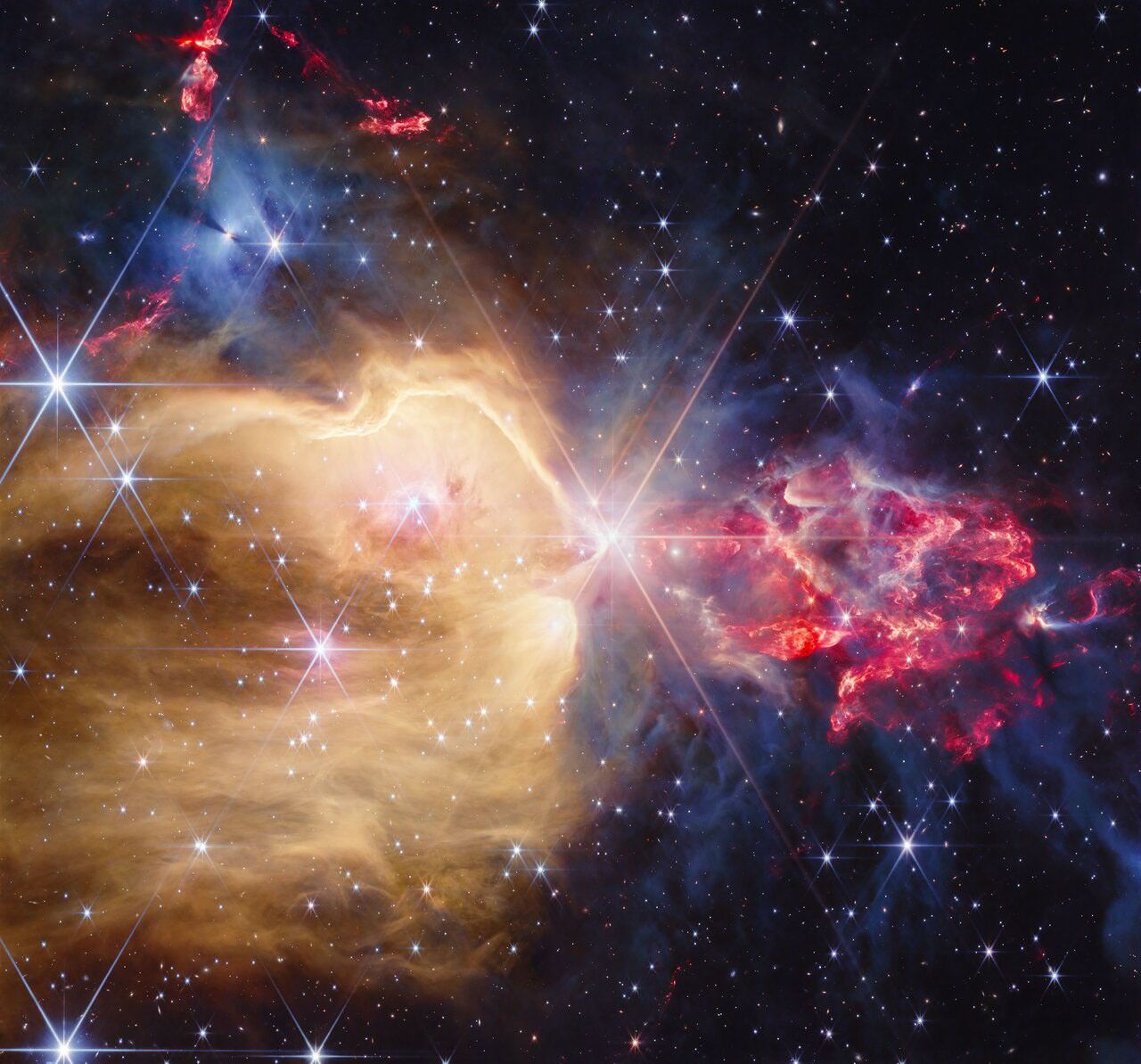
The James Webb Space Telescope has captured a high-resolution view of NGC 7129, a reflection nebula where nascent stars are emitting powerful supersonic jets into the surrounding gas.
DATA FEED: STAR FORMATION INFRARED ANALYSIS
According to NASA Breaking News, the James Webb Space Telescope (JWST) has delivered a detailed infrared look at the star-forming region NGC 7129. Located approximately 3,300 light-years away in the constellation Cepheus, this reflection nebula serves as a chaotic nursery for protostars that are currently reshaping their local environment.
//Kinetic Forcing and Jets
The primary feature of the new imagery is the visualization of high-velocity jets. As gravity collapses dense pockets of gas to form new stars, the conservation of angular momentum often results in the expulsion of material along the polar axes. These supersonic outflows collide with the ambient interstellar medium, creating shock fronts that glow in the infrared spectrum. These structures, known as Herbig-Haro objects, provide a diagnostic map of the protostellar activity hidden behind the nebula’s thick dust veils.
//Reflective Dynamics
NGC 7129 is dominated by a young open cluster. The intense radiation from these massive stars illuminates the surrounding dust, creating the characteristic blue glow typical of reflection nebulae in visible light. However, Webb’s instruments penetrate these layers to reveal the thermal signatures of the molecular gas being carved out by stellar winds. The resulting cavities demonstrate the feedback loop between star birth and galactic chemistry.
//Mission Context
This observation is part of ongoing efforts to categorize the earliest phases of stellar evolution. By mapping the kinematics of these jets, researchers can better calculate the mass-loss rates of young stars and the mechanical energy they contribute to the galaxy's evolution. The high-resolution data from Webb confirms that NGC 7129 remains one of the most active laboratories for studying the birth of solar systems similar to our own.