JWST PROBES EVENT HORIZON REGION: WATER AND DUST DETECTED
Analysis of data from the James Webb Space Telescope has confirmed the presence of dust and water molecules in close proximity to a supermassive black hole, challenging previous assumptions about molecular survival in high-radiation environments.
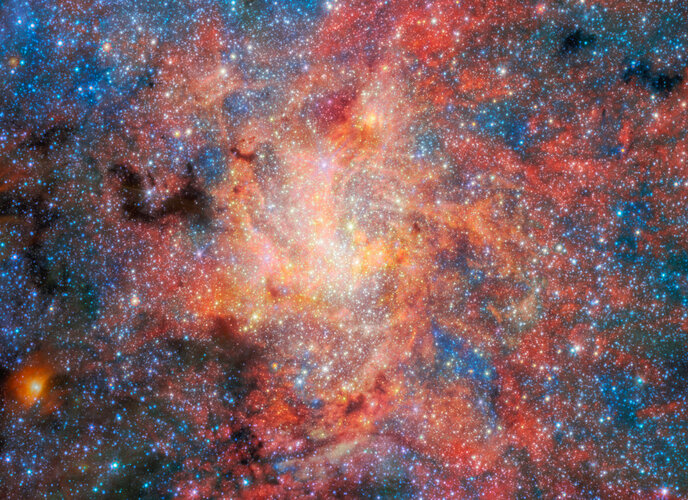
DATA FEED: NIRCam/MIRI SENSOR LOG
Deep-field observations conducted via the James Webb Space Telescope (JWST) have revealed unexpected chemical signatures in the immediate vicinity of a supermassive black hole. According to ESA, researchers utilizing the telescope’s Mid-Infrared Instrument (MIRI) and Near-Infrared Camera (NIRCam) have successfully mapped the distribution of gas and dust orbiting a central galactic engine.
//ANALYTICAL FINDINGS
The mission data indicates the presence of both dust grains and water molecules within the accretion region. Historically, astrophysicists theorized that the intense ultraviolet and X-ray radiation emitted by a black hole's active nucleus would disintegrate complex molecules. However, the JWST data suggests that dense pockets of gas may provide sufficient shielding to allow these elements to persist in extreme environments.
//INSTRUMENTATION IMPACT
The detection was made possible by Webb’s high-resolution spectroscopy, which isolated the specific infrared signatures of water vapor and silicate dust from the blinding glare of the galactic center. By analyzing these light patterns, the international team was able to determine the physical state and temperature of the material as it spirals toward the gravitational well.
This discovery provides a new baseline for understanding how black holes interact with their host galaxies. The presence of water and dust suggests that the chemical complexity of a galaxy is maintained even under the most violent conditions imaginable, offering fresh insights into the lifecycle of matter in the deep cosmos.